
Charleston Property Tax Records Search
Charleston property tax records are maintained by Charleston County and cover all parcels within city limits. The Charleston County Assessor determines property values, the County Auditor calculates the tax bill, and the County Treasurer handles collection. City of Charleston millage is added on top of county millage for properties inside city limits. This guide explains how to find property tax records, what assessment ratios apply, when taxes are due, and what to do if you need to appeal a value.
Charleston Property Tax Quick Facts
How Charleston Property Taxes Work
Three county offices share responsibility for property taxes in Charleston. The Charleston County Assessor determines the fair market value of each parcel. The County Auditor uses that value along with the applicable assessment ratio to calculate the taxable amount and generate the tax bill. The County Treasurer then collects what is owed.
Properties inside Charleston city limits carry both county millage and city millage. The city millage funds municipal services like roads, parks, and city infrastructure. Properties outside city limits but still in Charleston County pay only county and school district millage. This layered system means two homes with identical values can owe different amounts depending on where the city boundary falls.
South Carolina does not impose a state-level property tax. All property tax in Charleston flows to county, municipal, and school district coffers. The South Carolina Department of Revenue (SCDOR) oversees property tax policy statewide but does not collect local taxes directly.
Charleston County Assessment Ratios Explained
Assessment ratios in South Carolina determine what portion of a property's fair market value is subject to tax. Under S.C. Code Ann. Title 12, Chapter 43, owner-occupied primary residences are assessed at 4% of fair market value. Rental properties, commercial buildings, and investment properties are assessed at 6%. Manufacturing facilities carry the highest ratio at 10.5%.
The difference between a 4% and 6% assessment can mean hundreds of dollars per year on the same property. A home worth $400,000 assessed at 4% carries a taxable value of $16,000. The same home assessed at 6% carries $24,000. Multiplying those amounts by the combined millage rate shows how much the owner-occupied exemption is worth.
To qualify for the 4% owner-occupied rate, a Charleston homeowner must file a Legal Residence Application with the Charleston County Assessor. The property must be the owner's primary domicile. Chapter 43 also requires the county to conduct a countywide reassessment every five years to keep values current with the market.
Note: Filing the Legal Residence Application is not automatic. New homeowners in Charleston must submit the form to the Assessor's office after closing to receive the 4% rate on their primary home.
Search Charleston Property Tax Records Online
The Charleston County public access portal lets you look up property tax records by address, Property ID, PIN, or TMS number. The portal shows assessed values, tax bill amounts, payment status, and parcel details for properties throughout the county including all Charleston city addresses.
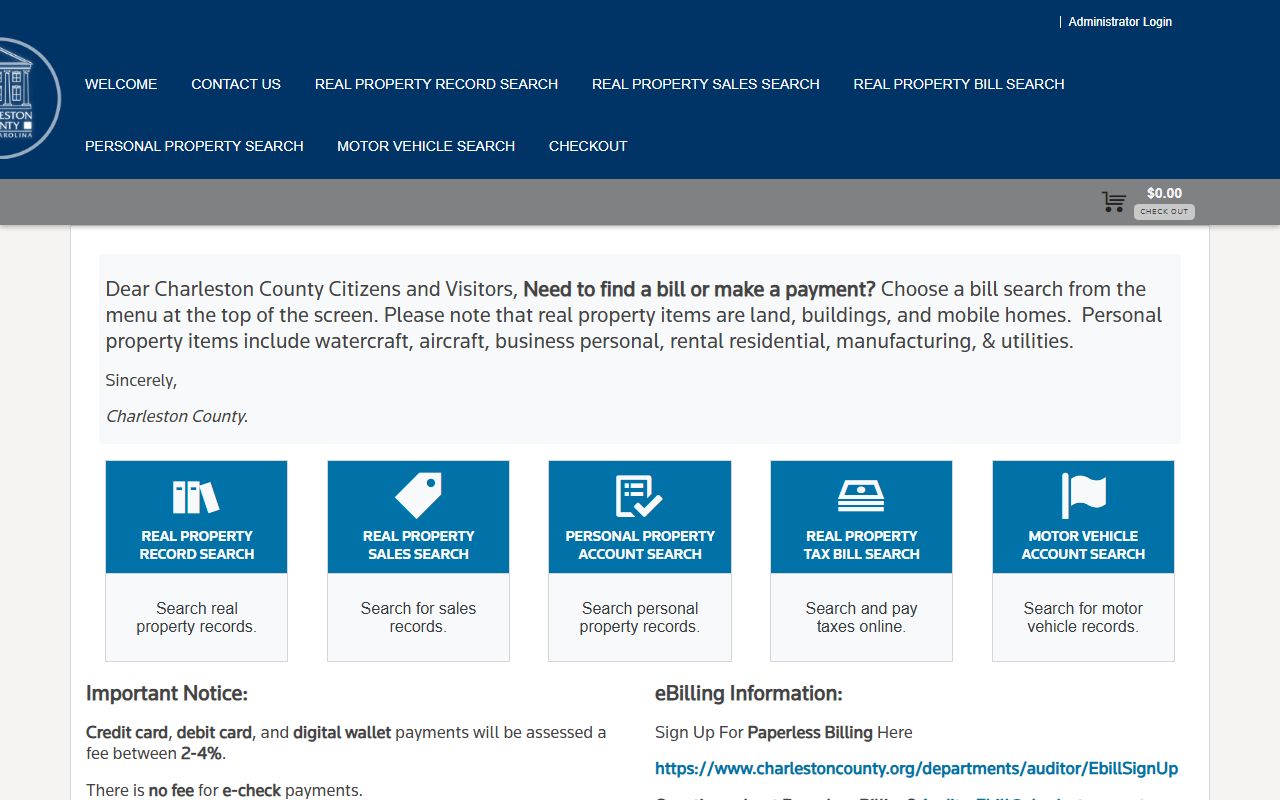
The portal at sc-charleston.publicaccessnow.com is the primary tool for searching Charleston property tax records. You can search by street address or by the TMS (Tax Map Sheet) number assigned to each parcel. Results display the property owner of record, assessed value, exemptions applied, and current tax status. The city resource directory at charleston-sc.gov also links to tax-related offices and tools.
For questions about a specific bill or payment, contact the Charleston County Treasurer at (843) 958-4360 or write to P.O. Box 878, Charleston, SC 29402. For value disputes, the Charleston County Assessor's main office is at 101 Meeting Street, Suite 135, Charleston, SC 29401, phone (843) 958-4100. A second Assessor office serves the northern part of the county at 3875 Faber Place Dr, Ste 100, North Charleston, SC 29405, phone (843) 958-4120.
Charleston Tax Due Dates and Penalties
Charleston property taxes are due on January 15 each year. S.C. Code Ann. Title 12, Chapter 45 sets both the due date and the penalty schedule for late payments. Missing the January 15 deadline triggers a 3% penalty on the unpaid balance.
Penalties increase sharply over time. After the initial 3% penalty, an additional 7% is added if the balance remains unpaid past a second deadline. A further 5% penalty follows after that. These compounding penalties make early payment important for Charleston property owners who want to avoid significant extra costs.
Delinquent accounts in Charleston follow the process outlined in S.C. Code Ann. Title 12, Chapter 51. A delinquency notice goes out on April 1 for accounts that missed the January 15 due date. Property owners then have a 12-month redemption period to pay the full amount owed and redeem the property before the county can proceed further.
For delinquent tax matters in Charleston, the Delinquent Tax Collector is Edrian Trakas, reachable at (843) 202-6579. Resolving a delinquent account early avoids additional fees and legal costs that accumulate over the redemption period.
Note: The 12-month redemption period under Chapter 51 gives Charleston property owners time to resolve delinquency before the situation escalates, but interest and fees continue to accrue during that window.
Charleston Homestead and Other Exemptions
South Carolina offers a Homestead Exemption that benefits many Charleston residents. Under S.C. Code Ann. Title 12, Chapter 37, the Homestead Exemption exempts the first $50,000 of fair market value from property tax for qualifying owners. To qualify, you must be 65 years of age or older, legally blind, or totally and permanently disabled. You must also have lived in South Carolina for at least one calendar year before applying.
Applications for the Homestead Exemption in Charleston go through the Charleston County Auditor's office, not the Assessor. The exemption is designed for primary residences and cannot be claimed on investment or rental properties. Once approved, the benefit renews automatically as long as the owner continues to meet the eligibility criteria.
Chapter 37 also covers other exemptions that may apply to Charleston properties. These include exemptions for certain agricultural properties, religious and charitable organizations, and government-owned parcels. Each exemption has its own eligibility rules and application process through the county.
Appealing a Charleston Property Tax Value
If you believe the Charleston County Assessor has assigned an incorrect value to your property, you have the right to appeal. The first step is to file a written objection with the Assessor's office within 90 days of receiving the assessment notice. The Assessor will review the objection and may adjust the value based on evidence you provide, such as a recent appraisal or comparable sales data.
If the Assessor's review does not resolve the dispute, the matter can proceed to the county Board of Assessment Appeals. Property owners who remain unsatisfied after that level can escalate to the South Carolina Administrative Law Court. S.C. Code Ann. Title 12, Chapter 60 governs the formal appeal process to the Administrative Law Court for property tax disputes throughout the state, including Charleston.
Gathering strong comparable sales data before filing an appeal improves your chances of a successful outcome. The TMS portal can help you identify nearby parcels with similar characteristics and recent sale prices. Presenting organized documentation to the Assessor at the first step often resolves disagreements without requiring a formal hearing.
City of Charleston Special Taxes and Millage
Beyond standard property taxes, the City of Charleston imposes several additional levies. A 2% Hospitality Tax applies to prepared food and beverage sales within city limits. A 2% Local Accommodations Tax applies to lodging rentals. These are not property taxes but are worth knowing for property owners who operate short-term rentals or food service businesses in Charleston.
Sales tax in Charleston totals 9%. That breaks down as 6% state, 1% Charleston County, 1% infrastructure and greenbelt, and 1% school improvement. These sales taxes do not appear on property tax bills but reflect the full tax environment for Charleston property owners and businesses.
The combined millage rate for properties inside Charleston city limits is higher than for those just outside city boundaries. City millage funds services that county millage does not cover. When evaluating a property purchase in the Charleston area, confirming whether the address falls inside or outside city limits helps project the actual annual tax cost.
Charleston County Property Tax Records
Charleston County is the source for all property tax records covering parcels within the city of Charleston. The Assessor, Auditor, and Treasurer offices all operate at the county level and maintain the official records for every property in the city.