
Beaufort County Property Tax Records
Beaufort County property tax records are maintained by the county Assessor and made available to the public through online portals, GIS mapping tools, and in-person requests. These records cover parcel identification, ownership history, assessed values, and tax status for properties across Beaufort County, including Bluffton, Hilton Head Island, and surrounding communities. The county ranks among the highest in South Carolina for average annual property taxes, making access to accurate records especially important for owners and buyers alike. You can reach the Assessor's office at 843-470-2522 or visit the official site at beaufortcountysc.gov.
Beaufort County Property Tax Quick Facts
Beaufort County Assessor Office
The Beaufort County Assessor's office is located at P.O. Box 1083, Beaufort, SC 29901. The main phone number is 843-470-2522. Other department contacts include the Mapping and GIS division at 843-470-2660, the Recorder at 843-470-2700, the Treasurer at 843-470-2765, and the Register of Deeds at 843-525-7440. Each office handles a specific part of the overall property tax system, and knowing which office to contact can save time.
Under SC Code Title 12, Chapter 37, every county must maintain a full-time assessor. The Beaufort County Assessor carries out all duties required by that statute, including tracking deed transfers, processing building permits, maintaining tax maps, and discovering unlisted property. The office also handles exemption applications for churches, schools, agricultural land, and household goods. Homestead exemption applications are processed through the Auditor's office.
Beaufort County's size and coastal location mean the Assessor's office handles a wide variety of property types. Single-family homes in Bluffton, resort properties on Hilton Head Island, commercial buildings, and rural agricultural tracts are all assessed under the same state framework but may carry different assessment ratios depending on use.
The screenshot below shows the official Beaufort County Assessor website, where you can find office information, forms, and links to the online property search and mapping portal.
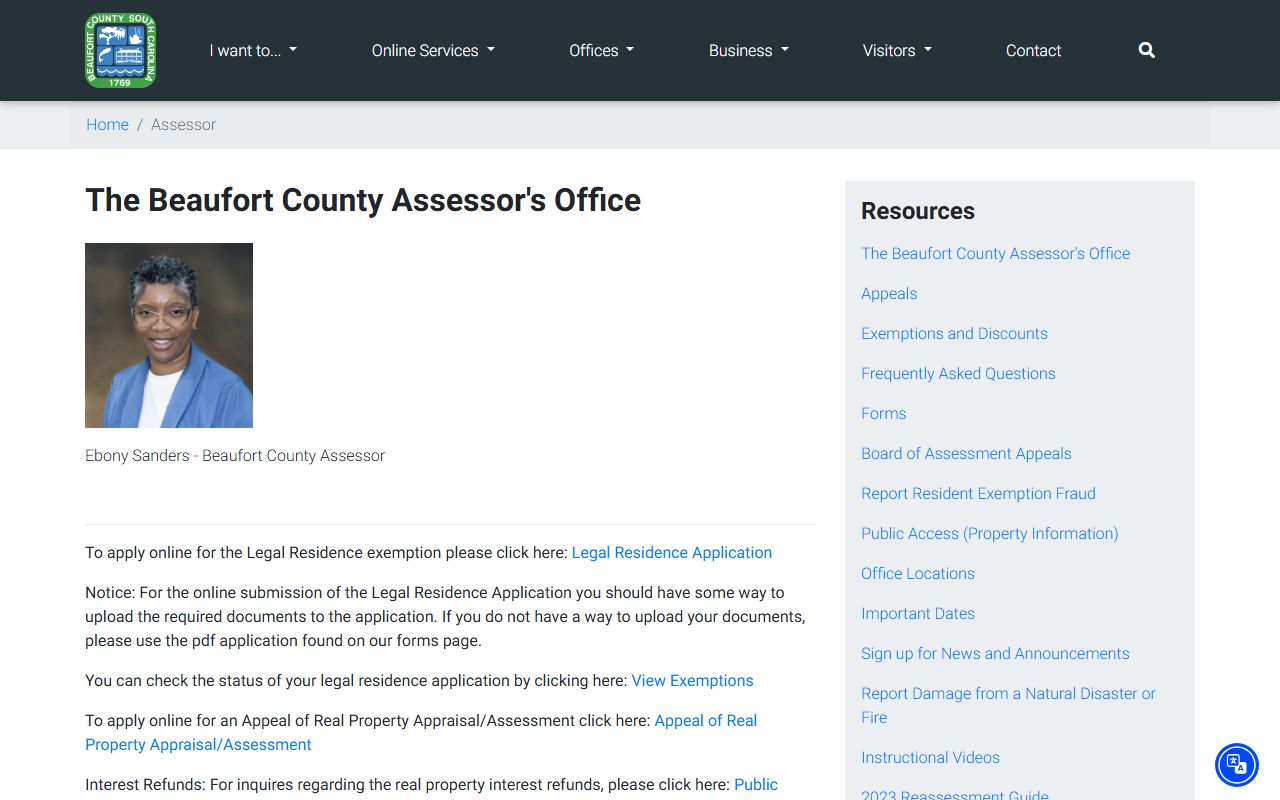
The Assessor's website provides direct access to parcel search tools, downloadable forms, and contact details for each division. It is the best starting point for any property tax research in Beaufort County.
Beaufort County Property Records Online Search
Beaufort County's public GIS mapping portal is available at gis.beaufortcountysc.gov/publicmapping. Users can search by parcel number, owner name, or street address. Satellite imagery, county maps, and parcel boundary overlays are all available within the mapping system.
The GIS system is one of the more advanced public mapping tools in South Carolina. You can view property boundaries against aerial photography, identify neighboring parcels, and pull up ownership and assessment data with a single click on the map. This level of detail is useful whether you are researching a single lot or comparing multiple parcels in a neighborhood.
For questions about the mapping system, contact the GIS division at 843-470-2660 or reach out through the county's main Assessor line. Staff can walk you through the portal if you encounter issues accessing a specific parcel or data layer.
Note: Parcel boundaries shown in the GIS viewer are based on recorded plats and tax maps. They are for reference purposes and do not replace a certified land survey.
Beaufort County Property Tax Assessment Ratios
South Carolina sets assessment ratios by statute, and they apply in every county. SC Code Chapter 43 establishes these ratios and governs the equalization process. In Beaufort County, the ratio for owner-occupied residential property is 4%. This applies to a primary residence on five acres or less. Rental properties, investment parcels, and second homes are assessed at 6%. Commercial property also carries a 6% ratio, while manufacturing property is taxed at 10.5%.
The distinction between a 4% and 6% ratio matters a great deal in a county like Beaufort, where many properties are vacation or investment properties. A homeowner who qualifies for the 4% legal residence rate pays significantly less than an investor holding the same property at 6%. If you own property in Beaufort County and use it as your primary residence, filing for the legal residence classification is one of the most important steps you can take.
Agricultural land has its own classification. Private agricultural tracts qualify for the 4% ratio. Corporately owned agricultural land is assessed at 6%. These distinctions are spelled out in Chapter 43 and apply uniformly under state law.
Reassessment in Beaufort County
State law under SC Code 12-43-217 requires each county to conduct a general reassessment every five years. Beaufort County follows this cycle. During a reassessment, all real property in the county is reviewed and values are updated to reflect current market conditions. Owners receive notice when new values are assigned.
Reassessment years often bring significant changes in assessed value, especially in coastal counties where real estate markets can shift quickly. If you believe your new assessment does not reflect the actual market value of your property, you have the right to appeal. Appeals must be filed within the time period stated on your assessment notice. The Assessor's office in Beaufort County can explain the appeals process and what documentation is needed.
Between reassessment cycles, property values generally remain capped unless ownership changes or significant improvements are made. This cap protects long-term owners from dramatic tax increases between general reassessments.
Note: Filing an appeal does not delay your obligation to pay taxes. Under South Carolina law, you must pay your tax bill by the due date even if an appeal is pending.
Beaufort County Tax Payment Due Dates and Penalties
Property taxes in Beaufort County are due by January 15 each year. SC Code Chapter 45 governs the Treasurer's duties and establishes the penalty schedule. If taxes are not paid by January 15, a 3% penalty applies starting January 16. An additional 7% penalty is added after February 2. A further 5% penalty is assessed after March 16. These penalties are set by state law and cannot be waived by the Treasurer's office.
Beaufort County offers online payment through the myBeaufortCounty portal at mybeaufortcounty.com. The platform accepts credit and debit cards, ACH bank transfers, Apple Pay, and offers eBilling enrollment. Installment payment plans are also available for taxpayers who qualify. The system is accessible as a mobile app, making it easy to manage tax payments from a phone or tablet.
The image below shows the myBeaufortCounty online payment portal, which allows residents to pay property taxes, enroll in installment plans, and manage billing preferences.
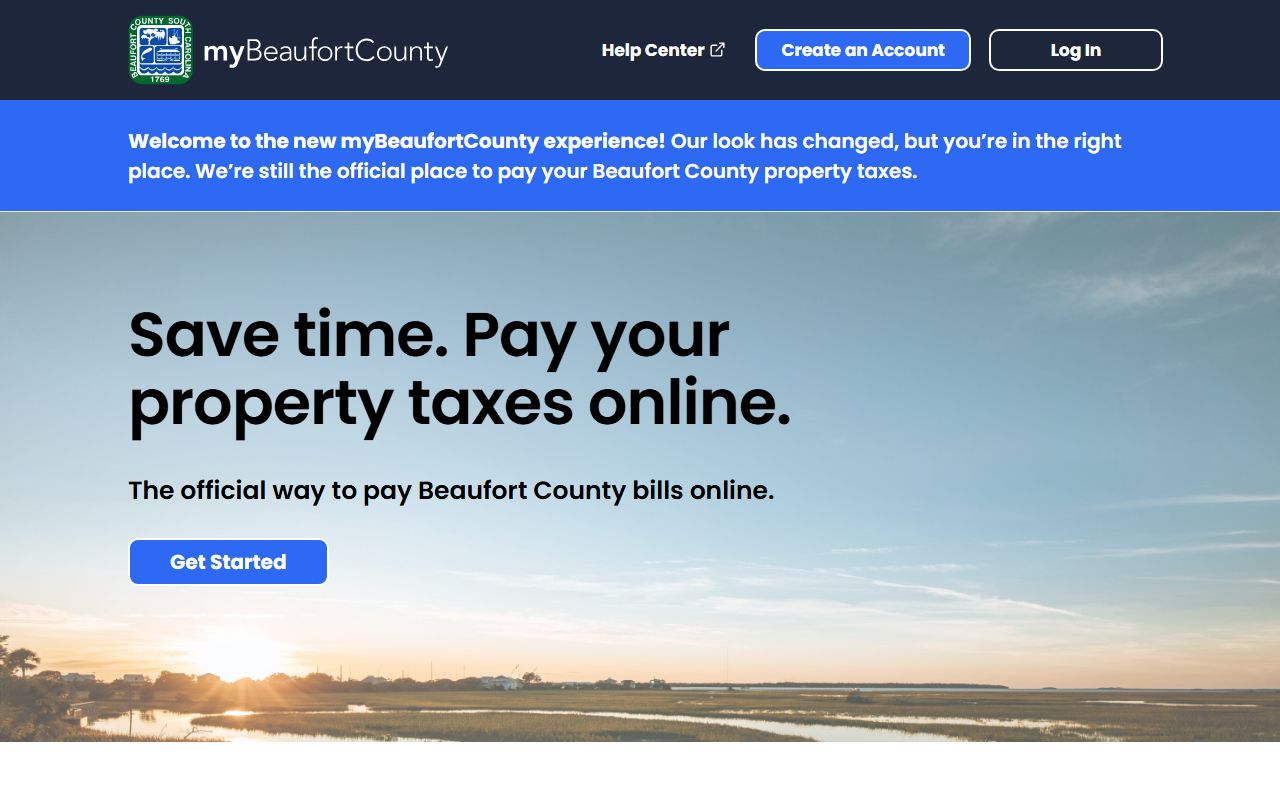
Online payments through the portal are processed securely and generate an immediate receipt. This is especially convenient for property owners who do not live near Beaufort County or prefer to avoid office visits.
If taxes remain unpaid after March 16, the account moves toward delinquency. Under SC Code Chapter 51, the county issues a delinquency notice around April 1. The property may eventually be advertised for a tax sale, which requires three weeks of public notice before the sale date. Owners retain a 12-month redemption period after the sale, during which they can reclaim their property by paying the outstanding taxes plus interest. Interest accrues at a rate of 3% per quarter for the first two quarters, then 6% and 9% in subsequent quarters.
Homestead Exemption for Beaufort County Property Owners
South Carolina's Homestead Exemption reduces the taxable value of a primary residence by the first $50,000 of fair market value. To qualify, the property owner must be 65 years of age or older, legally blind, or permanently disabled. The owner must also have held title to the property for at least one year. Applications are submitted through the county Auditor's office, not the Assessor.
In Beaufort County, where property values are among the highest in the state, the Homestead Exemption provides meaningful tax relief to eligible seniors and disabled residents. A $50,000 reduction in taxable value translates directly into a lower tax bill. Owners who become eligible due to age should apply as soon as they qualify, since the exemption does not apply retroactively to prior tax years.
Additional exemptions exist for certain institutional and religious properties. SC Code Chapter 37 lists exemptions that apply to schools, churches, and property used for charitable purposes. These are administered through the Assessor's office and require documentation at the time of application.
Beaufort County Tax Liens and Delinquent Property Records
Property taxes in South Carolina constitute a first lien on real property. Under SC Code 12-49, this lien attaches on December 31 of each tax year, giving it priority over most other claims against the property. In Beaufort County, this means that buyers of property with unpaid taxes take on responsibility for those outstanding amounts.
Researching delinquent tax status before purchasing property is an important step. The Beaufort County Treasurer's office can provide information on any outstanding taxes, penalties, or tax sale history associated with a parcel. This information is also often reflected in the GIS parcel viewer, though direct confirmation from the Treasurer is always the best approach.
The South Carolina Association of Counties provides general guidance on county government functions statewide, including how tax collection works across all 46 counties. The SC Department of Revenue also plays a role in certain property tax matters, particularly for commercial and manufacturing properties.
Appealing a Beaufort County Property Assessment
Property owners who disagree with an assessment have the right to appeal. The appeal must be filed within the deadline stated on the assessment notice. The Beaufort County Assessor's office handles informal reviews at the first level. If the dispute is not resolved, it can be escalated. Under SC Code Chapter 60, unresolved appeals may ultimately be heard by the Administrative Law Court.
Common grounds for appeal include evidence that the assessed value is higher than what similar properties recently sold for, errors in property data such as square footage or lot size, and incorrect property classification. Gathering comparable sales data and documentation of any property condition issues strengthens an appeal.
During the appeal process, the current tax bill remains due. Paying under protest does not waive your right to appeal. If your appeal results in a lower assessed value, you may receive a refund or credit on a future bill.
Nearby Counties
Beaufort County borders several other South Carolina counties. Use the links below to access property tax records in neighboring areas.