
Dorchester County Property Tax Records Online
Dorchester County property tax records cover all real property in the county, including parcels in Summerville, St. George, and the surrounding communities. Three county offices work together to administer the property tax system: the Assessor determines appraisal values, the Auditor calculates the tax, and the Treasurer collects payment. Residents and property researchers can access Dorchester County property tax records through online portals and county offices located at 201 Johnston Street in St. George and a satellite office at 500 North Main Street in Summerville.
Dorchester County Property Tax Quick Facts
How Dorchester County Property Taxes Are Administered
Dorchester County uses a three-office model for property tax administration. The Assessor's Office appraises real property and assigns values. The Auditor's Office uses those values along with applicable millage rates to calculate the actual tax. The Treasurer's Office then handles collection of current property taxes, vehicle and watercraft taxes, and registration fees.
Treasurer Cindy L. Chitty oversees the collection function and can be contacted at Treasurer@DorchesterCountySC.gov. The Treasurer does not set property values or determine the tax amount. If you have a question about why your value changed, that goes to the Assessor. If you have a question about a calculation error on your bill, that goes to the Auditor. For payment, contact the Treasurer's office.
This separation of duties is common across South Carolina counties. Understanding which office handles which function saves time and ensures your question reaches the right person. All three offices have a presence at both the St. George and Summerville locations, making it more convenient for the large number of residents who live in the Summerville area.

The South Carolina Department of Revenue, shown above, provides the statewide framework that Dorchester County follows for property tax administration. The SCDOR oversees assessment standards, manufacturing property valuations, and the ratio system that determines how much of a property's value is taxable. County-level administration operates within those state-set guidelines.
Dorchester County Tax Payment Portal
Dorchester County property owners can pay taxes online through the dedicated tax payment portal at dorchestercountysctaxes.org. The portal accepts payments for current real property taxes, vehicle taxes, and watercraft taxes. Credit cards and electronic checks are accepted. Paying online provides an immediate confirmation receipt that serves as proof of payment.
Taxes are due January 15 each year under Title 12, Chapter 45. After that date, penalties begin accruing. A 3% penalty applies through February 1. From February 2 through March 16, the penalty grows by an additional 7%. After March 16, a further 5% penalty is added. Paying well before January 15 eliminates any risk of incurring a penalty due to processing delays.
Installment payment plans are available under Chapter 45 for property owners who prefer to spread their tax payments throughout the year. Enrolling in an installment plan before the prior year ends is typically required. Contact the Dorchester County Treasurer's office to confirm current installment options and enrollment deadlines.
Note: The Dorchester County Treasurer handles current tax collection; delinquent tax accounts are managed separately and may involve different offices and payment procedures.
Dorchester County Assessment Ratios
Dorchester County follows the same assessment ratio schedule as all South Carolina counties under Title 12, Chapter 43. Owner-occupied residential property is assessed at 4% of fair market value. Commercial property and non-owner-occupied residential property carry a 6% ratio. Manufacturing property is assessed at 10.5%.
Qualifying for the 4% owner-occupied rate requires filing a legal residence application with the Assessor. The property must be your primary place of residence. Second homes and investment properties do not qualify. For a home in Summerville valued at $300,000, the difference between the 4% and 6% rates represents $6,000 in assessed value, which at a moderate millage rate could mean several hundred dollars per year in additional taxes.
Countywide reassessment occurs every five years per Section 12-43-217. During a reassessment year, all properties are reviewed and values updated to current market conditions. Between reassessments, values generally hold steady unless there is new construction or an ownership change that triggers an update. Dorchester County's rapid growth in recent years, particularly around Summerville, means reassessment cycles have a meaningful impact on property values.
Dorchester County Assessor and Property Valuation
The Dorchester County Assessor's Office is responsible for appraising all real property in the county. The Assessor uses comparable sales, cost approaches, and income approaches as appropriate for different property types. Residential property values are primarily driven by comparable sales in the area. Commercial property may also use income data.
Under Title 12, Chapter 37, the Assessor must maintain deed records, building permits, and accurate tax maps. When a new deed is recorded with the Clerk of Court, the Assessor updates the ownership records in the property tax database. New building permits trigger an assessment of the construction once it is complete.
Delinquent Tax Records in Dorchester County
Properties with unpaid taxes in Dorchester County enter the delinquent process governed by Title 12, Chapter 51. A delinquency notice is issued on or about April 1. The county then publishes a list of delinquent properties in a local newspaper for three consecutive weeks. This public notice is a required procedural step before a tax sale can occur.
Following a tax sale, the original property owner retains a 12-month redemption period. During that period, the owner can reclaim the property by paying the delinquent taxes plus interest. The redemption interest rate is 3% for the first quarter, 6% for the second, 9% for the third, and 12% for the full 12-month period. After the redemption window closes, the tax sale purchaser can move to obtain title.
Under Title 12, Chapter 49, property taxes constitute a first lien on real estate. The lien attaches December 31 of each tax year. Anyone purchasing Dorchester County real estate should verify that no delinquent tax liens are attached before closing. This is a standard part of any title search in the county.
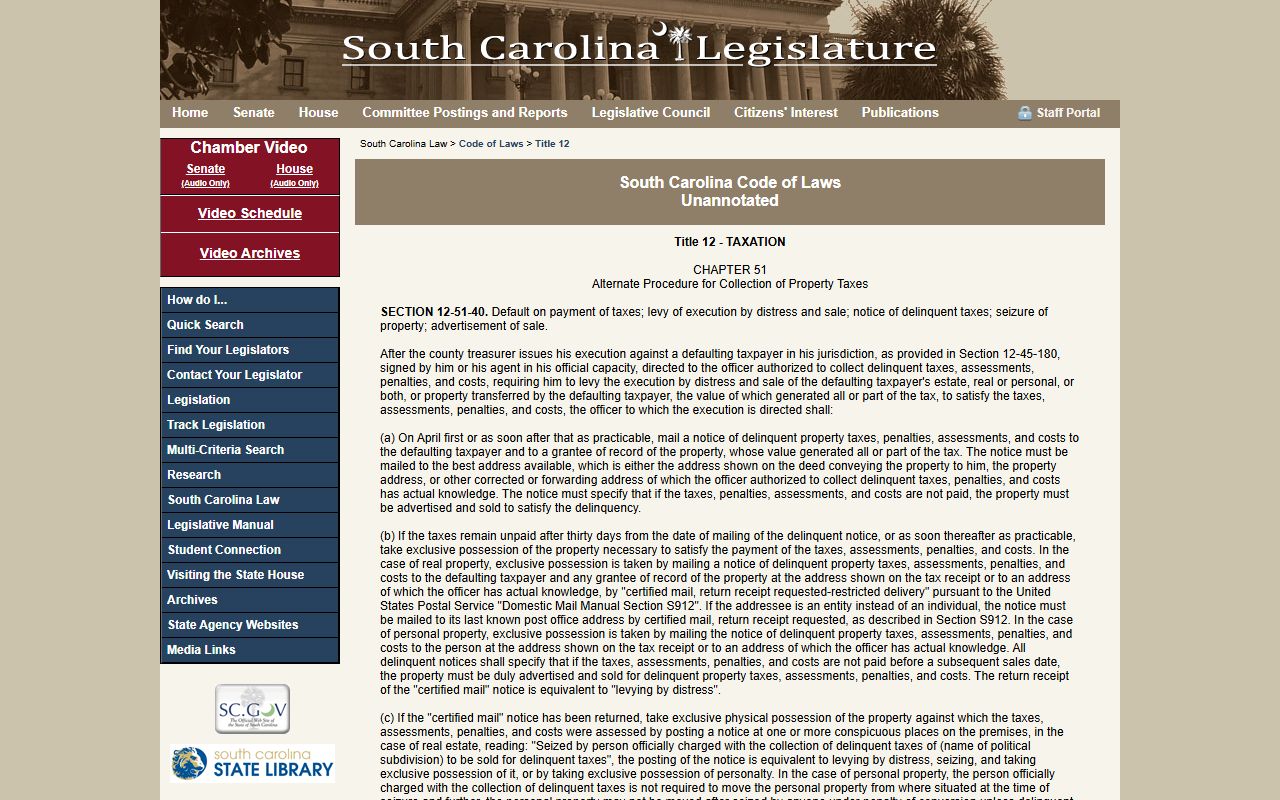
Chapter 51 of South Carolina's tax code, shown above, sets the delinquency and tax sale procedures that Dorchester County follows. The full text of Chapter 51 details the notice requirements, sale process, redemption rights, and timelines that govern how delinquent Dorchester County property tax records are handled through the enforcement process.
Homestead Exemption for Dorchester County Residents
South Carolina's Homestead Exemption is available to Dorchester County residents who are 65 or older, totally and permanently disabled, or legally blind. The exemption removes $50,000 of fair market value from the taxable base. Applicants must have held title to the property for at least one year. Filing is done through the county Auditor's office, not the Assessor.
The exemption can provide meaningful annual savings, especially given Dorchester County's growing property values. On a home appraised at $250,000, the $50,000 exemption reduces the taxable value to $200,000. Applied at the 4% residential rate, the assessed value drops from $10,000 to $8,000. At a millage rate of 300 mills, that is a savings of $600 per year.
Note: Dorchester County residents who qualify for both the Homestead Exemption and the 4% legal residence classification should apply for both through the appropriate county offices to maximize available savings.
Appealing a Dorchester County Property Assessment
Property owners who disagree with the Assessor's value have the right to appeal. Under Title 12, Chapter 60, the appeal process begins with a written filing to the Assessor within 90 days of the assessment notice date. The Assessor reviews the submission and issues a written response.
If the Assessor's response does not resolve the dispute, the next step is the county Board of Assessment Appeals. Further escalation can reach the South Carolina Administrative Law Court. Each level has its own filing deadlines and requirements. A strong appeal includes recent comparable sales, an independent appraisal if available, and documentation of any factual errors in the property description.
Dorchester County has experienced significant growth, particularly in and around Summerville. Rapidly rising home values in the area can lead to assessment increases that feel disproportionate to some property owners. Reviewing comparable sales data carefully before filing ensures you have a factual basis for your appeal rather than a general disagreement with market conditions.
Summerville and Dorchester County Property Tax Records
Summerville is the largest city in Dorchester County and one of the fastest-growing municipalities in South Carolina. Property owners in Summerville pay both county and city property taxes, as Summerville levies its own millage on top of the county and school district rates. The combined millage rate for properties within Summerville's city limits is higher than for unincorporated areas of Dorchester County.
The Dorchester County Assessor's office at 500 North Main Street in Summerville serves residents in the northern part of the county. This satellite office handles the same services as the main St. George location, including exemption applications, value inquiries, and assessment corrections. Having two offices helps serve the county's geographically spread population more effectively.
The South Carolina Association of Counties tracks data on millage rates, assessment levels, and tax collections across all 46 counties. Comparing Dorchester County's rates to neighboring counties gives context for how local taxes fit into the broader South Carolina property tax landscape.
Nearby Counties
Dorchester County is surrounded by Berkeley, Charleston, Colleton, Orangeburg, and Bamberg counties in the South Carolina Lowcountry.