
Carolina Forest Property Tax Records
Carolina Forest property tax records are managed entirely by Horry County. Carolina Forest is an unincorporated community with no municipal government of its own, which means there is no city tax layer added to your bill. All assessment, billing, and collection functions are handled by Horry County offices. This page explains how to find Carolina Forest property tax records, what assessment rates apply, how special tax districts may affect your bill, and how Horry County's notably low effective tax rate benefits property owners in the area.
Carolina Forest Property Tax Quick Facts
Carolina Forest Has No City Government
Carolina Forest is an unincorporated area of Horry County. It has no mayor, no city council, and no municipal tax authority. This is different from cities like Conway or Myrtle Beach, where a separate city millage is layered on top of county taxes. In Carolina Forest, your entire property tax bill comes from Horry County and any applicable special tax districts.
The Horry County Assessor handles valuation for every parcel in Carolina Forest. The Horry County Treasurer handles billing and collection. Because there is no intermediate city layer, the tax structure is simpler than in incorporated municipalities. Residents deal directly with county offices for all property tax matters.
The absence of municipal government also means residents rely on county-level and special district services for functions that cities typically handle directly. Fire protection, recreation, and certain utility services in unincorporated areas like Carolina Forest may be funded through special tax districts rather than a general city fund. These district levies can appear as separate line items on the Horry County tax bill.
Note: Just because Carolina Forest has no city government does not mean the tax bill is simple. Special district charges for fire, recreation, or other services can vary by the exact location of a parcel within Carolina Forest.
Horry County Property Tax Records for Carolina Forest
Horry County maintains parcel records for all property in the county including Carolina Forest. The county's online payment portal at horrycountytreasurer.qpaybill.com allows property owners to look up accounts, view bill amounts, and make payments. This is the primary digital access point for Carolina Forest property tax records.
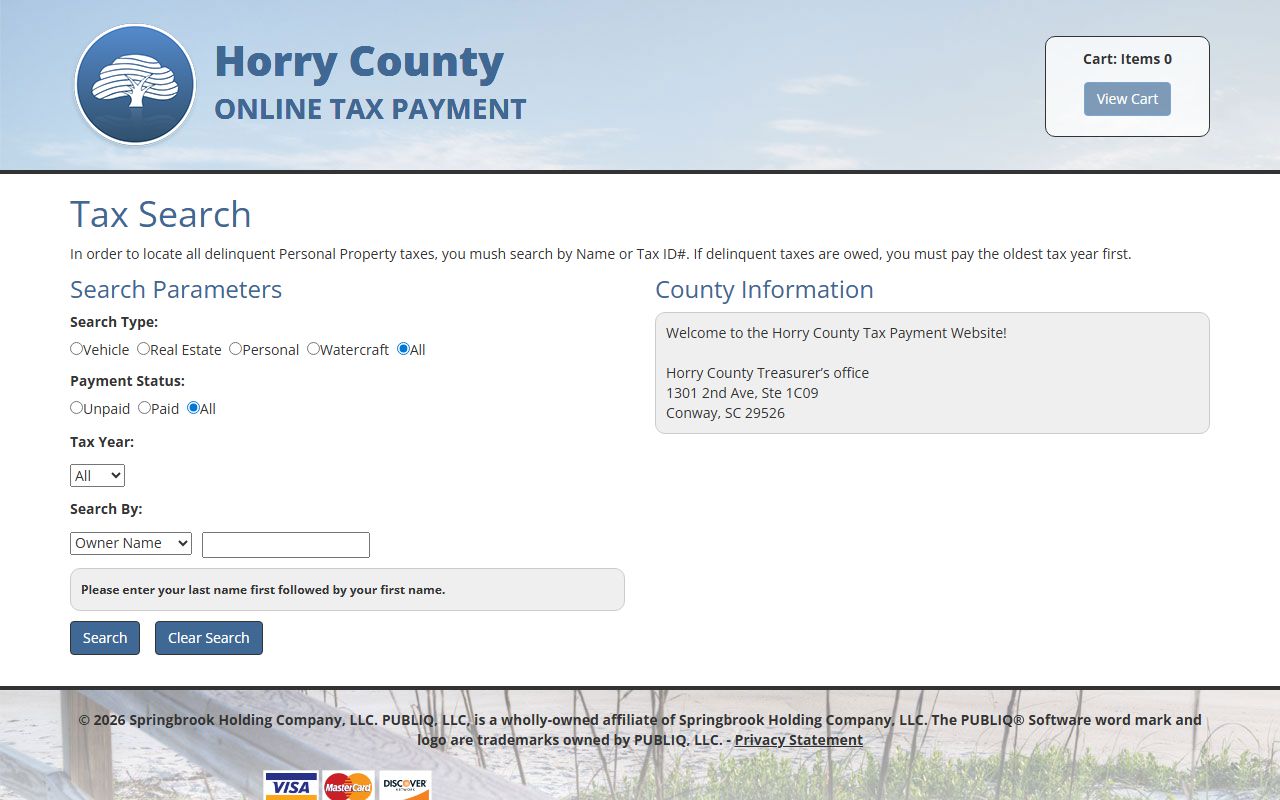
The payment portal is operated by Horry County and displays current and prior year tax bills for properties throughout the county. Searching by address or account number brings up the current balance, assessment classification, and any special district charges associated with the parcel. This is the fastest way to confirm whether taxes on a Carolina Forest property are current or delinquent.
For in-person or phone inquiries, the Horry County Assessor is located at 1301 2nd Ave, Conway, SC 29526, and can be reached at (843) 915-5040. The Horry County Treasurer, which handles collections, is at (843) 915-5470 and can also be reached by email at treasurer@horrycountysc.gov. Conway serves as the county seat of Horry County, so all county offices are centrally located there.
Horry County Assessment Ratios Explained
South Carolina law under S.C. Code Ann. Title 12, Chapter 43 sets the assessment ratios that apply to Carolina Forest property. Owner-occupied primary residences qualify for the 4% assessment ratio, which is the most favorable rate available for residential property. Properties that are not the owner's primary residence, including rentals, second homes, and vacant lots, are assessed at 6%. Commercial and industrial property carries higher ratios.
The 4% versus 6% distinction matters significantly at Horry County's overall millage level. A $300,000 Carolina Forest home assessed at 4% produces a $12,000 assessed value. The same home assessed at 6% produces an $18,000 assessed value. Applied against the county millage, that difference translates to real dollars on the annual bill.
To qualify for the 4% owner-occupied rate on a Carolina Forest home, the owner must file a legal residence application with the Horry County Assessor. The property must be the applicant's domicile. This application is not automatic after purchase. New homeowners should file as soon as possible after closing to ensure the correct rate is applied starting with the next tax year.
Special Tax Districts in Carolina Forest
Unincorporated areas in South Carolina can be subject to special purpose districts that levy their own millage for specific services. In Carolina Forest, residents may see charges on their Horry County tax bill from fire protection districts, recreation districts, or other service districts depending on where the parcel is located. These are not city taxes but rather county-administered special districts.
Special district millage rates vary by district boundaries. Two Carolina Forest homes on the same street could be in different fire districts, resulting in different total tax bills even if their assessed values and county millage are identical. The Horry County Assessor can tell you which special districts apply to a specific parcel.
The South Carolina Association of Counties provides information on how special districts operate throughout the state. In Horry County, these districts are governed by locally elected boards and operate under state oversight. Their budgets and millage rates are set annually and reflected in the county tax bill.
Note: If your Carolina Forest tax bill looks higher than expected, review each line item carefully. Special district charges can add meaningful amounts on top of the base county millage rate.
Horry County's Low Tax Rate Advantage
Horry County has the lowest average effective property tax rate in South Carolina at 0.35%. For Carolina Forest residents, this means the property tax burden is lower here than in almost any other part of the state. This rate reflects the combination of county, school district, and special district millage applied to assessed values.
The low effective rate is partly a function of how the county manages its budget and partly a reflection of the high volume of tourism-related commercial property in Horry County, which contributes to the tax base and reduces the residential burden. Whatever the cause, Carolina Forest property owners benefit directly from this low rate compared to homeowners in most other South Carolina counties.
The South Carolina Department of Revenue provides statewide property tax data that confirms Horry County's position relative to other counties. Property owners considering Carolina Forest for a home purchase often find the effective tax rate to be a meaningful financial advantage over comparable properties in Greenville, Richland, or other higher-rate counties.
Carolina Forest Tax Due Dates and Delinquency
Horry County property taxes are due January 15 each year. S.C. Code Ann. Title 12, Chapter 45 establishes this due date and the penalty structure for late payments. A 3% penalty applies to unpaid balances after January 15. Subsequent late penalties follow the state schedule with an additional 7% added after the second deadline and another 5% added after the third.
Accounts that remain unpaid enter the delinquency process governed by S.C. Code Ann. Title 12, Chapter 51. Delinquent properties in Horry County are subject to a tax sale, after which the original owner has a 12-month redemption period to pay the overdue amount and recover the property. Paying before the January 15 due date avoids the entire delinquency process and preserves clean title.
Homestead Exemption for Carolina Forest Homeowners
Carolina Forest homeowners who are 65 or older, permanently disabled, or legally blind may qualify for South Carolina's Homestead Exemption. This exemption covers the first $50,000 of a home's fair market value, which can reduce the taxable assessed value meaningfully on properties at that price point and above.
Applications for the Homestead Exemption are submitted to the Horry County Auditor, not the Assessor or Treasurer. The exemption is addressed under S.C. Code Ann. Title 12, Chapter 37. Qualifying homeowners should apply as soon as they become eligible. The exemption does not apply automatically and requires documentation of age, disability, or visual impairment.
Once approved, the exemption remains in effect as long as the applicant continues to occupy the property as a primary residence and continues to meet the eligibility requirements. Changes in residency or ownership require notifying the Horry County Auditor to avoid improper application of the exemption.
Appealing a Carolina Forest Property Assessment
Property owners in Carolina Forest who disagree with the Horry County Assessor's valuation have the right to appeal. The appeal process begins with an informal review at the Assessor's office. Bringing comparable sales data, an independent appraisal, or documentation of property condition issues can help support a lower value during the informal review.
If the informal review does not resolve the dispute, the property owner can file a formal appeal to the Horry County Board of Assessment Appeals. Further appeals after the county board level go to the Administrative Law Court under S.C. Code Ann. Title 12, Chapter 60. The Administrative Law Court provides an independent forum for contested property tax valuation disputes statewide.
The five-year countywide reassessment cycle required by Chapter 43 is the most common trigger for new assessments that prompt appeals. During a reassessment year, Horry County sends out new notices of assessed value. The notice itself establishes the appeal window, and missing that deadline means accepting the new value for the following tax year.
Horry County Property Tax Records
All Carolina Forest property tax records are held at the county level. Visit the Horry County page for assessor contact information, parcel search tools, and complete county tax details.