
Horry County Property Tax Records and Payment Info
Horry County property tax records are administered through offices at 1301 2nd Avenue, Conway, SC. Horry County is home to Myrtle Beach, Carolina Forest, and Socastee, making it one of the most visited and fastest-growing counties in South Carolina. It also holds a distinction that matters to every property owner: Horry County has the lowest property tax rates in all of South Carolina, with an average effective rate of just 0.35%. This page covers how Horry County property tax records are organized, where to search them, and what laws govern the system.
Horry County Property Tax Quick Facts
Horry County Assessor Property Records
The Horry County Assessor's office is located at 1301 2nd Avenue, Conway, SC, and can be reached at (843) 915-5040. The Assessor maintains property tax records for every parcel in Horry County, including parcel identification numbers, ownership information, legal descriptions, fair market values, assessed values, and property classifications. Under South Carolina Code Chapter 37, the Assessor must also maintain deed records, building permits, and tax maps as part of the property record system for Horry County.
Horry County's rapid growth means the Assessor processes a high volume of new deeds, permits, and parcel changes each year. The county includes densely developed coastal areas near Myrtle Beach and growing suburban communities like Carolina Forest and Socastee. Each new construction project, subdivision plat, and property sale generates updates to Horry County property tax records. The Assessor reviews sales data and building permits to keep valuations current between the five-year reassessment cycles required by Chapter 43.
Assessment ratios in Horry County follow the statewide framework. Owner-occupied primary residences are assessed at 4% of fair market value. Commercial and non-primary residential property is assessed at 6%. Manufacturing property carries a 10.5% ratio. These ratios, combined with Horry County's low millage rates, produce the lowest effective property tax burden in South Carolina for qualifying homeowners.
Note: Vacation and second-home properties in Horry County are assessed at 6% rather than the 4% primary residence rate. This is a common point of confusion for owners who have multiple properties. Only one property per owner qualifies for the 4% legal residence classification.
Why Horry County Has the Lowest Property Tax Rates in South Carolina
Horry County's property tax rates are the lowest in South Carolina primarily because of the local option sales tax credit. An 88% property tax credit is available to Horry County property owners through the county's local option sales tax program. This credit offsets a large portion of the property tax bill each year, dramatically reducing the effective burden on property owners.
The local option sales tax generates revenue from tourists and visitors who spend money in Horry County. Because Myrtle Beach and the Grand Strand attract millions of visitors annually, a significant share of the tax burden is shifted from property owners to visitors through sales tax collections. The result is that Horry County property owners pay far less in property taxes relative to their property's value than owners in almost any other South Carolina county.
The average effective tax rate of 0.35% in Horry County is well below the South Carolina average. A property with a $250,000 fair market value assessed at 4% produces a $10,000 assessed value. Before the credit, that property's Horry County tax bill would be calculated at the local millage rate. After the 88% credit is applied, the net amount owed is substantially reduced. Horry County property tax records reflect both the gross assessed tax and the credit, so owners can see exactly how the credit reduces their annual obligation.
Horry County Treasurer Tax Payment Records
The Horry County Treasurer handles all property tax collections for Horry County. The Treasurer's office can be reached at (843) 915-5470 or by email at treasurer@horrycountysc.gov. All Horry County property taxes are due January 15 under South Carolina Code Chapter 45. The Treasurer's records show each parcel's billing history, payment history, and current balance.
Horry County provides an online tax payment portal at horrycountytreasurer.qpaybill.com. Through this portal, property owners can search for their Horry County property tax record, view the current amount due, and make payments online.
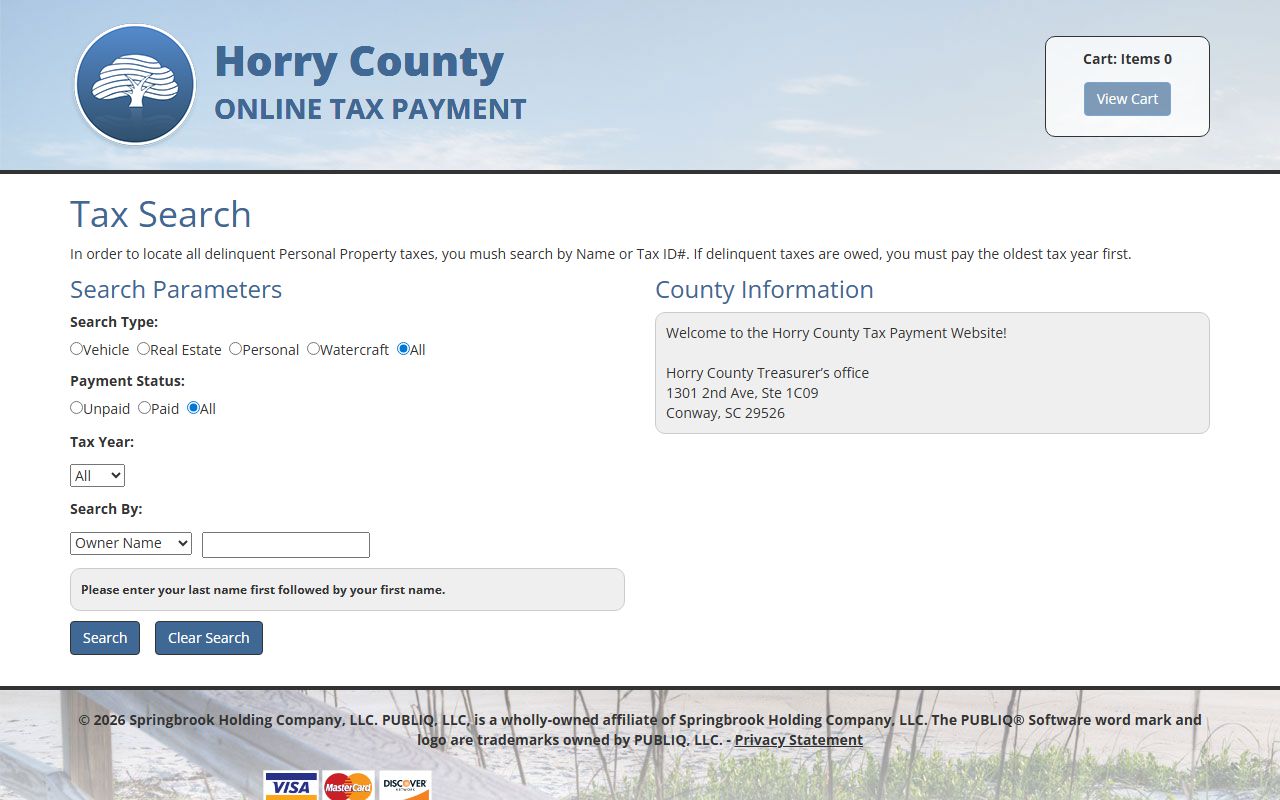
The online payment portal is a convenient option for the large number of part-time residents and second-home owners in Horry County who may not be present in the county when tax bills are due. Horry County property owners can access the portal from anywhere to confirm their tax record status and pay without mailing a check or visiting the Treasurer's office in Conway.
Late payments in Horry County trigger penalties under Chapter 45. The first penalty is 3% of the unpaid balance. A second penalty of 7% applies at the next stage, followed by an additional 5%. These penalties accumulate on top of the base tax owed, so Horry County property owners are advised to use the online payment portal or contact the Treasurer's office before the January 15 deadline each year.
Note: Property taxes in Horry County are a first lien on real property under Chapter 49. The lien attaches December 31 each year. Buyers should confirm Horry County property tax records are current before any real estate closing.
Horry County Reassessment Property Records
Horry County conducts a general reassessment every five years under Chapter 43. Given the rapid appreciation in coastal real estate values near Myrtle Beach, reassessment cycles can produce significant changes to Horry County property tax records. When a new reassessment value is higher than the prior value, the tax bill in Horry County typically increases unless the local option sales tax credit offsets the difference.
Horry County property owners who disagree with a reassessment value have the right to appeal. The appeal process starts at the Assessor level in Horry County. If not resolved at the county level, the dispute can proceed to the Administrative Law Court under Chapter 60 procedures. Filing deadlines apply, and owners should respond promptly to any reassessment notice they intend to challenge.
Between reassessment cycles, Horry County property tax records generally hold values steady. Triggering events such as a sale, new construction, or a change in use can prompt an interim update. The sale price of a property is one of the strongest indicators of market value and is commonly used by the Horry County Assessor to update records when a deed is recorded after a sale.
Horry County Delinquent Tax Records
When Horry County property taxes remain unpaid past the penalty stages, the account moves into the delinquency process under Chapter 51. Horry County issues formal delinquency notices beginning April 1. Properties with unresolved delinquent balances may be scheduled for a tax sale.
Original Horry County property owners have a 12-month redemption period after the tax sale. During that time, the owner can recover the property by paying all outstanding taxes, penalties, and costs. If the redemption period expires without payment, the tax sale purchaser proceeds to clear title. Horry County delinquent tax records are public and can be accessed through the county.
The South Carolina Association of Counties provides resources on the delinquent tax process for all South Carolina counties. The SCAC's guidance can help Horry County property owners understand their rights and options when dealing with delinquent tax situations.
Homestead Exemption in Horry County
Horry County property owners who qualify for the South Carolina Homestead Exemption can reduce their taxable base by $50,000 of fair market value. Qualifying conditions include being 65 or older, legally blind, or permanently and totally disabled. The owner must have held title to the Horry County property for at least one full year.
Applications for the Homestead Exemption in Horry County are filed with the Auditor's office. Once approved, the exemption appears in the Horry County property tax record and reduces the annual bill. Combined with the 88% local option sales tax credit, the Homestead Exemption can result in a very low net property tax obligation for qualifying Horry County senior homeowners.
The exemption is defined under Chapter 37 provisions that apply statewide. The South Carolina Department of Revenue provides oversight of exemption programs and guidance to county Auditors on eligibility verification. The full statutory basis for the Horry County property tax system is available through Title 12.
Nearby Counties
Horry County is located along the northeastern coast of South Carolina and borders several other counties in the region.