
Find Columbia SC Property Tax Records
Columbia property tax records are managed through Richland County and the City of Columbia Finance Department. Richland County assigns property values, calculates tax bills, and collects payments. The City of Columbia adds its own municipal millage for properties inside city limits. Columbia carries one of the higher effective property tax rates in South Carolina at approximately 0.74%. This guide covers how to find tax records, what rates apply, key deadlines, and available exemptions for Columbia property owners.
Columbia Property Tax Quick Facts
How Columbia Property Taxes Are Calculated
Three offices share the work of Columbia property taxation. The Richland County Assessor assigns a value to each property. The Richland County Auditor uses that value to calculate the tax owed and keeps the official records. The Richland County Treasurer collects payments. The City of Columbia then adds municipal millage for properties that fall within city limits, which funds city services.
South Carolina does not impose a state-level property tax. Every dollar of property tax collected in Columbia flows to county, city, or school district accounts. The South Carolina Department of Revenue establishes property tax policy and oversees assessment ratios statewide but does not collect local taxes.
The Richland County Assessor office is located at 2020 Hampton St, Ste. 2067, Columbia, SC 29204. For questions about your bill, payment history, or account status, the Columbia City Finance Department can be reached at (803) 545-3095 at 1136 Washington Street, Columbia, SC 29201. The city's finance portal at finance.columbiasc.gov provides additional resources for Columbia property owners.
Columbia Property Tax Records and the Finance Portal
The City of Columbia Finance Department operates a dedicated web portal where residents can access property tax information and city financial resources. The portal covers city millage details, payment options, and links to county-level tax tools.
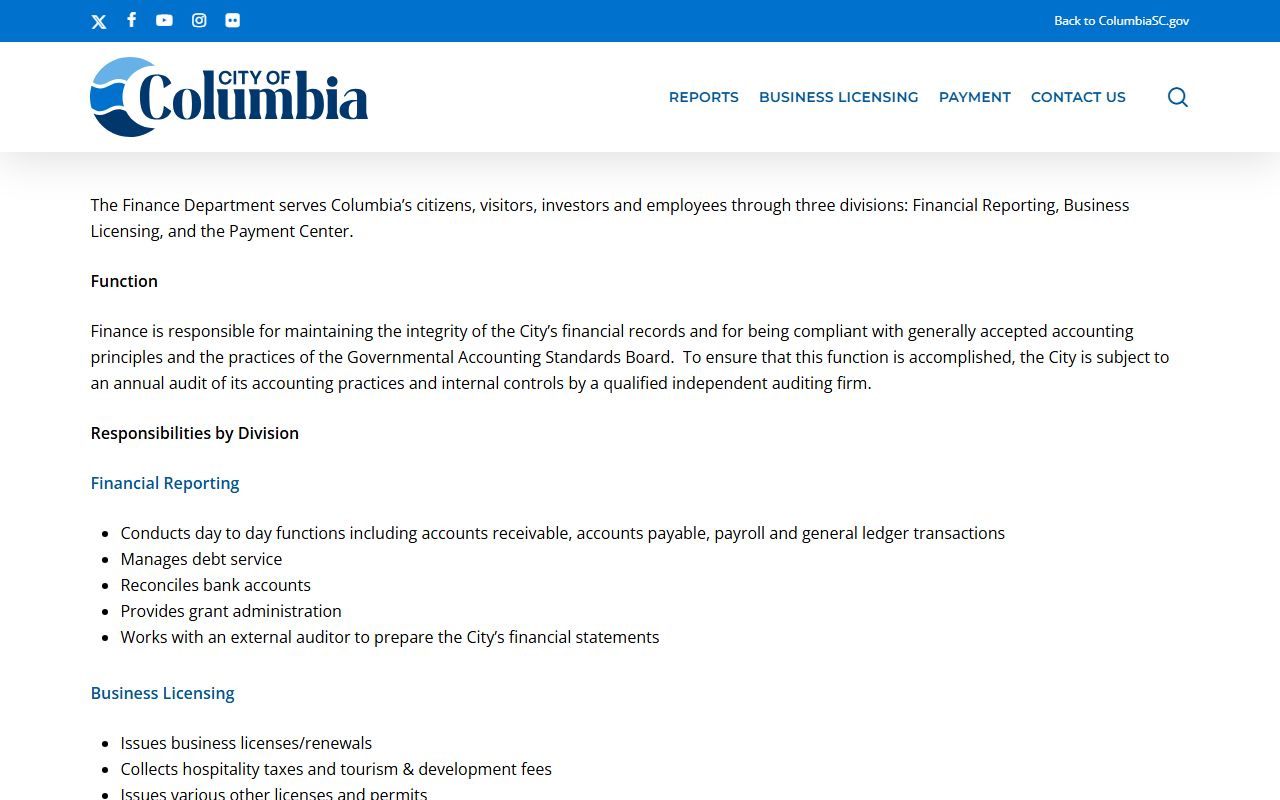
For parcel-level records in Columbia, the Richland County Assessor maintains the official property database. You can search by address, owner name, or parcel number to find assessed values, exemptions on file, and historical data. The county also publishes current millage rates for the current tax year. Updated 2025 millage rates are available through the Richland County website and the city finance portal at finance.columbiasc.gov.
Note: The City of Columbia Finance Department handles city-related tax questions, but the official source for parcel values and assessment records is always the Richland County Assessor.
Columbia Assessment Ratios and Property Classes
Assessment ratios in South Carolina set the taxable portion of a property's value. S.C. Code Ann. Title 12, Chapter 43 establishes these ratios statewide. Owner-occupied primary residences in Columbia are assessed at 4% of fair market value. Rental homes, commercial properties, and non-primary residences are assessed at 6%. Manufacturing properties carry the highest ratio at 10.5%.
Columbia's effective rate of approximately 0.74% reflects a combination of Richland County base millage, city millage, and school district millage. When layered together, these make Columbia one of the higher-tax cities in South Carolina. Property owners who qualify for the 4% owner-occupied rate save significantly compared to those assessed at 6%.
Chapter 43 also requires each county to conduct a countywide reassessment every five years. Richland County follows this cycle to keep assessed values aligned with actual market conditions. After a reassessment year, some property owners in Columbia may see significant changes in their assessed values depending on how the local market has moved.
Columbia Tax Due Dates and Late Payment Penalties
Columbia property taxes follow the statewide due date of January 15. S.C. Code Ann. Title 12, Chapter 45 governs due dates and penalties for all South Carolina counties, including Richland County where Columbia is located. Paying by January 15 avoids any late penalties.
Missing the January 15 deadline triggers a 3% penalty on the unpaid balance. A second deadline adds 7% more. A third threshold adds 5% on top of that. These cumulative penalties compound quickly and can add a substantial amount to an already-high Columbia tax bill.
Delinquent accounts move into a formal collection process under S.C. Code Ann. Title 12, Chapter 51. A delinquency notice issues on April 1 for accounts still unpaid from the prior January 15. Columbia property owners then have a 12-month redemption window to pay the full amount owed before the county takes further action. Fees and costs continue to accumulate throughout this window, so resolving the delinquency early is always the better approach.
Homestead Exemption for Columbia Residents
South Carolina's Homestead Exemption is available to qualifying Columbia homeowners. Under S.C. Code Ann. Title 12, Chapter 37, the exemption removes the first $50,000 of fair market value from taxation. Eligible owners must be 65 or older, totally and permanently disabled, or legally blind. They must also have been South Carolina residents for at least one full calendar year before applying.
Applications in Columbia go through the Richland County Auditor, not the Assessor. The exemption applies only to a primary residence. Investment properties and rental homes in Columbia do not qualify. Once granted, the exemption renews automatically each year as long as the owner remains eligible.
For a home valued at $200,000, the Homestead Exemption effectively removes $50,000 from the taxable base. At Columbia's effective rate, that translates to roughly $370 in annual savings. Owners who have not yet applied but believe they qualify should contact the Richland County Auditor to get the application started.
Note: The Homestead Exemption application deadline in South Carolina is typically July 15 of the tax year for which you want the benefit to apply.
Columbia Property Tax Appeals Process
Columbia property owners who disagree with the Richland County Assessor's value have the right to appeal. The process starts with a written objection filed with the Assessor within 90 days of receiving the assessment notice. Strong supporting documentation, such as a recent independent appraisal or recent comparable sales in the same neighborhood, gives the objection the best chance of success at this first step.
If the Assessor's review does not resolve the dispute, the owner can appeal to the Richland County Board of Assessment Appeals. A further appeal can go to the South Carolina Administrative Law Court. S.C. Code Ann. Title 12, Chapter 60 governs appeals to the Administrative Law Court for property tax matters throughout South Carolina. The South Carolina Association of Counties at sccounties.org also provides guidance on county-level tax processes and property owner rights.
Understanding Columbia's Combined Millage Rate
Columbia's total millage rate is a sum of several components. Richland County base millage covers county operations. The Columbia city millage funds municipal services like police, fire, parks, and public works for properties inside city limits. School district millage typically represents the largest single portion of the total bill for Columbia property owners.
Millage rates are expressed in mills, where one mill equals $1 per $1,000 of assessed value. A property with an assessed value of $20,000 facing a total millage of 400 mills would owe $8,000 in taxes. For Columbia's owner-occupied properties, the 4% assessment ratio keeps the taxable base lower than the full market value, which helps moderate the final bill despite the relatively high combined millage.
Richland County publishes updated millage rates each year. Current 2025 rates are available on the county website and through the city finance portal. Property owners reviewing records for Columbia should confirm which millage year their bill reflects, particularly if they purchased mid-year or if a reassessment has recently taken effect.
Richland County Property Tax Records
Richland County is the official source for all property tax records covering parcels within Columbia city limits. The Assessor, Auditor, and Treasurer all operate at the county level and maintain the records that govern every Columbia property tax bill.