
Greenville Property Tax Records and Rates
Greenville property tax records are administered by Greenville County for all parcels within city limits. Greenville County is one of the most complex tax jurisdictions in South Carolina, with 136 separate taxing districts, 18 special-purpose districts, and 31 fire service areas. The City of Greenville adds its own municipal millage to county and school district rates for properties inside city limits. This guide covers how to search Greenville property tax records, understand the multi-district tax structure, and navigate the assessment, exemption, and appeals processes.
Greenville Property Tax Quick Facts
How Greenville City Property Taxes Work
Three county offices handle property taxation for Greenville city properties. The Greenville County Assessor determines the fair market value of each parcel. County Auditor Scott Case calculates the tax bill by applying the correct assessment ratio and millage. County Treasurer Jarret Winget collects the payments. City of Greenville millage is added to county and school district rates for all properties inside city limits.
South Carolina has no state property tax. Every mill levied in Greenville flows to Greenville County, the City of Greenville, or the school district. The South Carolina Department of Revenue oversees property tax policy and assessment ratios statewide but does not collect local taxes.
The Greenville County Assessor is located at 301 University Ridge, Ste S-1000, Greenville, SC 29601, phone (864) 467-7300. Auditor Scott Case can be reached at (864) 467-7040. Treasurer Jarret Winget is at (864) 467-5673. The City of Greenville's main website is at greenvillesc.gov, and the departments directory is at greenvillesc.gov/950/Departments.
Greenville Property Tax Records and Online Tools
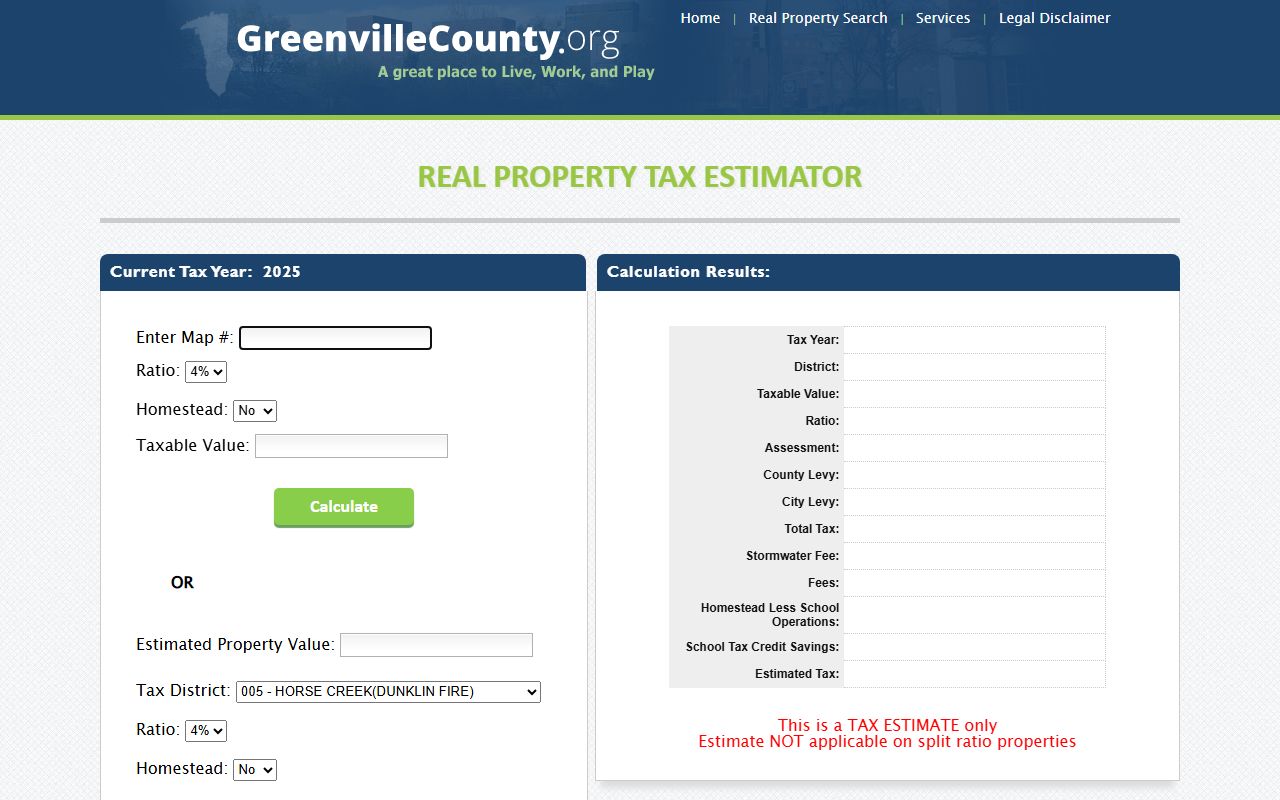
Greenville County provides several online tools for searching and estimating property taxes. The Greenville County Real Property Tax Estimator at greenvillecounty.org allows property owners to enter parcel information and calculate an estimated tax bill based on current millage rates. This tool is useful for budgeting and for comparing the tax impact of owner-occupied versus investment classification.
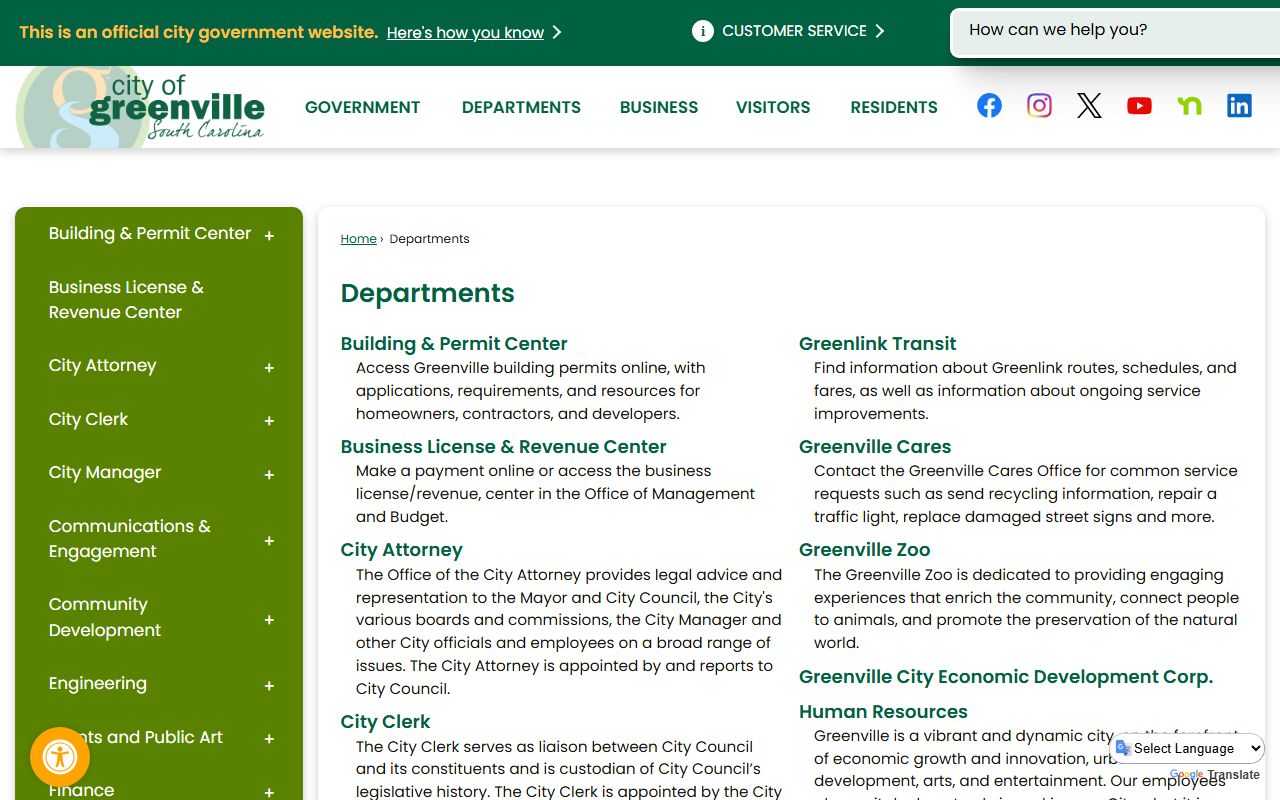
The City of Greenville's departments page at greenvillesc.gov/950/Departments links to relevant city offices and provides contact information for city services that intersect with property ownership. For parcel-level records, the Greenville County Assessor maintains the official database of all property values and exemptions within the city.
For GIS-based parcel searches in Greenville, the county's interactive map at grvlsc.maps.arcgis.com lets you browse parcels by location and view ownership, value, and boundary data for properties across Greenville County. GIS tools are especially useful in Greenville given the complexity of the county's 136 taxing districts.
Note: Because Greenville County has 136 taxing districts, two neighboring properties can have meaningfully different tax bills even if their assessed values are identical. The online estimator accounts for district codes when calculating estimates.
Greenville Assessment Ratios and Property Classes
Assessment ratios in Greenville follow the rates set by South Carolina law. Under S.C. Code Ann. Title 12, Chapter 43, owner-occupied primary residences are assessed at 4% of fair market value. Commercial property and non-primary residential property carry a 6% ratio. Manufacturing facilities are assessed at 10.5%, the highest ratio in the state.
For Greenville city properties, the school district tax is typically the largest single component of the combined bill. County base millage of 48.8 mills covers county operations and debt service. City millage covers municipal services. Special-purpose district millage and fire service area charges may apply depending on the specific parcel's location within Greenville County.
Chapter 43 requires Greenville County to conduct a countywide reassessment every five years. Given the growth of the Greenville market in recent years, reassessment cycles can produce significant changes in assessed values for city properties. Property owners should review their assessment notice carefully during reassessment years and compare it against recent comparable sales before deciding whether to accept or challenge the new value.
Greenville Tax Due Dates and Late Penalties
Greenville property taxes are due January 15 each year. S.C. Code Ann. Title 12, Chapter 45 establishes the due date and the penalty structure for all South Carolina counties including Greenville.
Missing January 15 triggers a 3% penalty on the unpaid balance. A second threshold adds another 7%. A final 5% penalty then applies. These three compounding penalties can add meaningfully to any bill, especially in Greenville where city, county, school district, and special district charges can combine into a substantial annual amount.
Delinquent accounts proceed under S.C. Code Ann. Title 12, Chapter 51. A formal delinquency notice issues on April 1 for accounts unpaid since January 15. Greenville property owners then have a 12-month redemption period to pay the full balance plus fees. Taking care of delinquency early in the redemption window limits the total amount owed.
Homestead Exemption for Greenville Property Owners
South Carolina's Homestead Exemption is available to qualifying Greenville residents. Under S.C. Code Ann. Title 12, Chapter 37, the exemption removes the first $50,000 of fair market value from taxation. Qualifying owners must be 65 or older, totally and permanently disabled, or legally blind. They must also have lived in South Carolina for at least one full calendar year before applying.
Applications in Greenville go through the Greenville County Auditor Scott Case at (864) 467-7040. The exemption is limited to primary residences. It does not apply to investment properties, rental units, or commercial parcels within Greenville city limits. Once approved, the exemption renews automatically each year provided the owner remains eligible.
The South Carolina Association of Counties at sccounties.org provides a statewide overview of the Homestead Exemption and other county-administered programs. For Greenville-specific questions about eligibility or the application process, the County Auditor's office is the authoritative source.
Appealing Greenville Property Tax Assessments
Greenville property owners who believe the County Assessor has overvalued their property can file an appeal. The appeal must be submitted in writing to the Assessor within 90 days of receiving the assessment notice. Providing solid evidence, such as a recent independent appraisal or a comparative market analysis of recent Greenville sales, gives the objection its best chance of success at the first level.
If the Assessor review does not resolve the dispute, the owner can go to the Greenville County Board of Assessment Appeals. A further escalation path leads to the South Carolina Administrative Law Court. S.C. Code Ann. Title 12, Chapter 60 establishes the formal framework for these administrative appeals throughout the state. Each level requires its own filing and carries its own deadlines.
Greenville's complex multi-district structure occasionally produces billing errors related to which special districts a parcel is assigned to. If you suspect your bill includes a district charge that does not apply to your property, raise this with the County Auditor as well as the Assessor, since district assignments are sometimes a separate issue from the base valuation.
Note: Property taxes must still be paid on time during a pending appeal. If the appeal succeeds, the county will issue a credit or refund. Nonpayment while waiting for an appeal outcome will generate penalties regardless of the appeal's status.
Greenville County's Multi-District Tax Structure
Greenville County's 136 taxing districts make it one of the more complex property tax environments in South Carolina. A single Greenville city address may be subject to county base millage, school district millage, city millage, a special-purpose district assessment, and a fire service area levy. Each of these components is set independently by the governing body responsible for that district.
The 18 special-purpose districts in Greenville County fund neighborhood-specific services. The 31 fire service areas fund local fire protection. Properties inside Greenville city limits receive city fire services, so the applicable fire district charge may differ from properties in unincorporated parts of the county. The online tax estimator accounts for these district assignments when generating estimates for specific parcels.
For Greenville property owners buying or selling in the city, confirming the full millage composition for a specific parcel address is important. Two homes on the same street can occasionally fall in different special districts. The Greenville County Assessor's office can confirm which districts apply to any given parcel address.
Greenville County Property Tax Records
Greenville County is the official source for all property tax records covering parcels within the City of Greenville. The Assessor, Auditor, and Treasurer offices at the county level maintain every record that determines a Greenville city property tax bill.