
Search Greenville County Property Tax Records
Greenville County property tax records are managed through the Assessor, Auditor, and Treasurer offices at 301 University Ridge, Greenville, SC. Greenville County is the most populous county in South Carolina, with a broad and complex property tax system covering 136 taxing districts and 31 fire service areas. From the online tax estimator to the interactive GIS mapping portal, Greenville County provides multiple tools for looking up parcel data, assessed values, and tax information. This page covers everything you need to know about Greenville County property tax records.
Greenville County Property Tax Quick Facts
Greenville County Assessor and Property Records
The Greenville County Assessor's office is at 301 University Ridge, Suite S-1000, Greenville, SC 29601. The main phone number is (864) 467-7300. The Assessor's office maintains property tax records for every parcel in Greenville County, covering ownership, valuation, and classification. Under South Carolina Code Chapter 37, the Assessor must maintain deed records, building permits, and tax maps as part of the county's property tax record system.
Greenville County has a median home value of $148,100 and a median annual property tax of $971. The effective tax rate is 0.66%, one of the lower rates in the Upstate region. The base millage rate is 48.8 mills, but the actual rate paid by any Greenville County property owner varies by location across 136 taxing districts. School district taxes represent the largest single component of the overall Greenville County property tax bill. There are also 18 special-purpose districts and 31 fire service areas that may apply depending on where in Greenville County your property is located.
Assessment ratios in Greenville County follow the statewide framework under Chapter 43. Owner-occupied primary residences are assessed at 4% of fair market value. Commercial and non-primary residential properties are assessed at 6%. Manufacturing and industrial properties carry a 10.5% ratio. These ratios apply uniformly across all properties in Greenville County, so the classification of your property has a direct effect on your tax bill.
Note: Greenville County covers cities including Greenville, Greer, Mauldin, and Simpsonville. Each area may fall within different taxing districts, so the specific mills applied to a parcel depend on its exact location within Greenville County.
Greenville County Property Tax Estimator Tool
Greenville County offers an online property tax estimator at greenvillecounty.org. This tool allows property owners and prospective buyers to calculate an estimated tax bill based on property value, classification, and location within Greenville County. It is a useful starting point for understanding what a Greenville County property tax obligation might look like before a sale closes or an assessment is reviewed.
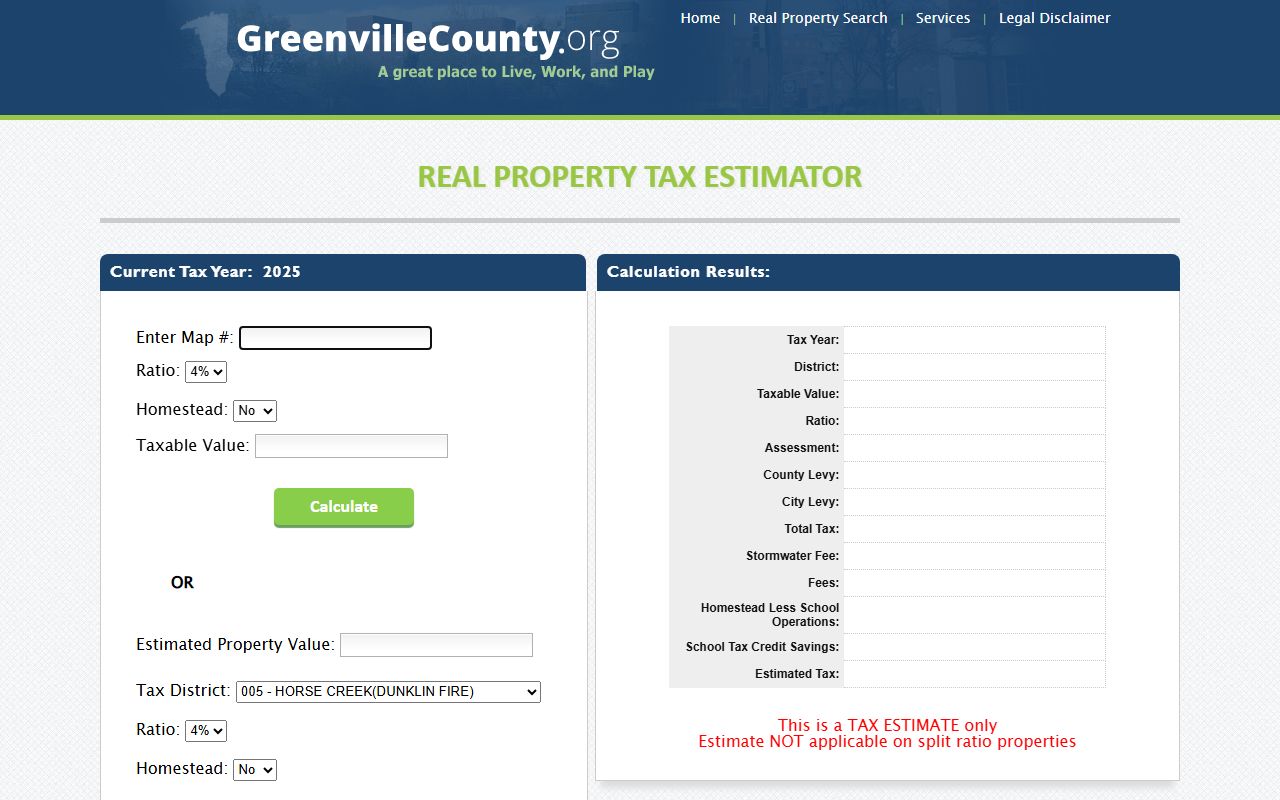
The tax estimator uses current Greenville County millage rates and assessment ratios. It is not a substitute for the official Greenville County property tax record, but it provides a reliable estimate that most users find accurate enough for planning purposes. Enter the property value and select the appropriate classification to see what the estimated annual tax would be in Greenville County.
Greenville County GIS Property Maps
The City of Greenville provides an interactive GIS mapping portal at grvlsc.maps.arcgis.com. The tool allows users to zoom by location and view property information throughout Greenville County. Interactive maps are useful for confirming parcel boundaries, viewing lot dimensions, and identifying nearby parcels when researching Greenville County property tax records.

GIS maps complement the data found in Greenville County property tax records by adding a spatial dimension. You can view where a parcel sits in relation to roads, waterways, and other properties. This is particularly useful in Greenville County, where the county's size and diverse geography mean that parcel boundaries and district lines can be complex. The GIS tool helps resolve questions that raw data alone cannot answer.
Note: The GIS map is maintained by the City of Greenville and covers much of Greenville County. For parcels outside city limits, the county Assessor's office maintains tax maps under the requirements of Chapter 37.
Greenville County Auditor and Treasurer Records
Scott Case serves as the Greenville County Auditor, reachable at (864) 467-7040. The Auditor prepares the tax roll for all taxable property in Greenville County, listing each parcel by owner, classification, location, and assessed value. This roll is the official record used by the Treasurer to generate tax bills. If you believe your Greenville County tax record contains an error in classification or value, the Auditor's office is the right contact for many types of corrections before the bill issues.
Jarret Winget serves as the Greenville County Treasurer, reachable at (864) 467-5673. The Treasurer's office handles all property tax collections for Greenville County. Taxes are due January 15 under South Carolina Code Chapter 45. Late payments trigger a 3% penalty first, then an additional 7%, then a further 5% if the balance remains unpaid through the later stages of the collection process. The Treasurer's office can provide payment history records and confirm the status of any Greenville County property tax account.
Property taxes in Greenville County represent a first lien on real property under Chapter 49. The lien attaches on December 31 each year. This priority means that unpaid Greenville County property taxes take precedence over most other claims against the property, including mortgages and judgment liens. Buyers and lenders routinely verify Greenville County property tax records before closing to confirm that no unpaid tax liens exist.
Greenville County Reassessment Records
Greenville County reassesses all real property every five years under Chapter 43. The reassessment process involves reviewing market data, comparable sales, and property characteristics to determine updated fair market values. When the reassessment cycle is complete, new values appear in Greenville County property tax records and take effect for the next tax year.
Property owners who disagree with their Greenville County reassessment value can file an appeal. The appeal process starts at the county Assessor level and can proceed to the Administrative Law Court if the dispute is not resolved at the county level. Procedures are governed by Chapter 60. Filing deadlines apply, so Greenville County property owners should act promptly upon receiving a reassessment notice they intend to challenge.
Greenville County City Departments and Property Resources
The City of Greenville maintains a departments page at greenvillesc.gov that provides access to city-level property and tax-related resources. City residents in Greenville County may have obligations to both the city and the county, and both sets of records are part of the broader picture of Greenville County property tax data.
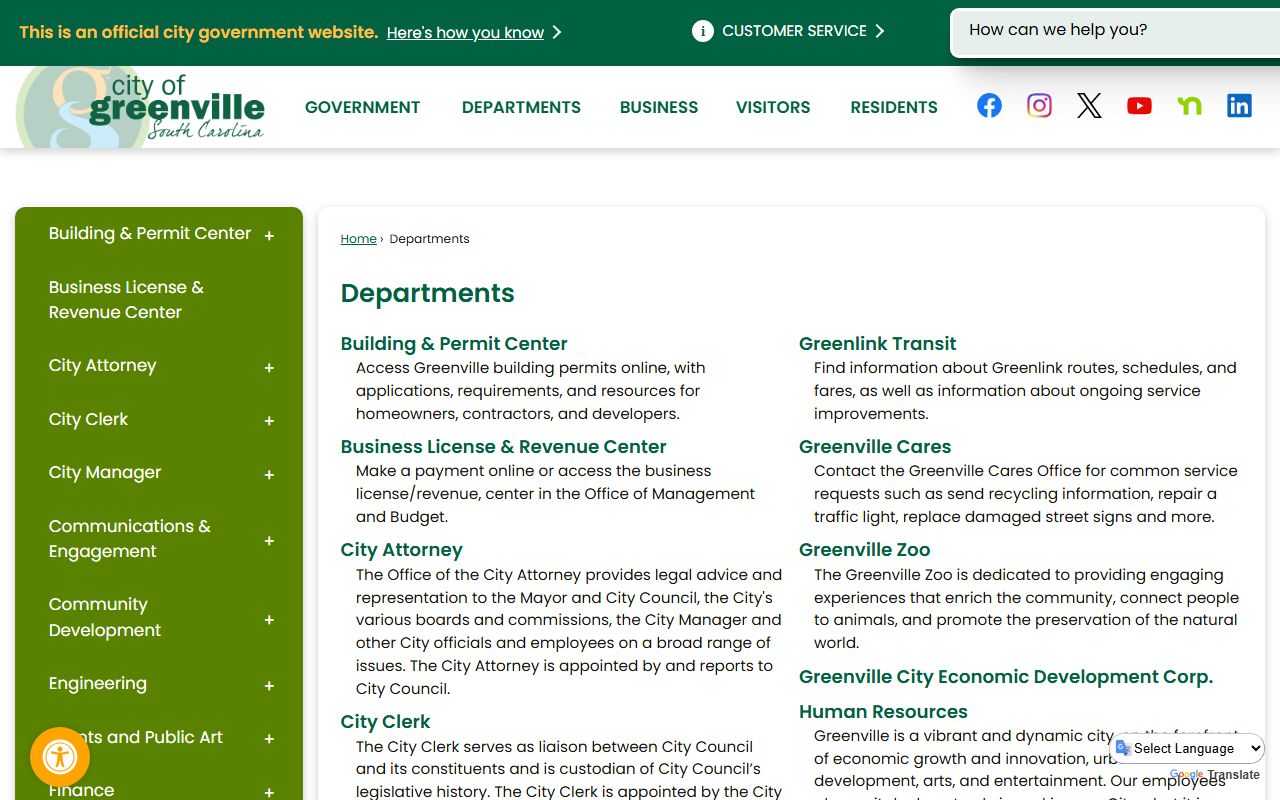
The city departments resource is useful for residents of the City of Greenville who want to understand how city services relate to their property tax obligations. City taxes and county taxes are assessed separately in Greenville County but are typically collected together on the same annual bill. Understanding both components helps property owners verify that their Greenville County tax records are complete and accurate.
Homestead Exemption in Greenville County
Greenville County property owners who qualify for South Carolina's Homestead Exemption can reduce the taxable value of their primary residence by $50,000 of fair market value. Qualifying conditions include being 65 or older, legally blind, or permanently and totally disabled. The owner must have held title to the property for at least one full year before applying.
Applications for the Homestead Exemption in Greenville County are filed with the Auditor's office. Once approved, the exemption appears in the Greenville County property tax record and reduces the bill going forward each year. The exemption is defined under Chapter 37 exemption provisions. The savings on a Greenville County property with a $200,000 fair market value can be substantial, since the taxable base at 4% drops from $8,000 to $6,000 assessed value after the $50,000 exemption is applied.
The South Carolina Association of Counties and the South Carolina Department of Revenue provide guidance on exemption eligibility and application procedures for Greenville County and all other South Carolina counties. The full statutory framework is available at Title 12.
Delinquent Property Tax Records in Greenville County
When Greenville County property taxes remain unpaid through the penalty stages, the account enters delinquent status. Under Chapter 51, the county begins the delinquency notice process on April 1. Greenville County can then proceed to a tax sale for properties with unresolved delinquent balances. The original owner has a 12-month redemption period after the sale to recover the property by paying all outstanding taxes, penalties, and costs.
Delinquent tax records in Greenville County are public and can be searched through the county. Given the size of Greenville County and the volume of parcels, the delinquent tax list represents a meaningful source of property research data. Investors and buyers sometimes review Greenville County delinquent tax records to identify properties that may be candidates for acquisition through the tax sale process.
Note: The 12-month redemption window gives original Greenville County owners a meaningful opportunity to recover their property after a tax sale. Acting within that window is critical to preserving ownership rights.
Nearby Counties
Greenville County borders several Upstate South Carolina counties. Property owners near county lines should confirm which county's records apply to their parcel.