
Myrtle Beach Property Tax Records
Myrtle Beach property tax records are maintained by Horry County, which handles all assessment and collection functions for properties within city limits. Myrtle Beach sits entirely within Horry County, home to the lowest property tax rates in all of South Carolina. Owners and researchers can access Myrtle Beach property tax records to view assessed values, current bills, and payment history through the Horry County Treasurer's online portal. The county assessor's office and treasurer are both located in Conway, a short drive from Myrtle Beach.
Myrtle Beach Property Tax Quick Facts
Why Myrtle Beach Property Tax Records Reflect Low Rates
Horry County has the lowest average effective property tax rate in South Carolina at approximately 0.35%. That figure puts Myrtle Beach property owners in an exceptionally favorable position compared to most of the country. As one observer noted, South Carolina residents enjoy property taxes that are "almost comically cheap" compared to what many paid before moving here.
The low effective rate results from several factors working together. South Carolina's 4% assessment ratio for primary residences dramatically reduces the taxable base. Full-time South Carolina residents who claim their Myrtle Beach property as a primary home benefit most from this ratio. The assessed value of a $250,000 primary residence is $10,000 — the taxable base on which millage is applied.
At the 2025 city millage of 74.50 mills, a $250,000 primary residence in Myrtle Beach produces a city-level tax contribution that, combined with county millage, results in a total annual tax of approximately $2,415. A secondary residence assessed at 6% on the same $250,000 value produces approximately $3,622 annually. The assessment ratio difference between 4% and 6% is one of the biggest drivers of tax variation among Myrtle Beach property owners.
These rates are governed by South Carolina Code Chapter 43, which establishes the 4%/6%/10.5% assessment ratio structure applied statewide.
Horry County Assessor and Myrtle Beach Tax Records
The Horry County Assessor is located at 1301 2nd Ave, Conway, SC 29526. The main phone number is (843) 915-5040. The Assessor establishes the appraised value for every Myrtle Beach parcel and assigns the correct property class — residential, commercial, agricultural, or other — that determines which assessment ratio applies.
Reassessments occur every five years as required by Chapter 43. Between reassessment years, assessed values are generally held at a capped level for properties without major changes. Myrtle Beach has seen strong real estate appreciation, meaning reassessment years can bring notable value adjustments for many property owners.
The South Carolina Department of Revenue oversees the statewide assessment framework and provides guidance to assessors on valuation standards, property classification, and compliance with the state code.
Myrtle Beach Tax Payment Portal and Treasurer Contact
The Horry County Treasurer manages collection of all property taxes for Myrtle Beach. The Treasurer's office is at 1301 2nd Ave, Ste 1C09, Conway, SC 29526. The main phone is (843) 915-5470 and the email contact is treasurer@horrycountysc.gov.
Online payments can be made through the official payment portal. The image below links to the Horry County Treasurer's payment system, which accepts payments for all Myrtle Beach and Horry County properties.
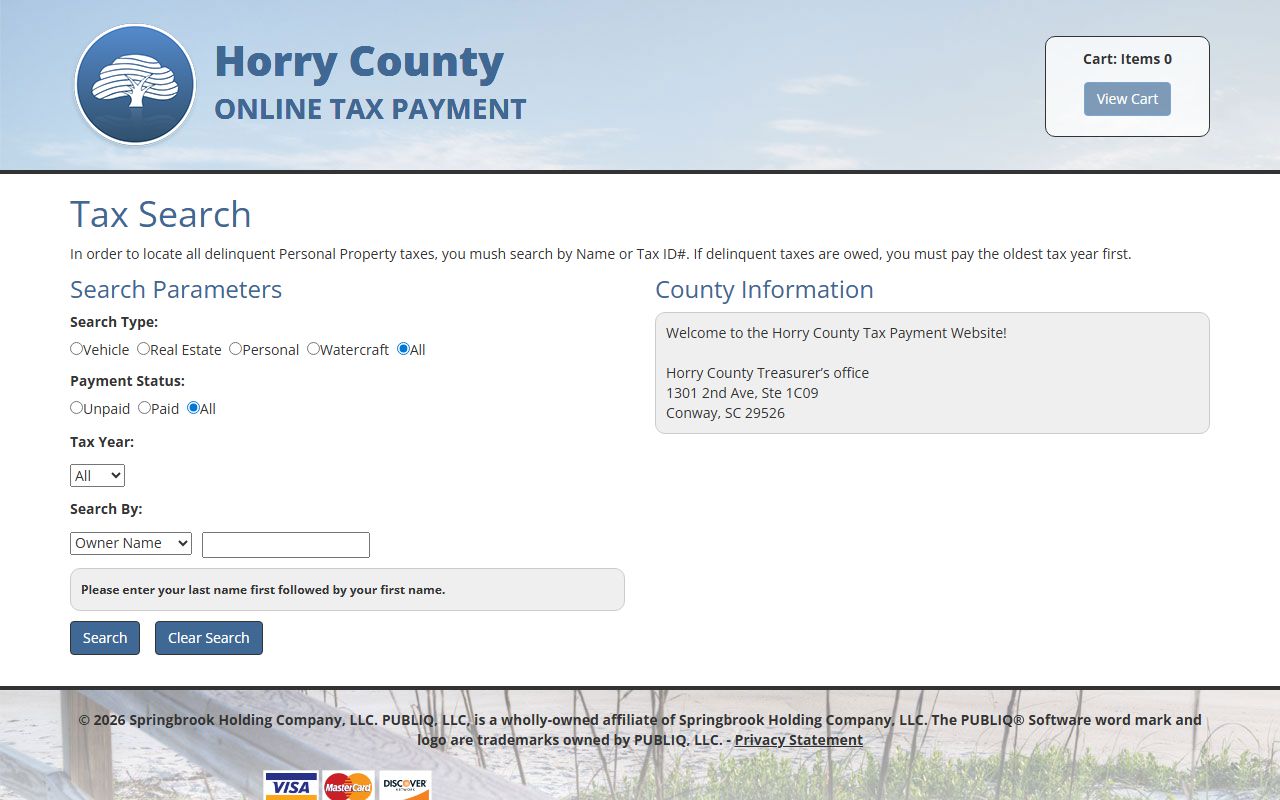
The portal at horrycountytreasurer.qpaybill.com allows property owners to search by name, parcel number, or address. Users can view current balances, review payment history, and complete payment by card or electronic check. This system is available around the clock and is the most convenient way to pay Myrtle Beach property taxes before the January 15 deadline.
Note: Payments should be completed well before January 15. Under Chapter 45, a 3% penalty applies to any unpaid balance after that date, with further penalties accumulating in subsequent months.
Myrtle Beach Property Records and Special Assessments
Myrtle Beach property tax records may include special assessment line items beyond the base county and city millage. The city has several tourism-related levies that can appear on bills depending on property type and use.
An Accommodations Tax applies to short-term rentals, consisting of a 3% local fee on top of the state-level accommodations tax. The city also imposes a Hospitality Tax on food and beverage sales. Neither of these directly affects standard residential property tax bills, but owners of vacation rentals or commercial properties need to factor both into their overall tax picture.
A Tourism Development Fee also applies in some commercial contexts within the city. The South Carolina Association of Counties and the Horry County Treasurer's office can provide current guidance on which additional assessments may apply to a specific Myrtle Beach parcel.
Short-Term Rentals and Myrtle Beach Property Tax Classification
Myrtle Beach has a substantial short-term rental market, and the property tax treatment of short-term rental properties differs from owner-occupied homes. A property used as a short-term rental is generally not eligible for the 4% owner-occupied assessment ratio. Instead, it is assessed at 6% as non-owner-occupied residential or at higher rates if classified as commercial.
The classification that Horry County applies to a Myrtle Beach property directly determines the assessment ratio and therefore the annual tax amount. Short-term rental restrictions and licensing requirements within the city may also affect how a property is classified for tax purposes. Property owners who convert a primary residence to a short-term rental should expect their assessment classification to change at the next reassessment or ownership review.
Under Chapter 37, the rules governing property classification must be applied consistently. The Horry County Assessor at (843) 915-5040 can confirm how a specific Myrtle Beach property is currently classified.
Tax Due Dates and Delinquency in Myrtle Beach
South Carolina property taxes are due January 15 under Chapter 45. The three-tier penalty structure starts with a 3% penalty on unpaid balances after that date. An additional 7% follows in February, with a further 5% in March. These penalties accumulate quickly and can significantly increase the amount owed.
Properties that remain delinquent enter the formal delinquency and tax sale process under Chapter 51. Horry County may conduct a tax sale, after which the original owner has 12 months to redeem the property by paying the full outstanding amount plus all accrued interest and costs. After the redemption window closes, the tax sale purchaser can move to obtain a deed.
Given the low base tax rates in Myrtle Beach, most property owners find the annual obligation manageable. Still, missing the January 15 deadline is easily avoided by using the online payment portal before the end of the year.
Homestead Exemption and Myrtle Beach Property Tax Reductions
Full-time Myrtle Beach residents who are 65 or older, permanently disabled, or legally blind can apply for the South Carolina Homestead Exemption. The exemption removes the first $50,000 of fair market value from the assessed tax base. Applications are filed with the Horry County Auditor.
For a $250,000 primary residence, the Homestead Exemption reduces the appraised value subject to the 4% ratio from $250,000 to $200,000. At the 4% assessment ratio, the assessed value drops from $10,000 to $8,000 — producing a meaningful reduction in the final tax bill.
The Homestead Exemption applies only to the primary residence. Vacation homes, investment properties, and short-term rentals do not qualify. Additionally, under Chapter 60, owners who dispute an exemption denial can appeal through the county process and, if needed, to the Administrative Law Court.
The Horry County Treasurer at treasurer@horrycountysc.gov can answer questions about the application process and timing for the exemption.
Horry County Property Tax Records
Horry County is the sole source of Myrtle Beach property tax records, providing all assessment, billing, and payment collection services for every parcel within the city.