
Look Up Marlboro County Property Tax Records
Marlboro County property tax records are maintained by county offices in Bennettsville, the county seat, with mailing correspondence directed to P.O. Box 62. The Assessor values all real property, the Auditor compiles the tax rolls, and the Treasurer collects payments and keeps payment records. These three offices work together to administer property taxes throughout Marlboro County. This page explains how these records are organized, the assessment ratios that apply, the payment schedule property owners must follow, and the rights available under South Carolina law.
Marlboro County Property Tax Quick Facts
Marlboro County Assessor Property Tax Records
The Marlboro County Assessor's office in Bennettsville is responsible for identifying, listing, and valuing all real property throughout the county. South Carolina law under Chapter 37 of Title 12 requires every county to maintain a full-time assessor. Marlboro County's Assessor must discover unlisted property, keep deed records current, maintain building permit data, and update tax maps as parcels change. These records form the foundation of the Marlboro County property tax system.
Each Marlboro County property tax record at the Assessor level contains a parcel identification number, the owner's name and mailing address, the property's legal description, its fair market value, its assessed value, and its classification. Classification determines which assessment ratio applies to the parcel. Under Section 12-43-220, owner-occupied residential property up to five acres is assessed at 4% of fair market value. Commercial and non-primary residential property is assessed at 6%. Manufacturing and industrial uses carry a 10.5% ratio. These ratios apply consistently across all Marlboro County property tax records.
Tax maps maintained by the Marlboro County Assessor show parcel boundaries across the county. When a property is subdivided or a new plat is recorded, the tax map is updated to reflect the change. Building permits provide another data source for updates. When a permit is issued for new construction or a significant improvement in Marlboro County, the Assessor uses that information to update the parcel's value before the next reassessment cycle.
Note: Property owners in Marlboro County who have recently purchased land or completed construction should verify with the Assessor that the correct owner name and property value are on file. Errors in Marlboro County property tax records are easiest to correct before the annual bill is generated.
Marlboro County Property Tax Assessment and Ratios
Understanding how Marlboro County property tax records translate into a tax bill requires understanding the assessment ratio system. The fair market value assigned by the Assessor is multiplied by the applicable ratio to produce the assessed value. A residential home in Marlboro County valued at $120,000 with a 4% owner-occupied ratio has an assessed value of $4,800. The combined millage rate from county, school, and other taxing districts is then applied to that $4,800 to determine the annual tax obligation.
Agricultural land is another property type with favorable treatment in the Marlboro County assessment system. Private individuals who own land used for genuine agricultural purposes qualify for the 4% ratio. Corporate-owned agricultural land is assessed at 6%. Applications for agricultural classification go through the Marlboro County Assessor, and documentation of agricultural use is required. The agricultural classification can reduce the tax burden on rural land significantly compared to the standard commercial rate.

The South Carolina Association of Counties provides resources that help property owners across all 46 counties, including Marlboro, understand how assessments work and what rights are available throughout the process. SCAC resources cover assessment ratios, appeals, exemptions, and the overall structure of the South Carolina property tax system.
Paying Marlboro County Property Taxes
Property taxes in Marlboro County are due on January 15 each year. The Marlboro County Treasurer's office in Bennettsville handles all payments and maintains the payment records for every parcel. Under Chapter 45 of the South Carolina Code, a payment mailed with a US postmark on or before January 15 is treated as timely, regardless of when it physically arrives at the Treasurer's office.
Penalties apply after the due date in stages. Beginning January 16, a 3% penalty is added to the unpaid amount. After February 2, an additional 7% penalty applies. After March 16, another 5% penalty is added. All of these penalties accumulate, so a Marlboro County property owner who delays past mid-March faces a total penalty of 15% on top of the original bill. Installment payment arrangements may be available through the Marlboro County Treasurer's office for property owners who qualify. Asking about installment options before the January 15 deadline is the most effective approach.
Under Chapter 49, property taxes are a first lien on all real property in South Carolina. This lien attaches automatically on December 31 of each year. Any review of Marlboro County property tax records for title or purchase purposes should confirm that no prior-year balances remain outstanding. The first lien priority means unpaid taxes can survive a property sale if not properly resolved before closing.
Marlboro County Delinquent Tax Records and Sales
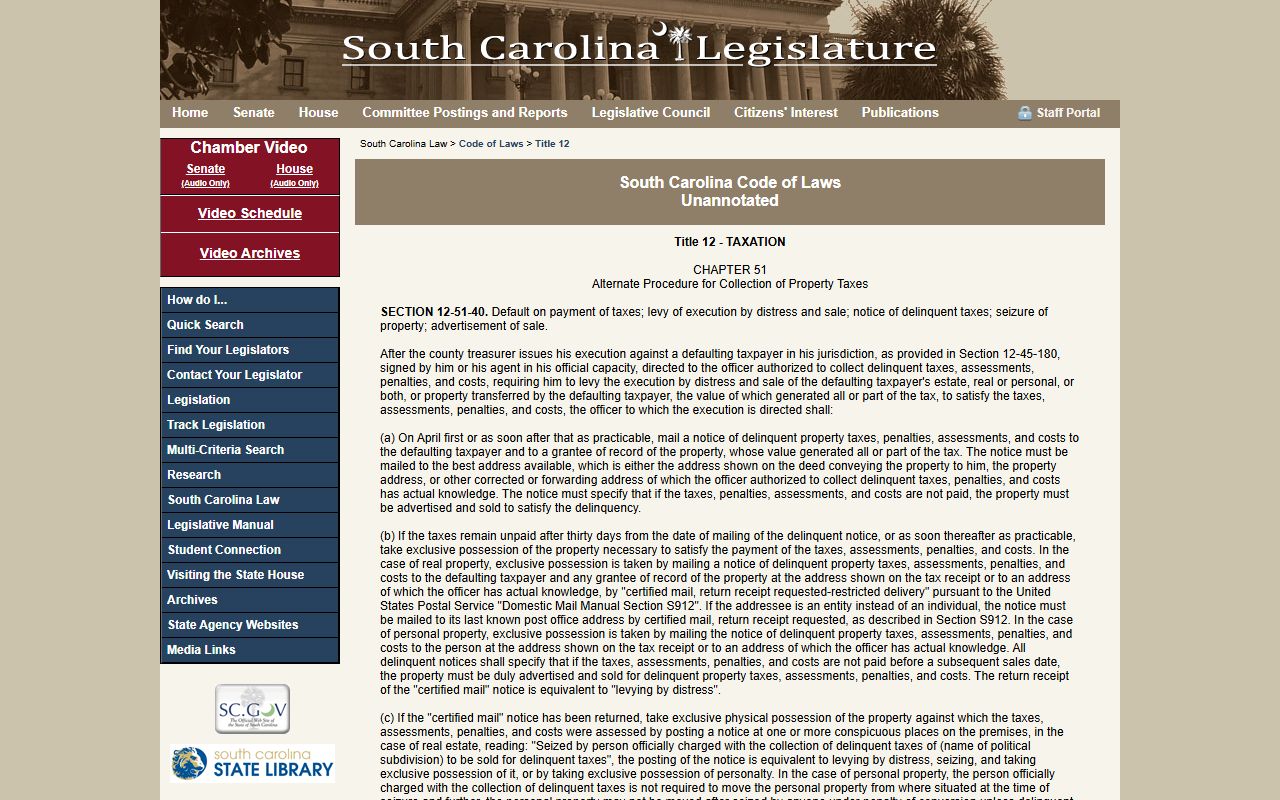
When Marlboro County property taxes go unpaid through the penalty period, the account becomes delinquent. Chapter 51 of the South Carolina Code governs this process across all counties. Marlboro County must send delinquency notices by April 1. After notice is sent, delinquent properties are advertised for three consecutive weeks. This advertising period precedes the delinquent tax sale, which allows the county to recover unpaid taxes.
Marlboro County property owners who lose property at a tax sale retain a 12-month redemption right. During this period, the original owner can recover the property by paying all outstanding taxes, penalties, and costs. The redemption addition increases quarterly: 3% for months one through three, 6% for months four through six, 9% for months seven through nine, and 12% for the final quarter. Once the 12-month window closes, the original owner loses the right to redeem and the tax sale purchaser moves toward clearing title.
Marlboro County delinquent tax records are public. Reviewing these records before purchasing real estate in Bennettsville or elsewhere in Marlboro County helps confirm that no outstanding tax obligations exist. The county Treasurer or Delinquent Tax Collector can provide current delinquency information and details on any pending tax sales.
Note: Once a Marlboro County property enters the delinquency and advertisement process, costs accumulate quickly. Acting as soon as a delinquency notice is received minimizes the total amount required to bring the account current.
Homestead Exemption in Marlboro County
South Carolina's Homestead Exemption reduces the taxable value of a primary residence for qualifying Marlboro County property owners. The exemption removes the first $50,000 of fair market value from the assessment. For a home in Marlboro County valued at $100,000, the Homestead Exemption reduces the assessable value to $50,000. The tax bill is then calculated based on that lower amount.
Marlboro County residents who are age 65 or older, legally blind, or permanently and totally disabled qualify for the exemption. The property must serve as the owner's primary residence. Holding title for at least one full year before applying is required. Applications are submitted through the Marlboro County Auditor's office in Bennettsville. Once approved, the exemption appears in the Marlboro County property tax record and reduces the annual obligation going forward.
Other exemptions are also available in Marlboro County under Chapter 37. Properties owned by qualifying churches, schools, and nonprofit organizations may be fully exempt from property taxes. Agricultural products held on farms for sale can also qualify for exemption under Chapter 37 provisions. Marlboro County property owners who believe any of these exemptions may apply should contact the Assessor or Auditor to review eligibility and begin the application process.
Five-Year Reassessment and Marlboro County Records
Marlboro County conducts a countywide property reassessment every five years, as required by Section 12-43-217. The Assessor reviews market data and updates the fair market value for every parcel in the county during the reassessment year. Property owners receive written notice when their value changes. That notice triggers the appeal window for the reassessment cycle.
Between reassessments, Marlboro County property tax records remain stable for most parcels unless a qualifying event occurs. Sales, new construction, and changes in use are the primary triggers for mid-cycle reassessment. Property owners who sell, improve, or change the use of their Marlboro County property should expect a reassessment notice. Reviewing the updated record promptly and comparing it to the prior value helps identify potential errors before they carry forward into multiple tax years.
The South Carolina Department of Revenue provides oversight for all county assessors, including Marlboro County. DOR resources and the South Carolina Code Title 12 together define the standards that Marlboro County's property tax records must meet. Property owners who have questions about reassessment methodology or want to understand how the Assessor arrived at a particular value can consult DOR guidance for additional context.
Appealing Marlboro County Property Tax Assessments
Marlboro County property owners who disagree with their assessed value can appeal under Chapter 60 of the South Carolina Code. The first step is filing a written appeal with the Marlboro County Assessor within the deadline shown on the assessment notice. The Assessor reviews the appeal and issues a determination. If the result is unsatisfactory, the property owner can proceed to the county Board of Assessment Appeals.
The Administrative Law Court is the next level of review after the county board. This court handles property tax disputes from all 46 counties and applies the procedural rules established under Chapter 60. Supporting documentation is important at every stage of the appeal process. Recent comparable sales of similar properties in Marlboro County, an independent appraisal report, and documentation of any features that the Assessor may have overvalued or missed are all useful elements of a strong appeal.
Deadlines govern every stage of the Marlboro County property tax appeal process. Missing a deadline forfeits the appeal for that tax year. Property owners should review assessment notices immediately upon receipt and consult with the Assessor's office if they have questions about the process. Filing early preserves all options for escalation if the initial review does not resolve the dispute.
Nearby Counties
Marlboro County borders several South Carolina counties where similar property tax record systems and state-mandated assessment procedures apply.