
Oconee County Property Tax Records
Oconee County property tax records are kept and managed through the Assessor, Auditor, and Treasurer offices located in the county seat of Walhalla, South Carolina. These records cover every parcel of real property in the county, including residential homes, commercial buildings, vacant land, and agricultural tracts. The Register of Deeds office, open Monday through Friday from 8:30 AM to 5:00 PM, plays a central role in keeping ownership information current. This page covers how Oconee County property tax records are created, maintained, and accessed.
Oconee County Property Tax Quick Facts
Oconee County Assessor and Property Records
The Oconee County Assessor is responsible for identifying and valuing all real property within the county. This includes maintaining detailed records for each parcel: ownership history, property description, land and building data, deed references, and tax map information. These records form the basis for generating annual property tax bills.
Under South Carolina Code Title 12, Chapter 37, county assessors must maintain current ownership data using deed recordings, building permits, and other instruments. In Oconee County, the Assessor works closely with the Register of Deeds to ensure ownership transfers are reflected promptly in assessment records.
Oconee County is located in the far northwestern corner of South Carolina, bordered by Anderson and Pickens counties to the east. The county seat, Walhalla, serves as the hub for county government operations. The region is known for its lakes, mountains, and outdoor recreation, which also shapes the nature of its real estate market and property valuations.
Note: Because Oconee County includes substantial vacation and recreational property, some parcels may carry different use designations than primary residences. Use designation affects which assessment ratio applies to your property.
Register of Deeds Hours and Oconee Property Records
The Oconee County Register of Deeds is open Monday through Friday, 8:30 AM to 5:00 PM. This office maintains the official record of all real estate transactions in Oconee County. Deeds, mortgages, plats, liens, and other documents affecting real property are recorded here.
When a property changes hands, the deed must be recorded with the Register of Deeds before the transfer is legally effective against third parties. The recorded deed then flows to the Assessor's office, triggering an ownership update in the tax records. This creates a continuous chain of title for every parcel in Oconee County.
Researchers examining a property's ownership history will find the Register of Deeds records indispensable. Historical deeds, survey plats, and other instruments recorded over decades provide a complete picture of how ownership has changed. The South Carolina Association of Counties supports county offices like Oconee's Register of Deeds in maintaining these vital public records.
Assessment Ratios for Oconee County Properties
South Carolina law sets fixed assessment ratios that apply to different classes of property. Owner-occupied residential properties, those qualifying for the legal residence designation, are assessed at 4% of fair market value. Commercial and rental properties are assessed at 6%. Manufacturing real property carries a 10.5% ratio.
These ratios determine how much of a property's fair market value is subject to taxation. The millage rate is then applied to the assessed value to calculate the tax bill. For Oconee County homeowners with the legal residence designation, the 4% ratio provides a significant advantage compared to the 6% rate for non-owner-occupied properties.
Title 12, Chapter 43 requires South Carolina counties to reassess all real property at least every five years. During a reassessment, the Oconee County Assessor reviews market data and updates fair market values for every parcel. This process ensures that assessed values reflect current conditions rather than values from many years prior.
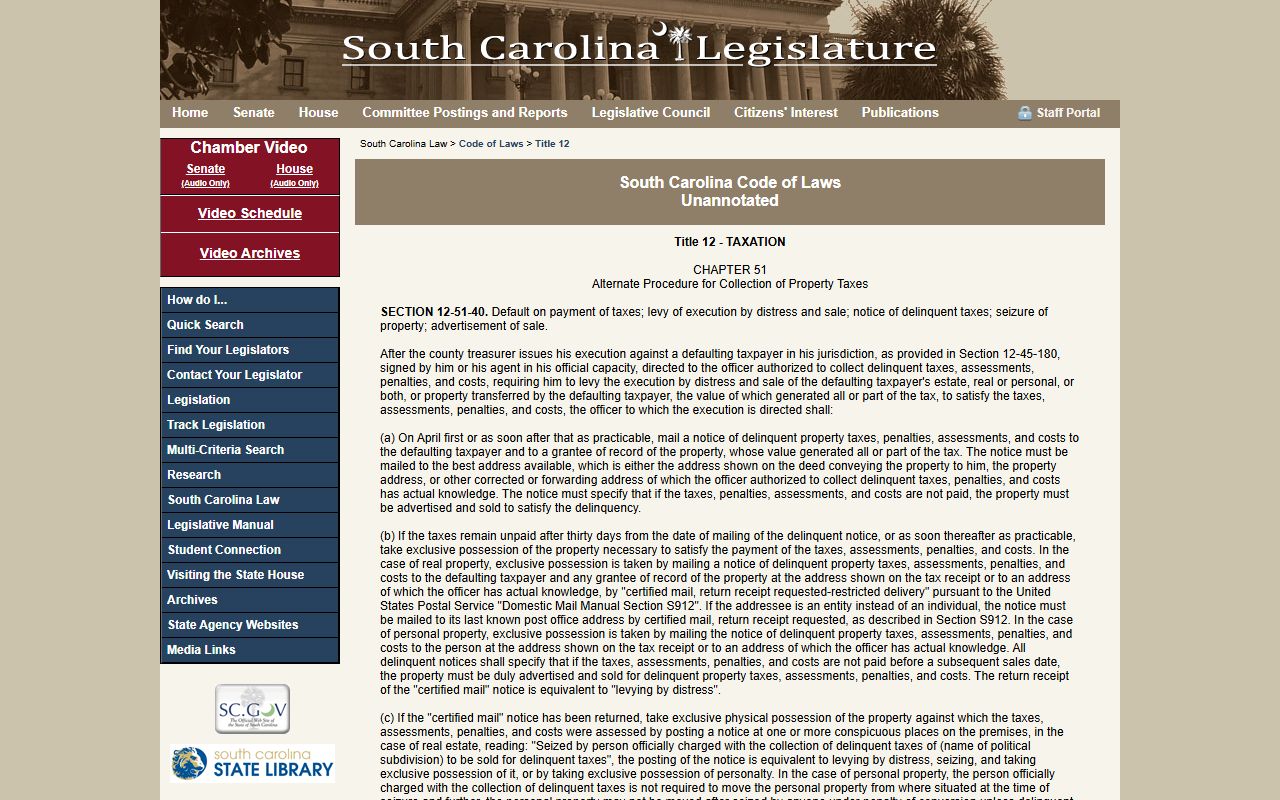
South Carolina Code Title 12, Chapter 51 governs the delinquent tax process that applies in Oconee County when property taxes go unpaid. This chapter outlines the April 1 delinquency notice, the 12-month redemption period, and the steps that follow if taxes are not paid.
Oconee County Property Tax Due Dates and Payments
Property taxes in Oconee County are due on January 15 each year. The Oconee County Treasurer's office is responsible for collecting these payments. Tax bills are typically mailed well before the deadline to give property owners adequate time to review and pay.
Payments can be made in person at the Treasurer's office during regular business hours. Mailed payments are accepted and are considered timely if they bear a US Postal Service postmark dated on or before January 15, as provided by Title 12, Chapter 45. This postmark rule benefits property owners who mail their payments close to the deadline.
Chapter 45 also establishes installment payment plans for property owners who qualify. Rather than paying the full tax bill at once, eligible owners can spread payments across multiple installments. This option provides flexibility for those managing fixed or seasonal incomes. Contact the Oconee County Treasurer's office to learn whether your property qualifies for an installment plan.
Late Payment Penalties in Oconee County
Failing to pay Oconee County property taxes by January 15 triggers a series of escalating penalties. The first penalty is 3% of the outstanding tax amount. If payment still does not arrive, a 7% penalty is added. A further 5% penalty follows after that stage.
These penalties compound the original obligation quickly. A property owner who delays payment significantly will owe substantially more than the original tax bill. The penalty structure under Chapter 45 leaves little room for procrastination.
Note: Interest and penalties on delinquent Oconee County taxes are not typically subject to waiver. The most effective way to avoid them is to pay before or on January 15 each year.
Delinquent Oconee County Tax Records
After penalties accumulate and payment is still not received, a property's tax account enters delinquent status. The Oconee County Treasurer sends a formal delinquency notice on April 1 under the process established by Title 12, Chapter 51. From that point, the property owner has 12 months to redeem the property by paying the full amount owed, including all penalties and costs.
If the redemption period expires without payment, the county may proceed with a tax sale. Delinquent tax records become public during this process and are often published in local newspapers and maintained in county records. Buyers considering properties with tax delinquencies should carefully research the redemption status before proceeding.
Under Title 12, Chapter 49, property taxes are a first lien on real estate. This lien attaches on December 31 of the tax year. Any purchase of Oconee County property should include a title search that verifies no delinquent tax liens are outstanding.

The South Carolina Association of Counties provides resources and support for Oconee County and all 46 South Carolina counties in administering property tax systems, maintaining public records, and serving county residents effectively.
Homestead Exemption for Oconee County Property Owners
The South Carolina Homestead Exemption is available to Oconee County residents who are 65 or older, legally blind, or permanently and totally disabled. Qualifying property owners receive an exemption equal to the first $50,000 of their property's fair market value, effectively reducing the assessed value used to calculate their tax bill.
Applicants must have owned and occupied the property as their primary legal residence for at least one full year before applying. Applications are filed with the Oconee County Auditor's office. Once approved, the exemption is renewed automatically each year as long as eligibility requirements are met. Property owners should notify the Auditor promptly if they no longer qualify due to a change in age, disability status, or primary residence.
Oconee County Property Assessment Appeals
Property owners in Oconee County who believe their assessed value is higher than it should be have the right to appeal. The appeal process begins with a written request to the Oconee County Assessor. The Assessor will review the basis for the value and respond with a determination.
If the Assessor's response does not satisfy the property owner, the appeal can proceed to the Oconee County Board of Assessment Appeals. This independent body reviews the evidence and issues its own ruling. Further appeal to the South Carolina Administrative Law Court is available under Title 12, Chapter 60 if the county-level process does not resolve the dispute.
Evidence matters in property tax appeals. Recent comparable sales from the Oconee County market, documentation of property condition issues, or a recent independent appraisal all support a well-reasoned appeal. The South Carolina Department of Revenue provides additional context on the statewide framework governing assessment appeals.
Nearby Counties
Oconee County borders Anderson and Pickens counties in South Carolina, each with their own property tax record systems operating under the same state framework.