
Anderson County Property Tax Records
Anderson County property tax records are publicly available through the county Assessor's office and several online platforms. Anderson County is one of the larger counties in the Upstate region of South Carolina, with a population centered around the city of Anderson. The Assessor maintains detailed records on every real property parcel, including ownership history, assessed values, tax maps, and classification data. This page covers how to search Anderson County property tax records, what the assessment ratios mean, and what to do if you need to appeal a value or manage a delinquent account.
Anderson County Property Tax Quick Facts
Anderson County Assessor and Tax Office
The Anderson County Assessor is Mike Freeman. The mailing address is P.O. Box 8002, Anderson, SC 29622. The Assessor's office can be reached by phone at 864-260-4028. The Assessor's page on the county website is at andersoncountysc.org. The Treasurer can be reached at 864-260-4033, and the Register of Deeds is at 864-260-4054.
The Assessor's page on the Anderson County website provides direct links to search tools, GIS viewers, and information about applying for special property classifications. The image below shows the Assessor's official page, which serves as the main starting point for Anderson County property tax records.
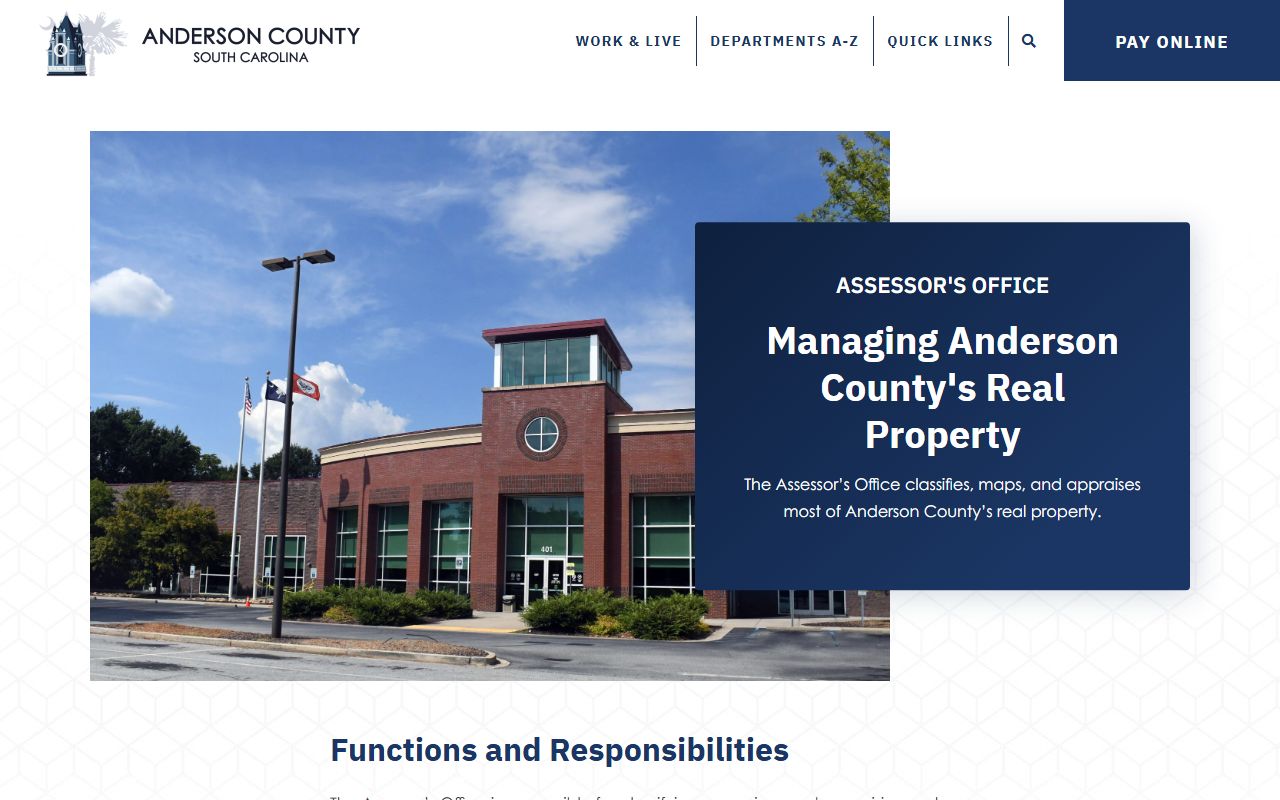
From the Assessor's page, you can navigate to the online property viewer, download forms for legal residence and agricultural classification, and find contact information for staff who can answer questions about your assessment.
The Register of Deeds keeps records of all deed transfers in Anderson County. When a property changes ownership, the deed is recorded here, and the Assessor uses that information to update the tax rolls. This coordination between offices ensures that the names on tax bills are current and that any changes in classification triggered by a sale are applied promptly.
Under SC Code 12-37-90, every county assessor in South Carolina must maintain a full inventory of real property, process building permits, keep tax maps current, and identify any unlisted property. Anderson County's Assessor follows this mandate, updating records regularly as development continues across the county.
Searching Anderson County Property Tax Records
Anderson County offers several tools for searching property tax records online. The primary tool is the Property Viewer GIS at propertyviewer.andersoncountysc.org/mapsjs. This interactive map is built with mobile access in mind, so it works on smartphones and tablets as well as desktop computers.
The Property Viewer GIS allows you to search by parcel number, road name, Tax Map Sheet (TMS) number, or street address. Once you select a parcel, the viewer displays ownership information, assessed values, and boundary lines. The system also supports E911 addressing data and road closure information, which makes it useful for emergency planning and civic research as well as tax research.
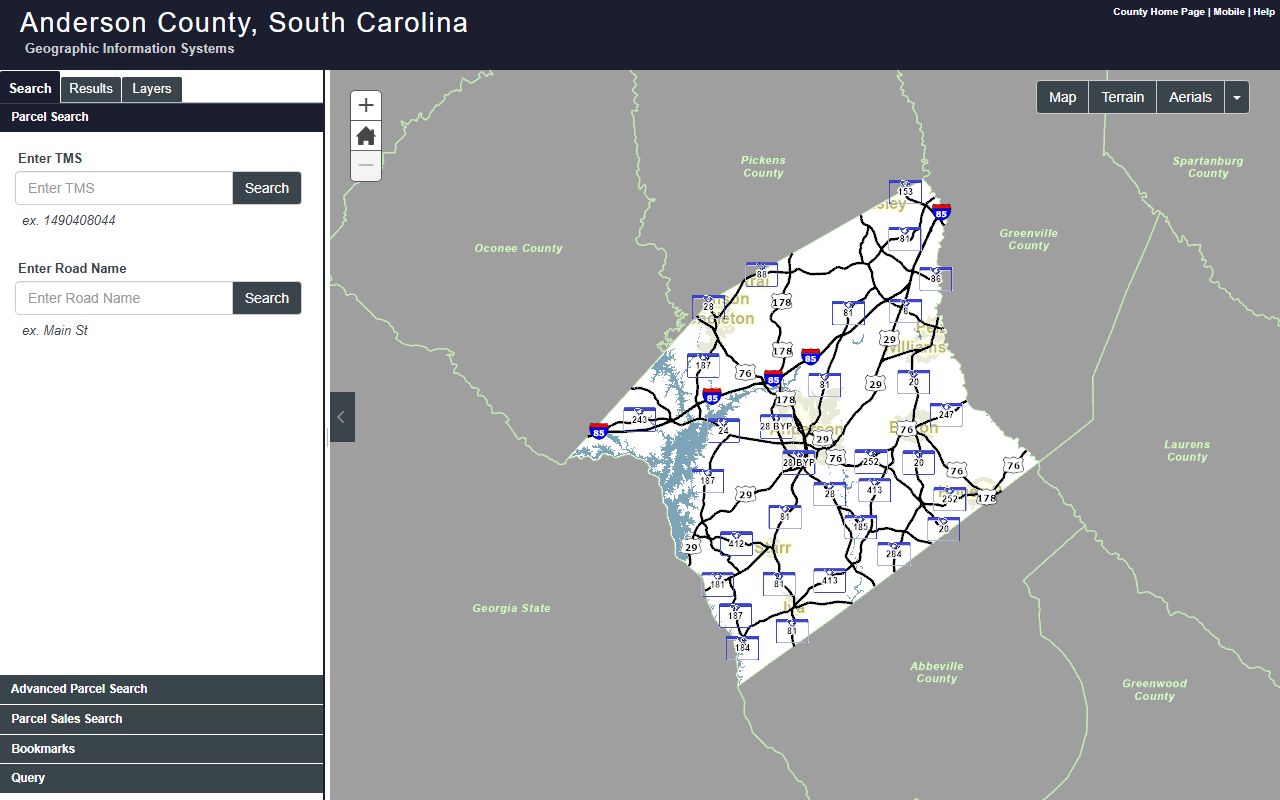
The GIS viewer is updated regularly to reflect new ownership records and assessment changes. Use the map to verify boundaries, check neighboring parcel classifications, and confirm that your property's information is recorded correctly.
For paying taxes online or looking up your current tax balance, use the ACPASS portal at acpass.andersoncountysc.org. This portal handles tax payments for real property, personal property, and vehicle taxes. You can search by owner name or account number and pay directly from the portal.
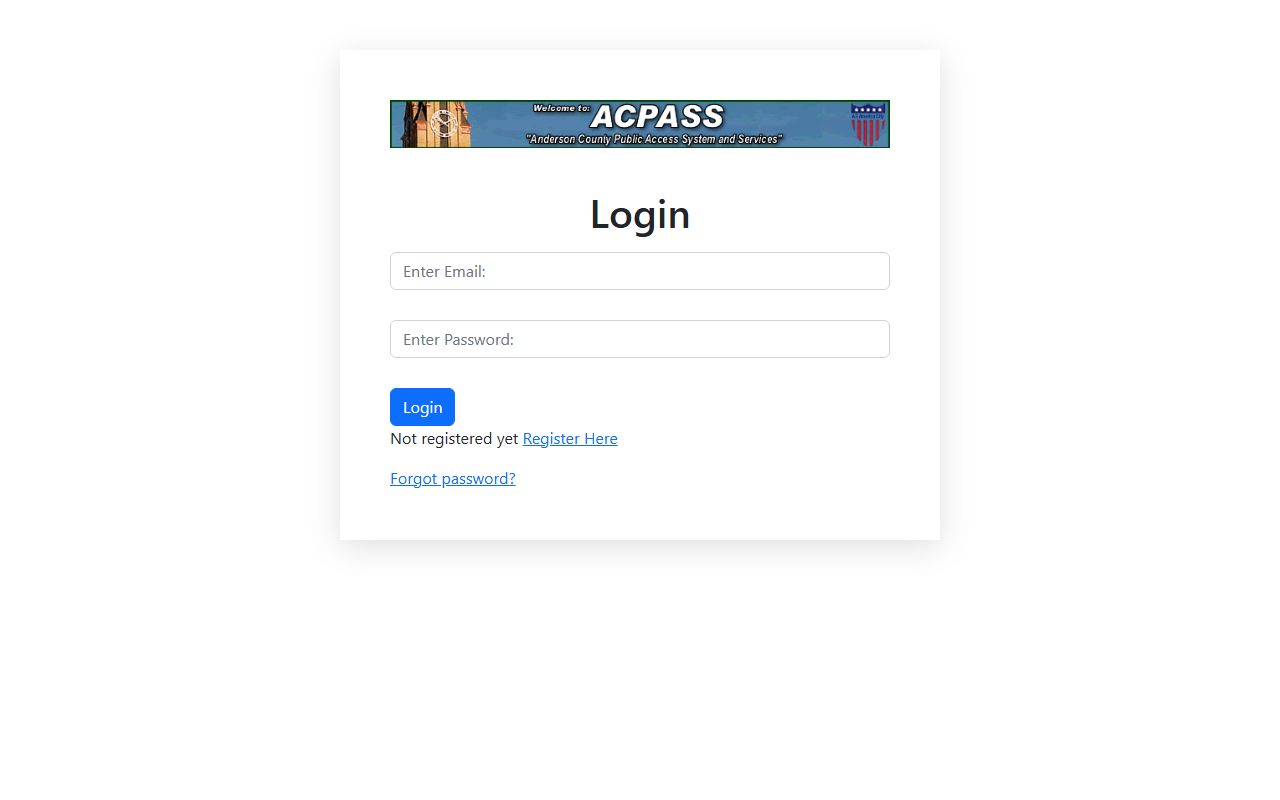
The ACPASS tax portal is available around the clock. Payments made online are processed quickly, and you will receive a confirmation that serves as your payment receipt. Keep that confirmation in case a question arises about whether or when your payment was received.
Note: GIS data in Anderson County is updated on a regular schedule. If a recent property transfer or new construction is not yet reflected in the viewer, allow a few weeks for the records to be processed and updated.
Anderson County Property Tax Assessment Ratios
Property in Anderson County is assessed at a percentage of its fair market value. That percentage depends on how the property is used. The rates are set by SC Code 12-43-220 and are the same across all 46 South Carolina counties.
Owner-occupied homes with five acres or less are assessed at 4%. To get this rate, you must apply for the legal residence classification with the Assessor's office and certify that the home is your primary residence. Agricultural land owned by private individuals is also assessed at 4%. Second homes, commercial properties, and agricultural land owned by corporations are all assessed at 6%. Manufacturing property is assessed at 10.5%, the highest ratio in the state classification system.
The difference between the 4% and 6% rates is significant. On a home with a fair market value of $200,000, the legal residence classification reduces taxable value from $12,000 to $8,000. That reduction directly lowers your annual tax bill. Applying for the classification is free, and it only needs to be done once unless your circumstances change.
Exemptions for Anderson County Property Owners
Anderson County residents may qualify for several property tax exemptions under South Carolina law. The Homestead Exemption is the most commonly used. It removes the first $50,000 of fair market value from taxation. You must be 65 or older, totally and permanently disabled, or legally blind to qualify. You must also have held title to the property and been a South Carolina resident for at least one year. Applications are processed by the Auditor's office, not the Assessor.
Other exemptions under SC Code 12-37-220 include property owned by churches and religious organizations, schools, and qualifying nonprofits. Household goods and certain agricultural products are also exempt. If you believe your property should be receiving an exemption that is not currently applied, contact the Assessor or Auditor to review your account. Exemptions that are not properly applied can result in overpayment of taxes over several years.
Anderson County Property Tax Payments and Deadlines
Taxes are due January 15 each year. Pay on time to avoid penalties.
Penalties in Anderson County follow the schedule set by SC Code 12-45-70. A 3% penalty applies from January 16 through February 1. The penalty increases to 7% between February 2 and March 15, and an additional 5% is added after March 16. Accounts still unpaid after March 16 are referred to the delinquent tax process.
Anderson County offers multiple payment methods. The ACPASS online portal at acpass.andersoncountysc.org is available 24 hours a day. You can also pay in person at the Treasurer's office during business hours. Mail payments are accepted, and under SC Code 12-45-180, the US postmark date determines whether your payment arrived on time. Installment payment plans are available under SC Code 12-45-75 for those who qualify.
Anderson County Reassessment Cycle and Property Appeals
Anderson County reassesses all real property every five years. This requirement comes from SC Code 12-43-217. The goal is to keep assessed values aligned with the current real estate market. Between reassessment years, values are generally held at the prior certified level unless a specific event triggers a change.
Events that can trigger an updated value between reassessment cycles include a property sale, completion of new construction, addition of an outbuilding, or discovery of a prior error. When any of these changes results in an increase in assessed value of more than $1,000, the Assessor sends a formal assessment notice to the property owner. That notice includes the new value, the reason for the change, and the deadline for filing an appeal.
Appeals must be filed by the date on the assessment notice. Missing that date generally means you cannot challenge the value until the next reassessment cycle. If you believe the Assessor's value is too high, start by contacting the office informally to discuss the data behind the valuation. Comparable sales in your area, recent appraisals, and documented physical conditions of the property are all useful in making your case. Unresolved disputes can be escalated to the county Board of Assessment Appeals and ultimately to the Administrative Law Court under SC Code Chapter 60.
The SC Association of Counties provides general guidance on how property tax administration works across the state, which can help you understand your rights and options during an appeal.
Delinquent Taxes in Anderson County
When taxes remain unpaid after the penalty deadlines, the account becomes delinquent. Under SC Code 12-51-40, a delinquency notice is sent by April 1. If the taxes are still not paid after that, the county publishes notice of the tax sale in a local newspaper for three consecutive weeks before the sale is held.
Under SC Code 12-49, property taxes are a first lien on all real estate. The lien attaches on December 31 for the taxes billed the following year. This means anyone buying property in Anderson County takes it subject to any unpaid tax liens that exist as of that date.
After a tax sale, the original owner has twelve months to redeem the property. Under SC Code 12-51-90, the redemption cost includes the delinquent taxes plus interest that accrues at 3% per quarter. Redeeming in the first quarter costs the least. Waiting until the fourth quarter means paying 12% interest on top of the taxes owed. Contact the Tax Collector's office as soon as possible if you are trying to redeem a property after a tax sale.
Nearby Counties
Property tax records are also available for counties that share a border with Anderson County.