
Anderson SC Property Tax Records
Anderson property tax records are administered by Anderson County, which covers all parcels within the City of Anderson and throughout the county. The Anderson County Assessor establishes fair market values, the County Auditor prepares tax bills, and the County Treasurer collects payments. Anderson is the county seat of Anderson County and sits at the heart of South Carolina's Upstate region. Three separate online tools give Anderson property owners convenient ways to search records, view parcel maps, and pay taxes. This guide walks through how to use each resource and explains the assessment, exemption, and payment rules that apply to Anderson properties.
Anderson Property Tax Quick Facts
Anderson County Tax Offices and Contact Information
Three Anderson County offices work together to administer property taxes for every parcel in Anderson city and the surrounding county. The Anderson County Assessor at (864) 260-4028 determines fair market value for each parcel. The County Auditor at (864) 260-4027 applies the correct assessment ratio and any exemptions to calculate taxable value. The County Treasurer at (864) 260-4033 issues the bill and collects payment. Anderson City Hall is located at 401 Main St, Anderson, SC 29624, and can direct residents to county offices for property tax questions.
Anderson County belongs to the Greenville-Anderson metropolitan area in South Carolina's Upstate region. The county has a strong manufacturing and industrial base alongside a large residential population. That mix means the Anderson County tax rolls include single-family homes, commercial storefronts, office parks, and manufacturing facilities, each subject to a different assessment ratio. Residents and investors searching Anderson property tax records should know which category applies to their parcel before interpreting the assessed value shown online.
The South Carolina Department of Revenue sets the statewide framework for property tax administration. Anderson County follows all SCDOR guidelines while also applying its own locally adopted millage rates. The combined rate on an Anderson city property includes the county general fund, the school district, and any city millage levied by the City of Anderson.
Note: Anderson County's effective tax rate of approximately 0.59% sits above the statewide average for South Carolina, partly reflecting the higher millage needed to fund services in a full-service urban county seat.
Anderson County Assessor Records and Property Values
The Anderson County Assessor website at andersoncountysc.org is where Anderson city property values and official parcel records are maintained for every property in the county.

The assessor office is responsible for valuing every Anderson parcel during each five-year countywide reassessment and handles owner appeals of those values throughout the year.
The Anderson County Assessor publishes fair market values, assessment histories, and ownership information for Anderson properties. Owners can search by parcel number, street address, or owner name. The assessor page also explains how to file an appeal if the assessed value appears inconsistent with actual market conditions. Under S.C. Code Ann. Title 12, Chapter 43, the assessor must complete a countywide reassessment every five years, with the most recent Anderson County reassessment year reflected in current bills.
Anderson property owners who purchased their home recently may see a value that differs significantly from the previous owner's assessed value. South Carolina's assessment cap limits annual increases for established owners but allows the assessor to update the value to the purchase price when the property changes hands. New purchasers should review their first tax bill carefully and contact the assessor at (864) 260-4028 if the assessed value appears inconsistent with the purchase price.
Anderson County GIS Parcel Viewer
The Anderson County GIS property viewer at propertyviewer.andersoncountysc.org is an interactive map tool that lets users explore Anderson city parcels with aerial imagery and property boundary overlays.
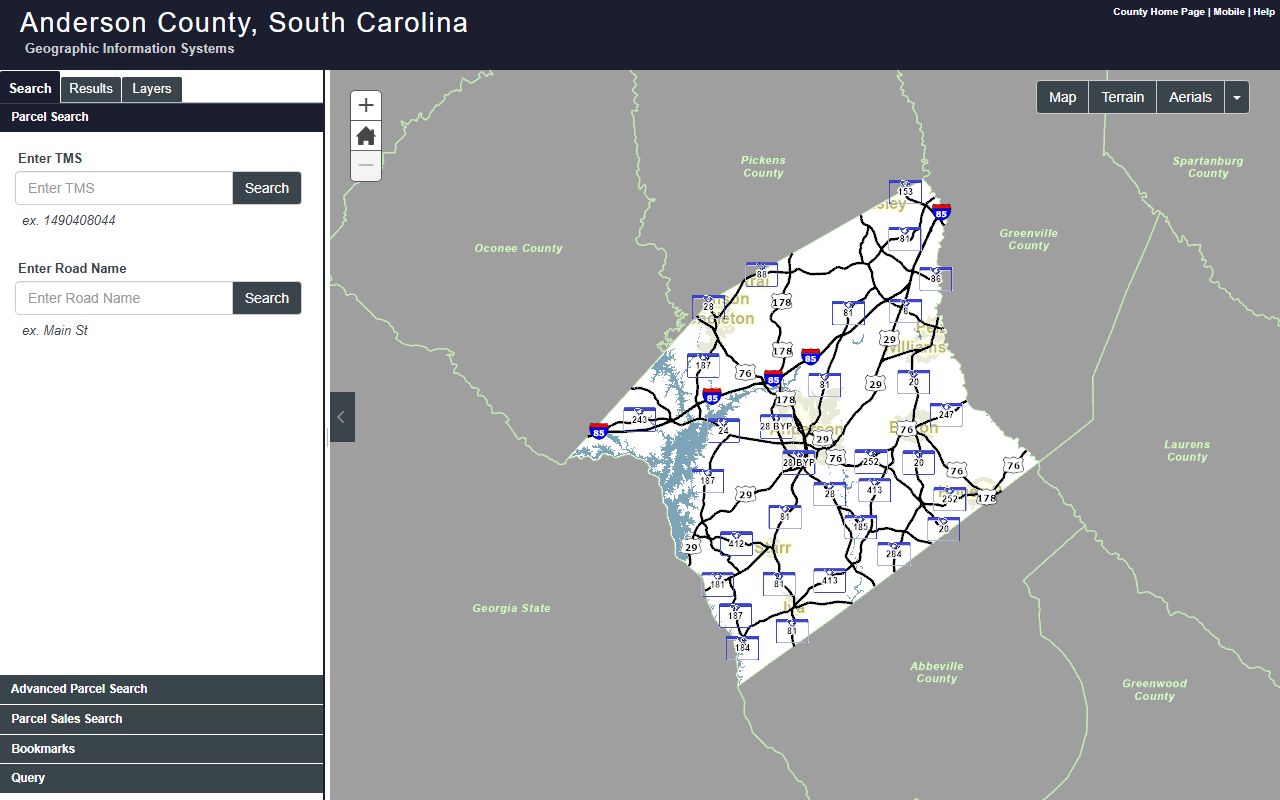
The GIS viewer displays parcel boundaries, acreage, land use codes, and ownership information for Anderson city properties, making it easy to identify neighboring parcels and verify lot dimensions.
Using the Anderson County GIS viewer, owners and researchers can click directly on any parcel within the city to pull up basic record data. The viewer links to the county's property database, so a single click on an Anderson address reveals the parcel ID, current assessed value, land area, and zoning class. Real estate professionals use the GIS viewer to research comparable sales in Anderson neighborhoods. Appraisers use it to verify lot lines before a physical inspection. The tool is free and requires no login.
The GIS viewer covers all parcels countywide, not just those inside Anderson city limits. This matters for owners of property that straddles the city boundary or for those who want to compare Anderson city parcels with similar properties in adjacent unincorporated areas. Parcels outside city limits do not carry city millage, which can make a meaningful difference in the total tax bill.
ACPASS Portal for Anderson Property Tax Search
The ACPASS portal at acpass.andersoncountysc.org is where Anderson property owners can search records, view tax bills, and pay taxes online in one place.
ACPASS provides access to Anderson County's full property tax database, including assessed values, bill amounts, payment history, and owner information for every parcel in the county.
ACPASS stands for Anderson County Public Access System. The portal provides the most comprehensive property tax search experience of the three online tools available for Anderson. Owners can pull up a complete bill, view itemized millage breakdowns that show how much goes to the county, the school district, and the city, and submit payment electronically. The portal also maintains payment history, which is useful when owners need to verify that a prior-year payment was received or when a mortgage lender requests tax payment confirmation.
To use ACPASS effectively, Anderson property owners should have their parcel number on hand. The parcel number appears on previous tax bills and can be retrieved from the county assessor's website or the GIS viewer. Searching by owner name or address also works but may return multiple results for common names or large properties with several separate parcel records. The South Carolina Association of Counties recognizes Anderson County's ACPASS system as a strong example of online property record access in South Carolina.
Note: ACPASS is the preferred method for paying Anderson property taxes online because it connects directly to the county treasurer's payment system and posts credits to the parcel record the same day.
Anderson Property Assessment Ratios and Exemptions
South Carolina sets assessment ratios by property use under S.C. Code Ann. Title 12, Chapter 43. Owner-occupied primary residences in Anderson are assessed at 4% of fair market value. A home valued at $200,000 would carry an assessed value of $8,000. Non-primary residential properties, commercial buildings, and rental homes are assessed at 6%, producing an assessed value of $12,000 on that same $200,000 property. Anderson's manufacturing sector means a meaningful share of county parcels fall under the 10.5% industrial assessment ratio.
The 4% Legal Residence exemption is applied by the Anderson County Auditor after the owner submits the appropriate form confirming that the property is their primary residence. Anderson property owners who recently moved to the city should apply as soon as they establish residency. The lower 4% ratio produces a substantially smaller tax bill compared to the default 6% rate, and the difference compounds over years of ownership.
South Carolina's Homestead Exemption under S.C. Code Ann. Title 12, Chapter 37 removes the first $50,000 of fair market value from taxation for Anderson owners who are 65 or older, permanently disabled, or legally blind. The application is filed with the Anderson County Auditor. Owners who qualify for both the 4% rate and the Homestead Exemption receive the maximum available reduction in their Anderson property tax bill.
Anderson Property Tax Due Dates and Penalties
Anderson County property tax bills are due January 15 each year. Paying on time avoids all penalties. A 3% penalty is assessed on any balance remaining after January 16 under S.C. Code Ann. Title 12, Chapter 51. An additional 7% penalty attaches after February 2. A further 5% penalty follows after March 16. The three penalties accumulate, so a bill that remains unpaid through mid-March carries a total penalty of 15% over the original amount.
A tax lien attaches to each Anderson parcel on December 31 of the year in which taxes become delinquent. The lien is a public record and can complicate any attempt to sell or refinance the property until resolved. Anderson property owners who anticipate difficulty paying by January 15 should contact the County Treasurer at (864) 260-4033 to discuss their options before the penalty clock starts running.
Properties sold at tax sale are subject to a 12-month redemption period. The original owner can reclaim the property during that window by paying the full delinquent amount plus quarterly interest that starts at 3% and can reach 12% for a full year. Anderson's active real estate market means tax sales draw competitive bidders, so owners facing delinquency should treat the January 15 deadline seriously.
Nearby Cities
Property owners and researchers near Anderson may also need records from other Upstate South Carolina communities in the Greenville-Anderson metro area.
Parent County
Property taxes in Anderson are administered by Anderson County. The county assessor, auditor, and treasurer handle valuation, billing, and collection for all properties within Anderson.