
Hilton Head Island Property Tax Records Search
Hilton Head Island property tax records are maintained by Beaufort County and cover every parcel on the island, from oceanfront resort properties to interior residential lots. The Beaufort County Assessor values each parcel, the County Auditor prepares the tax bill, and the Beaufort County Treasurer collects payment. Because Hilton Head Island draws a large number of vacation home owners and investors, many parcels carry a 6% commercial or second-home assessment ratio rather than the 4% owner-occupied rate. Searching for Hilton Head Island property tax records helps owners confirm their assessed value, verify exemptions, and track payment history.
Hilton Head Island Property Tax Quick Facts
How Beaufort County Taxes Hilton Head Island Properties
Three Beaufort County offices divide the property tax work for Hilton Head Island. The Beaufort County Assessor, reachable at (843) 255-2400, determines the fair market value of each parcel. The County Auditor at (843) 255-2500 applies the correct assessment ratio and subtracts any qualified exemptions to arrive at a taxable value. The Beaufort County Treasurer at (843) 255-2600 issues bills and collects payment. All three offices work together to administer the tax cycle for Hilton Head Island from January through the following January 15 due date.
The Town of Hilton Head Island incorporated in 1983 and became one of the first planned municipalities in South Carolina. Town millage is added on top of the Beaufort County base rate, and school district millage is layered on as well. Owners inside the town limits therefore pay a combined rate that reflects county, town, and school charges. Properties in the unincorporated portions of Beaufort County near the island may carry a different rate. Confirming which jurisdiction applies is an important first step when reading any Hilton Head Island property tax bill.
Beaufort County uses a PIN number system to identify each parcel rather than the TMS codes common elsewhere in South Carolina. The PIN appears on every bill, and owners should use it when searching records, making payments through myBeaufortCounty, or contacting county offices. Town Hall for Hilton Head Island is located at 1 Town Center Court, Hilton Head Island, SC 29928, and can assist with questions about local millage. The South Carolina Department of Revenue sets statewide property tax policy but does not collect local taxes directly.
Note: Beaufort County's effective tax rate on Hilton Head Island properties is among the lowest in South Carolina largely because very high property values spread the same levy across a broader base.
Hilton Head Island Assessment Ratios and Classification
South Carolina law sets assessment ratios that determine what share of fair market value is taxed. Under S.C. Code Ann. Title 12, Chapter 43, a primary residence occupied by its owner qualifies for a 4% assessment ratio. That means a home valued at $800,000 has a taxable assessed value of $32,000 before millage is applied. Vacation homes, rental properties, and commercial parcels are assessed at 6%, which raises the taxable base by 50% compared to the owner-occupied rate.
Hilton Head Island carries a particularly large share of 6% properties. Many parcels in Sea Pines, Palmetto Dunes, Port Royal, Shipyard, and other plantation communities are owned by non-residents who use them seasonally or rent them to visitors. Those owners pay the higher 6% ratio and are not eligible for the 4% Legal Residence exemption unless they establish the property as their primary residence and apply with the Beaufort County Auditor. Manufacturing and industrial real estate carries a 10.5% ratio under Chapter 43, though that category is rare on Hilton Head Island.
Applying for the 4% Legal Residence rate requires filing the appropriate form with the Beaufort County Auditor before the applicable tax year closes. Once approved, the lower ratio stays in place until the property's use or ownership changes. Owners who recently purchased a Hilton Head Island home as a primary residence should confirm that the 4% rate appears on the next tax bill.
Beaufort County Assessor Records for Hilton Head Parcels
The Beaufort County Assessor website at beaufortcountysc.gov/assessor is the central hub for Hilton Head Island property records. The assessor publishes parcel data, fair market values, and assessment histories. Owners can search by PIN number, street address, or owner name. The site also explains the appeal process for owners who believe their assessed value does not reflect actual market conditions.
The Beaufort County Assessor website at beaufortcountysc.gov/assessor/index.html is where Hilton Head Island property records and fair market values are maintained for every parcel on the island.
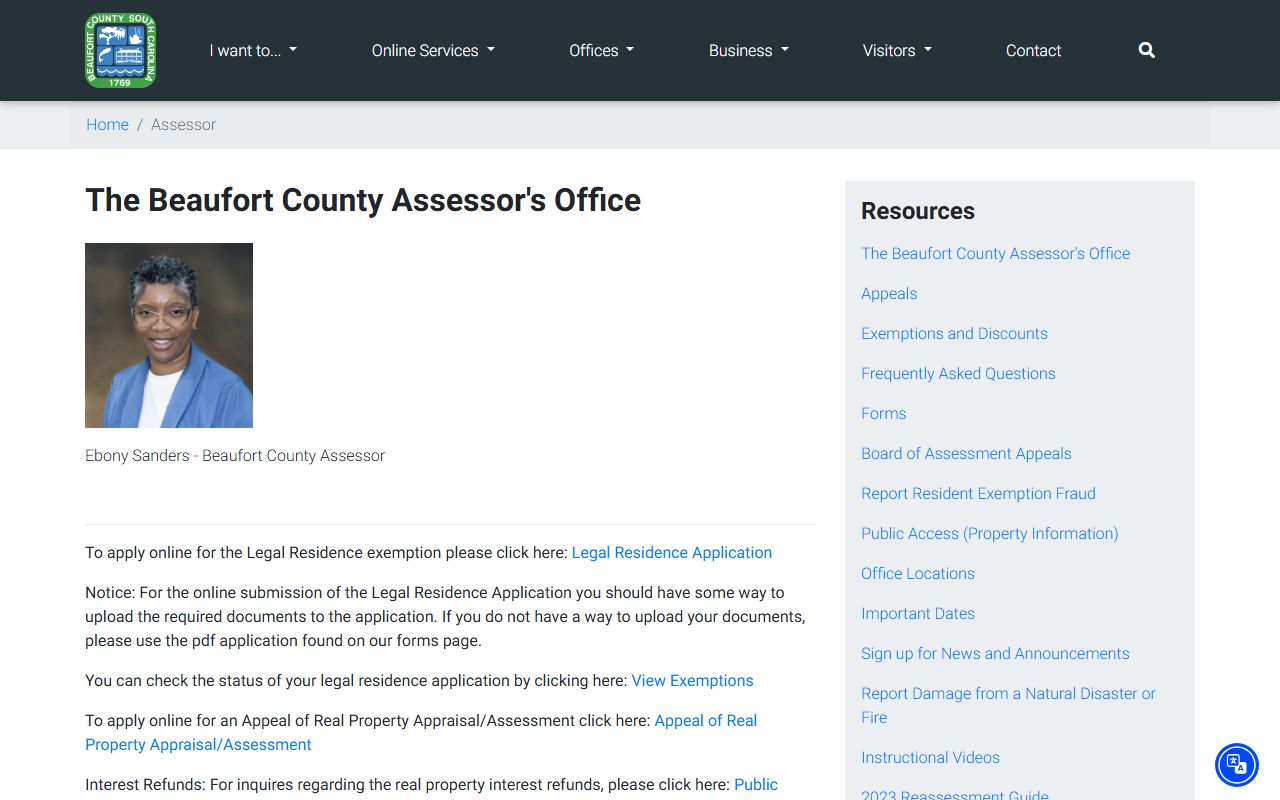
The assessor office is responsible for valuing every Hilton Head Island parcel during each countywide reassessment and handles owner appeals of those values.
Beaufort County completes a full reassessment every five years as required by S.C. Code Ann. Section 12-43-217. Between reassessment cycles, the assessor may adjust values only for new construction, change of ownership, or appeal outcomes. The five-year cycle keeps assessed values from drifting too far from true market prices, which matter especially on Hilton Head Island where the resort real estate market can shift rapidly.
Hilton Head Island Town Finance and Local Tax Resources
The Hilton Head Island Finance and Tax page at hiltonheadislandsc.gov offers residents and property owners a direct view into local tax information maintained by the town.
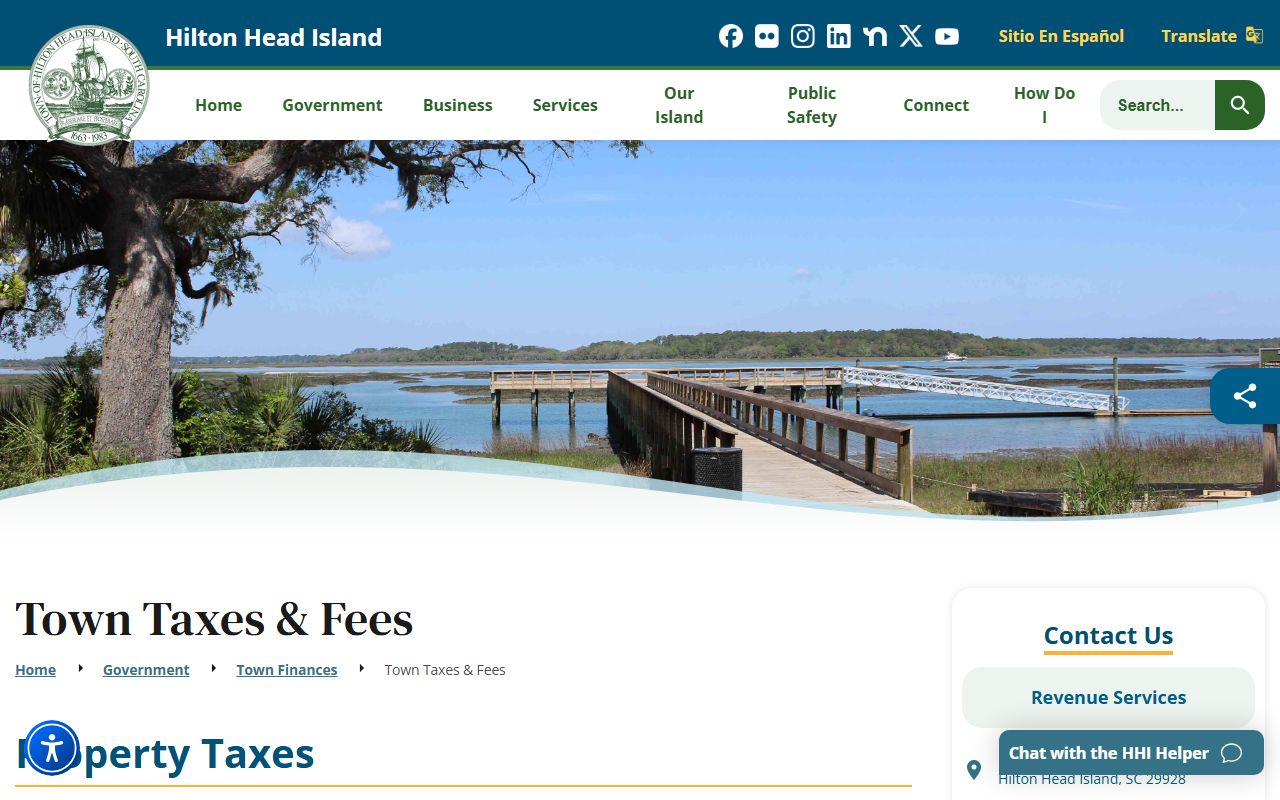
The town finance page explains how local millage is set each year, what services it funds, and where property owners can direct questions about town-specific charges on their Hilton Head Island tax bill.
The Town of Hilton Head Island does not administer property tax assessment or collection. Those functions rest entirely with Beaufort County. However, the town sets its own millage rate annually through the budget process, and that rate appears as a line item on the county-issued tax bill. Questions about town millage, stormwater fees, or other local charges should go to town finance staff rather than to the county offices.
Owners of short-term rental properties on Hilton Head Island should also be aware of the local Accommodations Tax and Hospitality Tax, which are separate from the annual property tax bill. These charges apply to rental income rather than to assessed value. The South Carolina Association of Counties publishes resources that compare how different counties administer these supplemental levies.
Paying Hilton Head Island Property Taxes
Beaufort County property tax bills are due January 15 each year under S.C. Code Ann. Title 12, Chapter 51. A 3% penalty applies to amounts unpaid after January 16. An additional 7% penalty attaches after February 2, and a further 5% penalty follows after March 16. Penalties stack, so owners who miss multiple deadlines face a compounding cost.
The myBeaufortCounty portal accepts online payments by credit card and electronic check. Owners can look up balances, print receipts, and view payment history using the parcel PIN. In-person payments are accepted at the Beaufort County Treasurer's Office. Mail-in payments must be postmarked by January 15 to avoid penalties. Mortgage lenders who escrow taxes will pay directly to the county; owners should verify their lender has the correct PIN on file to prevent misapplication of payment.
Note: A tax lien attaches to each Hilton Head Island property on December 31 if taxes for that year remain unpaid, which can affect refinancing and sale transactions.
Homestead Exemption for Hilton Head Island Owners
South Carolina's Homestead Exemption removes the first $50,000 of fair market value from taxation for eligible owners. Qualifying residents must be 65 or older, permanently disabled, or legally blind and must occupy the property as their primary residence. The exemption is applied by the Beaufort County Auditor after the owner files an application. On Hilton Head Island, where property values routinely exceed $1 million, the $50,000 exemption provides modest but meaningful relief for year-round residents who qualify.
The exemption under S.C. Code Ann. Title 12, Chapter 37 is separate from the 4% Legal Residence rate. An owner can qualify for both: the 4% rate on the full assessed value and the $50,000 exemption stacked on top. Owners who become eligible mid-year should apply promptly with the county auditor because the exemption takes effect for the following tax year.
Tax Sale and Redemption on Hilton Head Island
Properties with delinquent taxes are subject to a tax sale conducted by the Beaufort County Treasurer. After a tax sale, the original owner retains a 12-month redemption period under S.C. Code Ann. Title 12, Chapter 51. Redemption requires paying the full delinquent amount plus interest that accrues at 3% per quarter, reaching 12% for a full year. Hilton Head Island's high property values make tax sales relatively rare but not unheard of, particularly for investment properties whose owners are not monitoring their tax bills closely.
Owners who receive a notice of pending tax sale should contact the Beaufort County Treasurer immediately. The treasurer's office at (843) 255-2600 can confirm the exact amount needed to cure the delinquency and stop the sale. Acting before the sale date is far simpler than pursuing redemption after the fact. The Chapter 51 statutes govern the full process from delinquency notice through deed issuance to the tax sale purchaser.
Nearby Cities
Property owners and researchers near Hilton Head Island may also need records from surrounding coastal and Lowcountry communities.
Parent County
Property taxes in Hilton Head Island are administered by Beaufort County. The county assessor, auditor, and treasurer handle valuation, billing, and collection for all properties within Hilton Head Island.