
Clarendon County Property Tax Records
Clarendon County property tax records are maintained by the Assessor's Office at 411 Sunset Drive in Manning, South Carolina. The office keeps detailed data on every parcel in the county, including ownership history, assessed values, and tax map information. Whether you need to verify a tax balance, research a deed, or review an exemption, these records are available to the public. This page explains how to find and use Clarendon County property tax records and what rules apply under South Carolina law.
Clarendon County Property Tax Quick Facts
Clarendon County Assessor Property Records
The Clarendon County Assessor's Office is the primary source for property tax records in the county. Located at 411 Sunset Drive in Manning, the office is responsible for appraising all real property, maintaining tax maps, and processing ownership transfers as recorded deeds come in. Under South Carolina Code Title 12, Chapter 37, every county in the state must employ a full-time assessor. That assessor keeps deed records, building permits, and tax maps current throughout the year.
Property valuations in Clarendon County are based on fair market value as of December 31 each year. Taxes are then levied on October 1 of the following year using those December 31 values. This cycle means your tax bill reflects conditions from the prior year-end, not the current date. Knowing this timeline helps property owners understand when their value was last set and whether a recent sale or improvement would affect their next bill.
The Assessor also handles applications for the 4% legal residence exemption, agricultural use classifications, and other special assessments. These applications have strict deadlines, and missing them typically means waiting until the next tax year. Contact the office directly at 411 Sunset Drive, Manning, SC 29102, for specific filing windows.
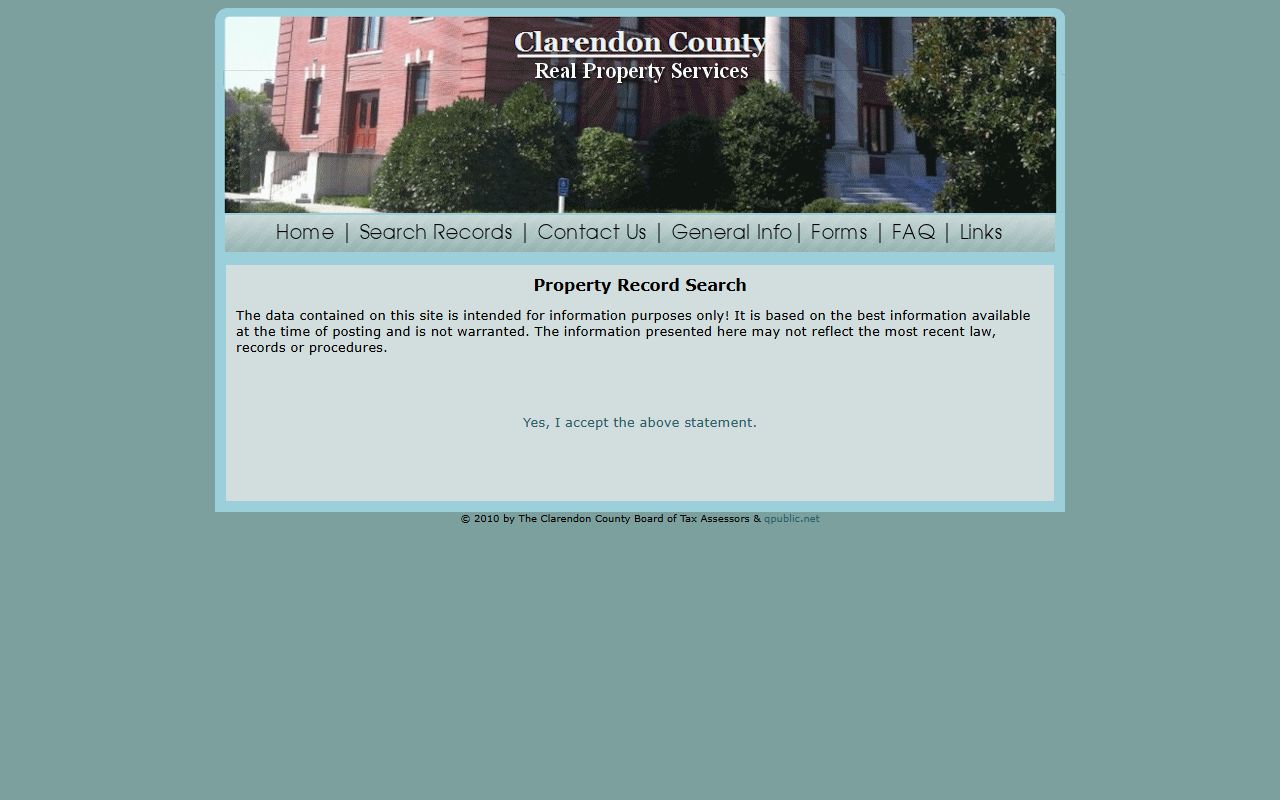
The QPublic portal above lets you search Clarendon County property tax records by owner name, parcel number, account number, location address, and map reference. Sales searches and sales reports are also available, making it useful for comparing recent transactions in a neighborhood. The Clarendon County property search is free to use and requires no account.
Clarendon Deed Records and Document Search
Deed records and other recorded instruments for Clarendon County are available through the county's online document portal. The system supports simple searches, name searches by grantor or grantee, instrument number lookups, document type filters, record date ranges, book and page references, and case number queries. These records document every transfer of real property in the county and are essential for title research, estate work, or tracing ownership history.
The Clarendon County deed records database is maintained separately from the Assessor's parcel data but the two systems work together. When a deed is recorded, the Assessor updates ownership in the property tax records. Reviewing both systems gives a complete picture of any parcel's history.
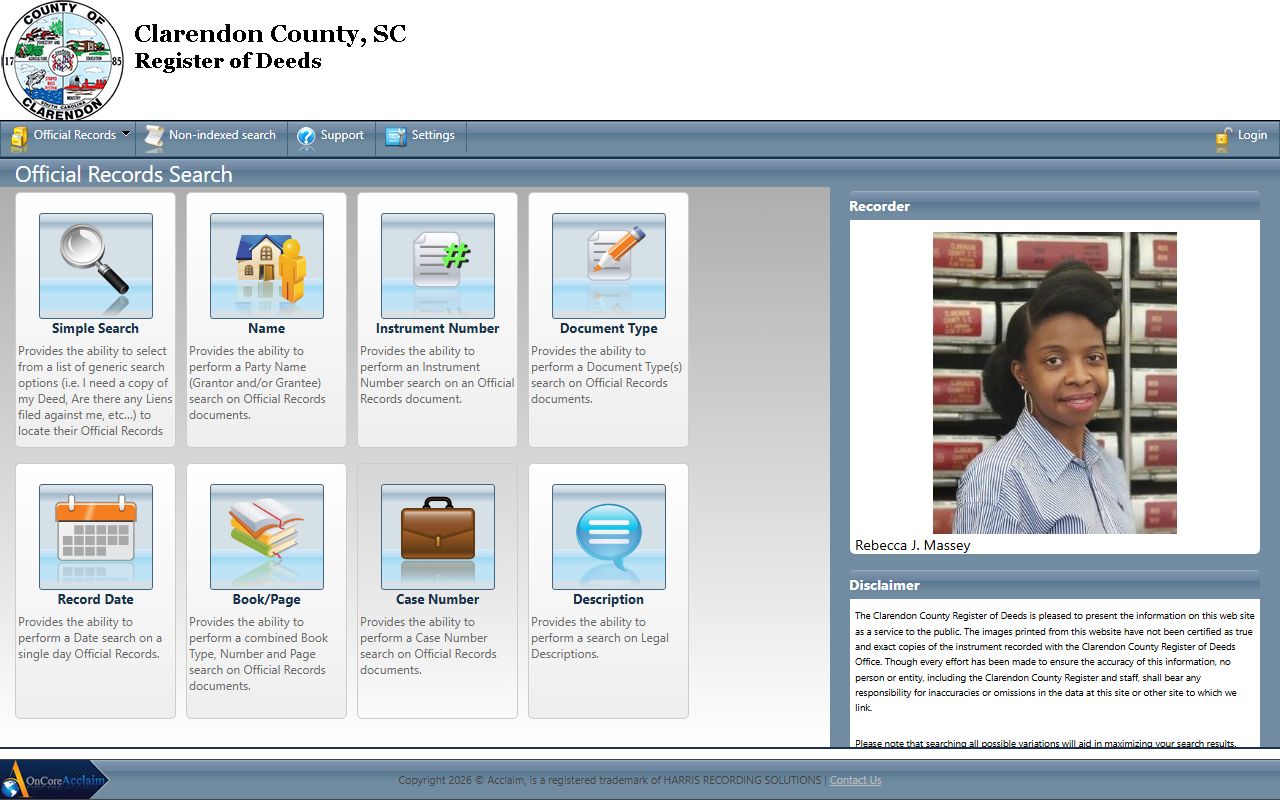
The Clarendon County deed and records portal shown above allows searches across multiple document types. You can look up mortgages, liens, plats, and other instruments alongside deeds. This is particularly useful when researching whether a property carries any encumbrances before a purchase or refinance.
Note: When searching deed records, using both grantor and grantee searches ensures you catch all instruments tied to a party, since the same person may appear on different sides of transactions.
Assessment Ratios for Clarendon County Property
South Carolina uses tiered assessment ratios, and Clarendon County follows the same schedule set by Title 12, Chapter 43. Owner-occupied residential property is assessed at 4% of fair market value. Commercial and rental property is assessed at 6%. Manufacturing property carries a 10.5% ratio. The ratio you qualify for has a direct impact on your tax bill because it determines the assessed value before the millage rate is applied.
Qualifying for the 4% owner-occupied rate requires filing a legal residence application with the Assessor. You must own and occupy the property as your primary residence. Second homes, investment properties, and vacation rentals do not qualify. The savings can be significant because the 4% rate cuts the taxable base by one-third compared to the 6% commercial rate.
Clarendon County also provides a local benefit worth noting. The first $100,000 of value on owner-occupied residential property is exempt from school operations taxes. This is separate from the statewide Homestead Exemption and applies specifically to how the county funds school district operations. Combined with the 4% ratio, this exemption meaningfully reduces the effective tax rate for qualifying homeowners.
Clarendon County Tax Due Dates and Penalties
Property taxes in Clarendon County are due January 15. Payments received by that date carry no penalty. After January 15, a 3% penalty applies through February 1. From February 2 through March 16, the penalty rises to 10%. After March 16, the penalty increases to 15% and the county may attach an enforceable lien to the property. These penalty tiers are steeper than the statewide default schedule, so Clarendon County property owners should prioritize paying on time.
The statewide framework in Title 12, Chapter 45 sets out payment and installment rules that counties follow as a baseline. Clarendon County's specific penalty schedule reflects local taxing authority decisions. If you are unsure which penalty tier applies to your account, contact the county tax office before making a late payment.
Installment payment arrangements may be available for qualifying property owners. Check with the Clarendon County tax office at 411 Sunset Drive, Manning, for current options and deadlines to enroll in any installment plan.
Delinquent Tax Records in Clarendon County
When property taxes remain unpaid past the penalty stages, the account moves into delinquent status. Under Title 12, Chapter 51, the county issues a delinquency notice around April 1 and must publish the delinquent list in a local newspaper for three consecutive weeks. Property owners who appear on that list have a 12-month redemption period during which they can pay the outstanding balance plus interest penalties of 3%, 6%, 9%, or 12% depending on when they redeem.
A delinquent tax sale transfers the right to collect from the property to a purchaser, but the original owner retains the right to redeem for 12 months. After that window closes without redemption, title can pass to the tax sale purchaser. Clarendon County property tax records will reflect delinquent status and any tax sale activity on the parcel record.
Note: Under South Carolina law, property taxes constitute a first lien on real property, attaching automatically on December 31 of the tax year under Title 12, Chapter 49.
Homestead Exemption for Clarendon County Residents
South Carolina's Homestead Exemption reduces the taxable value of a primary residence by $50,000 of fair market value. To qualify, the property owner must be 65 years of age or older, totally and permanently disabled, or legally blind. The exemption requires at least one year of title ownership and must be applied for through the county Auditor's office, not the Assessor.
Clarendon County residents who qualify should file their Homestead application as early as possible. Applications are generally accepted on a rolling basis, but there may be annual deadlines that affect when the exemption first appears on your bill. The Auditor's office at the Manning courthouse can confirm current deadlines and required documentation.
Remember that Clarendon County also offers the school operations tax exemption on the first $100,000 of value for owner-occupied residential property. Combining that local benefit with the statewide Homestead Exemption provides substantial savings for eligible residents. Reviewing both programs with the Auditor ensures you are not missing any available reduction.
Appealing Clarendon County Property Tax Assessments
Property owners who disagree with their assessed value have the right to appeal. Title 12, Chapter 60 lays out a straightforward procedure for challenging assessments in South Carolina. The first step is filing a written appeal with the Clarendon County Assessor within 90 days of receiving the assessment notice. The Assessor reviews the appeal and issues a written decision.
If you are not satisfied with the Assessor's decision, you may appeal further to the county Board of Assessment Appeals. From there, unresolved disputes can proceed to the South Carolina Administrative Law Court. Each level requires specific filings and timelines, so keeping track of deadlines is important from the start.
Common grounds for appeal include errors in property description, incorrect acreage, improper classification, or a valuation that does not reflect comparable sales in the area. Gathering recent sales data for similar properties near yours strengthens an appeal. The Clarendon County Assessor's website has additional guidance on the appeals process and required forms.
Millage Rates and Tax Calculation in Clarendon County
Millage rates in Clarendon County are set by the various taxing authorities, including the county government, school district, municipalities, and special purpose districts. One mill equals $1 of tax per $1,000 of assessed value. As an example, the Clarendon County School District operations millage has been set at 175.9 mills. Other taxing districts layer additional mills on top of that figure.
To estimate a tax bill, multiply the property's fair market value by the applicable assessment ratio (4%, 6%, or 10.5%), then multiply that assessed value by the total millage rate expressed as a decimal. For a home valued at $150,000 qualifying for the 4% rate, the assessed value would be $6,000. At a combined millage of 300 mills, the base tax would be $1,800 before any exemptions.
Millage rates can change each year as taxing authorities set their budgets. The South Carolina Association of Counties publishes annual millage data for all 46 counties, which provides a useful comparison tool.
Note: Clarendon County's school operations millage of 175.9 is one component of the total millage applied to a parcel; the actual bill includes rates from multiple taxing entities stacked together.
South Carolina Department of Revenue and Clarendon County
The South Carolina Department of Revenue plays a role in property tax administration even though day-to-day records are handled at the county level. The SCDOR establishes assessment guidelines, oversees the ratio framework under Chapter 43, and handles appeals that reach the state level. For manufacturing property, the SCDOR also directly assesses certain classes of industrial equipment.
Understanding the split between state oversight and county administration helps property owners know where to direct questions. Routine matters like exemption applications, value disputes, and payment arrangements are handled by Clarendon County offices. Broader policy questions, manufacturing assessments, and state-level appeals involve the SCDOR. The full framework is laid out in South Carolina Title 12.
Nearby Counties
Clarendon County borders Sumter, Lee, Williamsburg, and Florence counties, among others.