
Florence County Property Tax Records
Florence County property tax records are maintained across several county offices, including the Assessor, Register of Deeds, Treasurer, and Auditor. The Assessor's office is located at 180 N Irby Street in Florence and oversees more than 72,000 parcel records. Whether you are searching for assessed values, deed history, plat maps, or payment information, Florence County provides access through both in-person visits and online tools. This guide covers how those records are organized, what you can find, and where to look for property tax data in Florence County.
Florence County Property Tax Quick Facts
Florence County Assessor Records
The Florence County Assessor is Jamie Floyd, reachable at (843) 665-3056. The office is at 180 N Irby Street, MSC-A, Florence, SC 29501. The Assessor is responsible for identifying, listing, and valuing all real property in Florence County for ad valorem tax purposes. Under South Carolina Code Title 12, Chapter 37, a full-time assessor is required in each county. That same chapter defines the Assessor's duties to maintain deed records, building permits, and tax maps.
Florence County property tax records reflect assessments applied at different ratios depending on property use. Owner-occupied residential properties are assessed at 4% of fair market value. Commercial and non-primary residential property is assessed at 6%. Manufacturing and industrial property carries a 10.5% ratio under Chapter 43. These ratios directly affect your tax bill. The Assessor determines the value; the Auditor applies the millage; the Treasurer collects payment.
Reassessment in Florence County occurs every five years as required by state law. The process ensures assessed values reflect current market conditions. Property owners receive notice when their value changes, and they have the right to appeal. The appeal process in South Carolina is governed by Chapter 60, which sets procedures all the way through the Administrative Law Court if needed.
Note: The Florence County Assessor's office maintains plat maps and deed records as part of the property tax record system. These are useful for confirming property boundaries and ownership history.
Florence County Register of Deeds Property Index
The Florence County Register of Deeds maintains an online property records index at search.florencedeeds.com. More than 72,011 parcel records are available through this system. You can search by owner name, parcel number, or address to find document information and property records for Florence County.
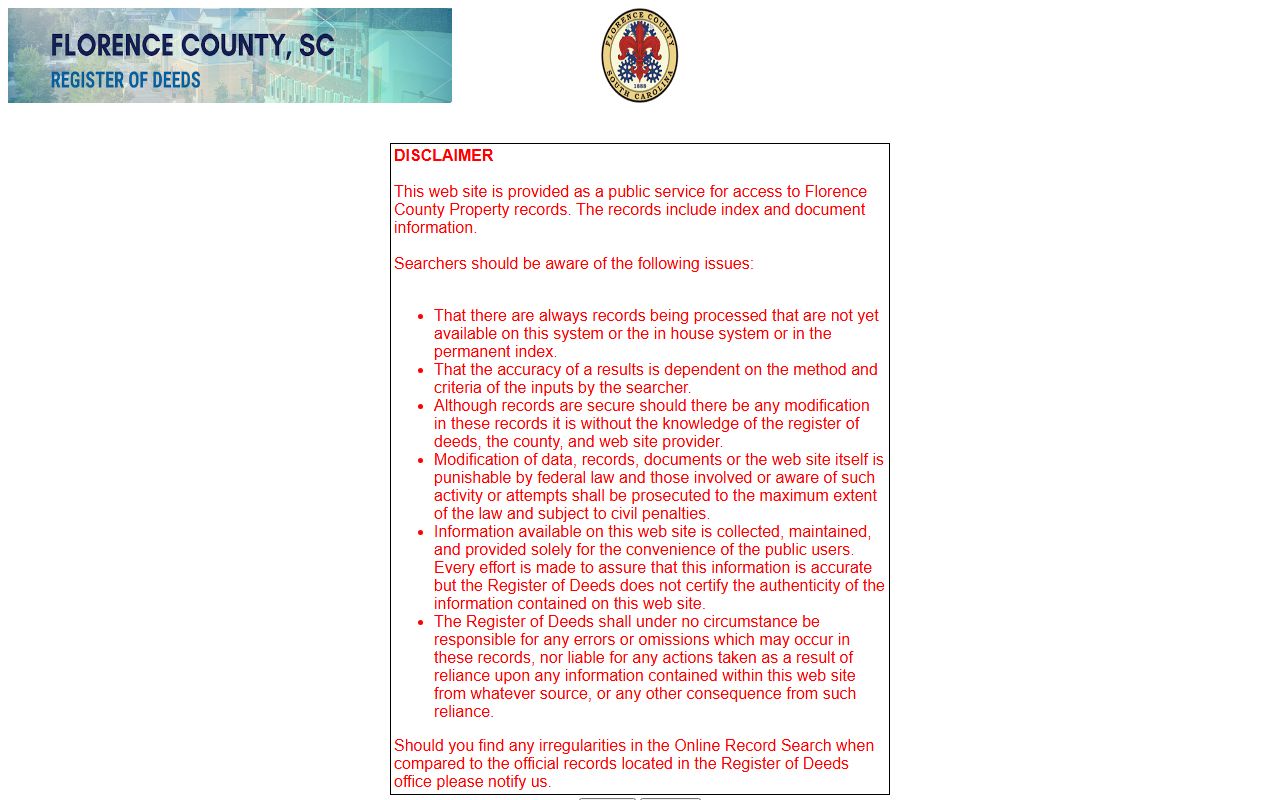
The Florence County Register of Deeds online system provides a convenient way to review property record indexes without visiting the office in person. Documents that appear in the system include deeds, mortgages, plats, and related instruments that affect title to real property in Florence County.
The Register of Deeds office has issued a disclaimer that users should understand before relying on the online data. Records are always being processed, so the index may not reflect the most recent filings. The accuracy of search results depends on the inputs you use. Any modification of the data is a federal crime. The information is provided as a convenience only. The Register of Deeds does not certify the authenticity of records accessed through the online system.
Land records in Florence County show a median price per acre of $4,533 based on sold land data. This figure helps establish context when evaluating assessed values or researching comparable sales. Plat maps are also available through the Register of Deeds, giving you a visual reference for parcel boundaries across Florence County.
Florence County Property Tax Payment Records
The Florence County Treasurer's office handles property tax collections. The Treasurer is located at 180 N Irby Street, Florence, SC, and can be reached at (843) 665-3041. All property taxes in Florence County are due by January 15 under South Carolina Code Chapter 45.
Missing the January 15 deadline triggers a penalty schedule. The first penalty is 3% added to the unpaid balance. After that, an additional 7% applies. A further 5% penalty follows if taxes remain unpaid past the next stage. South Carolina law also provides for installment payment plans in some circumstances, which can help property owners avoid the full penalty structure. Contact the Treasurer's office in Florence County to ask about installment options.
For city of Florence properties, an additional resource exists through the City of Florence's own payment portal. The city provides access to property tax payment information at cityofflorencesc.gov, which covers city-level obligations separate from county tax records.
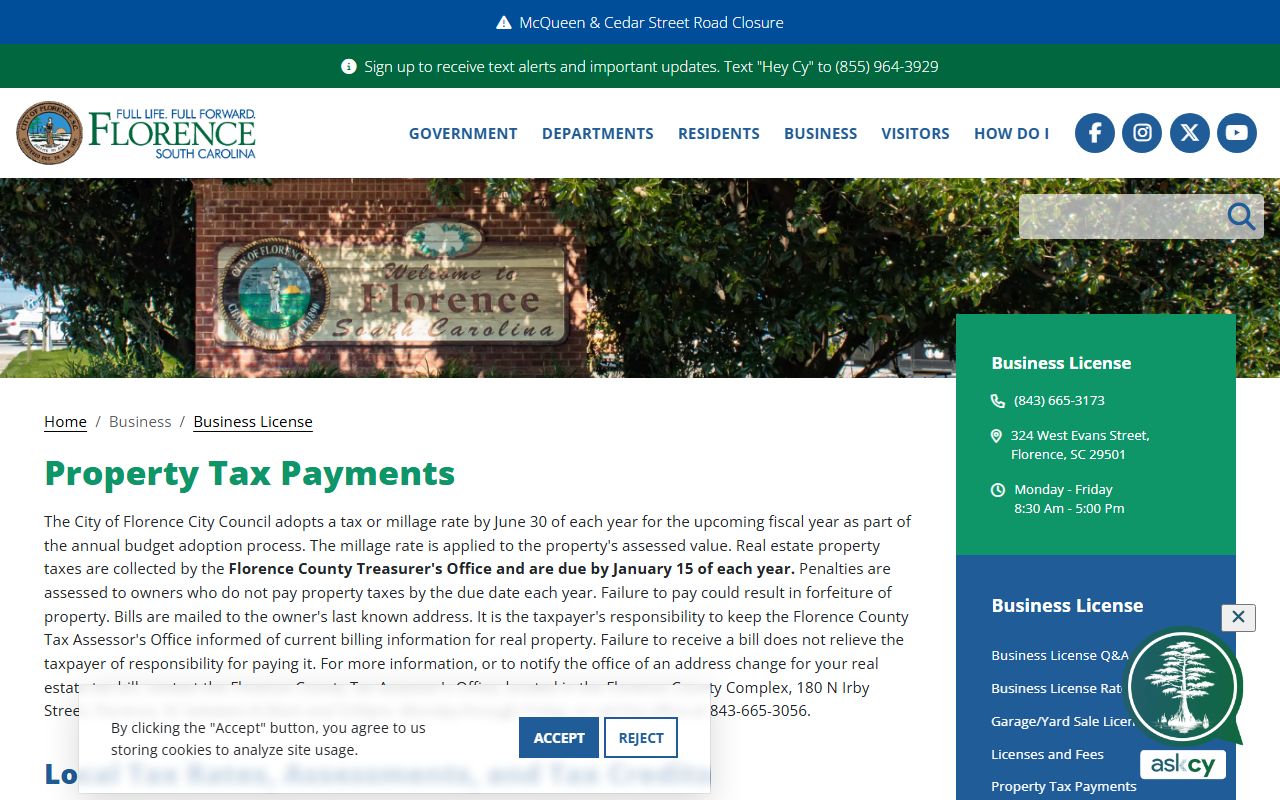
The City of Florence's payment portal is a convenient starting point for residents within city limits who need to track both city and county property tax obligations. County records and city records are separate, so owners within the city of Florence may have tax records on file with both offices.
Note: Property taxes in South Carolina represent a first lien on real property under Chapter 49. The lien attaches as of December 31 each year, regardless of when the bill is paid.
Florence County Delinquent Tax Records
When Florence County property taxes go unpaid past the penalty stages, the account becomes delinquent. Under South Carolina Code Chapter 51, the delinquency notice process begins on April 1. Delinquent tax sales are conducted to recover unpaid taxes. Property owners have a 12-month redemption period after the tax sale to reclaim their property by paying all outstanding amounts plus costs.
The 12-month redemption window is an important protection for Florence County property owners. During that period, the original owner can still recover the property. After redemption expires, the purchaser from the tax sale moves forward with clearing title. Florence County delinquent tax records are public and can be accessed through the county.
The Florence County Auditor, reached at (843) 665-3088, prepares the tax rolls used by the Treasurer for collection. If you believe an error exists in your Florence County property tax record, the Auditor's office is typically the right contact for corrections to the tax roll before the bill is generated.
Homestead Exemption in Florence County
South Carolina's Homestead Exemption reduces the taxable value of a primary residence for qualifying owners. The exemption removes $50,000 of fair market value from the assessment for eligible property owners. Qualifying conditions include being age 65 or older, being legally blind, or being permanently and totally disabled.
To receive the Homestead Exemption on your Florence County property tax record, you must have held title to the property for at least one full year. Applications are filed through the Florence County Auditor's office. Once approved, the exemption appears on your tax record and reduces the bill going forward. The exemption is governed by Chapter 37 provisions that define qualifying exemptions across South Carolina counties.
Understanding Florence County Tax Assessments
Florence County property tax records reflect a value assigned by the Assessor to each parcel. That value, called the assessed value, is a percentage of the fair market value. For a home assessed at 4% of a $200,000 fair market value, the assessed value used in calculating the tax bill would be $8,000. The millage rate set by Florence County's taxing districts is then applied to that assessed value.
The South Carolina Code Title 12 governs the entire property tax system. The South Carolina Department of Revenue at dor.sc.gov oversees compliance and provides guidance to county assessors. Florence County operates within this state framework, which means property owners can find consistent rules about assessment ratios, exemptions, and appeal rights regardless of which county they are in.
Florence County assessments are updated through the five-year reassessment cycle. In between cycles, assessed values generally remain fixed unless there is a qualifying change such as a sale, new construction, or a subdivision of the parcel. Keeping track of these changes is important for property owners who want to verify that their Florence County tax records are accurate.
The South Carolina Association of Counties provides resources for property owners across all 46 counties. The SCAC's resources can help Florence County property owners understand how assessments, appeals, and tax collection processes work statewide.
Note: If you believe your Florence County property tax assessment is incorrect, you have the right to appeal. The appeal process starts at the county level and can proceed to the Administrative Law Court under Chapter 60 procedures.
Florence County Property Record Types
Florence County maintains several categories of property tax records. Each type serves a specific purpose in the tax administration process.
The Assessor's records include the parcel identification number, owner name and mailing address, legal description, fair market value, assessed value, and property classification. These are the foundational records for calculating any Florence County property tax bill. Deed records from the Register of Deeds link ownership history to the parcel number. When a property sells, the deed is recorded and the Assessor updates the ownership record.
Tax maps are maintained by the Assessor and show parcel boundaries across Florence County. They are useful for confirming the location and size of any parcel. Plat maps, also available through the Register of Deeds, show recorded subdivisions and the individual lots created within them. Together, these map records support property tax records by confirming what is being taxed and where it is located in Florence County.
Building permits also feed into the assessment process. When a permit is issued for new construction or significant improvement in Florence County, the Assessor uses that information to update the value of the parcel. This is one of the ways the county ensures that improvements are reflected in property tax records between reassessment cycles.
Nearby Counties
Florence County borders several other South Carolina counties. Property owners near county lines may find it useful to compare records in adjacent jurisdictions.