
Williamsburg County Tax Records and Parcel Data
Williamsburg County property tax records are administered through the county's Assessor, Auditor, and Treasurer offices, with the county seat located in Kingstree, South Carolina. Property search and tax payment services are available online for Williamsburg County. The Assessor assigns fair market values and classifications to all real property in the county. The Auditor computes tax bills, and the Treasurer handles collections. State law in Title 12 of the South Carolina Code governs every step of the process, from initial valuation through enforcement of delinquent accounts.
Williamsburg County Property Tax Quick Facts
Williamsburg County Assessor Records and Parcel Data
The Williamsburg County Assessor maintains the core property tax records for all real estate within the county. Each parcel in Williamsburg County has a unique record in the Assessor's database. That record contains the parcel identification number, the legal description of the property, lot dimensions or acreage, the owner's name and mailing address, and the assessed value used to calculate annual taxes. Property classification data is also stored within each record, as the classification determines which assessment ratio applies.
Title 12, Chapter 37 of South Carolina law requires Williamsburg County to maintain a full-time assessor and to keep deed records, building permits, and tax maps current. Deed recordings at the Register of Deeds trigger updates in the Assessor's ownership records. Permit issuances for construction and renovation activity prompt valuation reviews. Plat changes from new subdivisions or parcel consolidations are reflected in the Assessor's tax maps. These continuous updates keep Williamsburg County property tax records as current as the underlying activity permits.
The following image is from Chapter 51 of Title 12, which governs delinquent property tax enforcement in Williamsburg County and statewide.
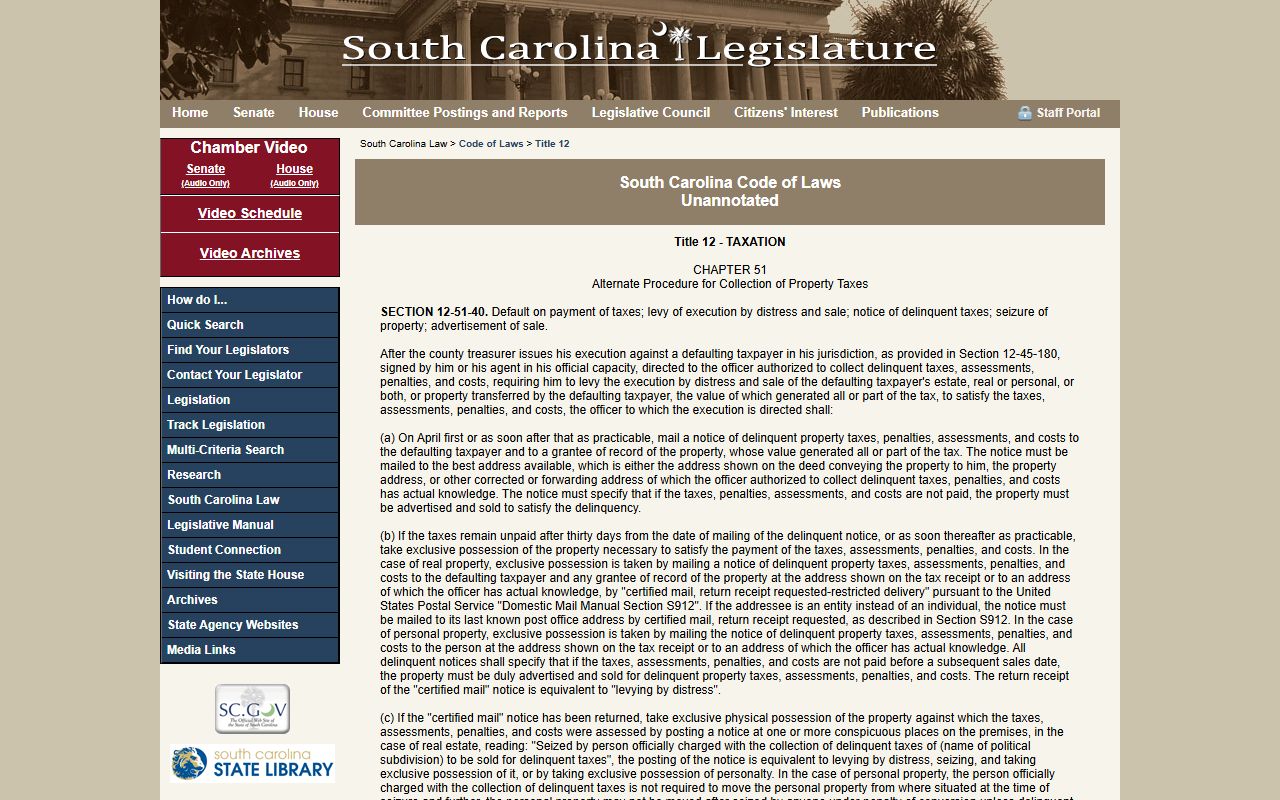
Chapter 51 of South Carolina's Title 12 sets the rules for delinquency, tax sales, and the 12-month redemption period that apply to Williamsburg County property owners with unpaid tax accounts.
Note: Property tax records in Williamsburg County are public documents. Ownership data, assessed values, and tax payment status are accessible through the county's online search tools.
Assessment Ratios Applied to Williamsburg County Property
Property taxes in Williamsburg County are calculated using assessment ratios established by Chapter 43 of Title 12. These ratios convert a property's fair market value into its assessed value, which is then multiplied by the local millage rate to produce the tax bill. Getting the classification right is essential for every Williamsburg County property owner, as even a small difference in ratio produces a significant difference in annual taxes.
Residential property used as the owner's primary domicile is assessed at 4% of fair market value. Commercial real property carries a 6% ratio. Manufacturing real and personal property is assessed at 10.5%. These three tiers cover the majority of taxable property in Williamsburg County. The 4% owner-occupied rate requires an application through the Assessor and cannot be assumed automatically when property changes ownership. New owners who intend to use a Williamsburg County home as their primary residence should file for the 4% special assessment as soon as possible after taking title.
The millage rates applied to Williamsburg County assessed values are set by the county council, school boards, and other local taxing entities. The Auditor combines the assessed value and the applicable millage to produce the final tax bill. Property owners can find the current millage rates through the Williamsburg County Auditor's office. Changes in millage from year to year can affect the tax bill even when the assessed value of the property stays the same.
Williamsburg County Reassessment and Value Updates
Williamsburg County completes a general reassessment of all real property every five years as required by Chapter 43. The reassessment reviews every parcel in the county and updates fair market values to reflect conditions at the time of the reassessment. The Assessor uses sales of comparable properties, construction cost data, and income information for commercial properties to support the updated values.
Each Williamsburg County property owner receives a notice of the new assessed value before the reassessment year takes effect. That notice includes the deadline for filing an appeal. The appeal process begins informally at the Assessor's office. An owner who disagrees with the Assessor's informal response may file a formal appeal with the county Board of Assessment Appeals. Unresolved disputes may be escalated to the Administrative Law Court under Chapter 60. All appeal activity becomes part of the Williamsburg County property tax record for the affected parcel.
Paying Williamsburg County Property Taxes
Williamsburg County property taxes are due on January 15 each year. Title 12, Chapter 45 establishes this deadline, the applicable penalties for late payment, and the installment payment option. The county Treasurer collects payments and maintains payment history records that are part of the overall property tax record for each parcel.
The US postmark rule applies: a tax payment mailed on or before January 15 with a valid USPS postmark is treated as timely even if it arrives at the Treasurer's office after that date. Payments that are not postmarked or received by January 15 trigger a 3% penalty under Chapter 45. Additional penalties of 7% and 5% follow as the delinquency progresses. Williamsburg County property owners who need to spread their payments can inquire about the installment plan, which allows the annual bill to be paid in portions across the year rather than in one lump sum.
Note: The installment payment option has enrollment windows that open well before the January due date. Contact the Williamsburg County Treasurer early in the year to confirm current enrollment periods and requirements.
Delinquent Tax Records for Williamsburg County
When Williamsburg County property taxes remain unpaid after the January 15 due date and into the following spring, the account becomes officially delinquent on April 1 under Chapter 51. The Treasurer then pursues collection, which may include placing the parcel in the county's annual delinquent tax sale. At the sale, outside bidders can purchase the delinquent tax lien on the property.
After a Williamsburg County parcel is sold at a delinquent tax sale, the original owner has 12 months to redeem the property. Redemption requires paying all delinquent taxes, accrued interest, penalties, and associated costs. The interest rate under Chapter 51 climbs each quarter: 3% in the first quarter, 6% after six months, 9% after nine months, and 12% at the close of the full 12-month redemption period. Once the redemption window closes without payment, the tax sale purchaser may pursue a deed to the property.
South Carolina's Chapter 49 of Title 12 establishes property taxes as the first lien on real estate. The lien attaches on December 31 of each tax year. This lien priority means Williamsburg County property tax obligations are satisfied before other claims. Title researchers and potential buyers reviewing Williamsburg County property tax records should confirm no delinquent lien is outstanding as part of any transaction review.
Homestead Exemption and Williamsburg County Tax Records
Qualifying Williamsburg County homeowners may reduce their taxable base by $50,000 of fair market value through South Carolina's Homestead Exemption. To qualify, the property owner must be 65 or older, legally blind, or permanently and totally disabled. The property must be the owner's primary residence and the owner must have held title for at least one year. Applications are submitted through the Williamsburg County Auditor's office.
The Homestead Exemption is reflected in Williamsburg County's property tax records after approval and carries forward each year automatically. For a homeowner with a property valued at $110,000, the exemption reduces the taxable value to $60,000. Applied at the 4% owner-occupied ratio, the resulting assessed value is $2,400 rather than the $4,400 that would apply without the exemption. The combined effect of both the exemption and the favorable 4% ratio represents a meaningful financial benefit for eligible Williamsburg County homeowners. Exemption rules are found in Chapter 37 of Title 12.
The following image is from the South Carolina Association of Counties, which provides resources on how county tax systems, including Williamsburg County's, operate under state law.

The South Carolina Association of Counties publishes guidance on property tax administration for all 46 counties, including Williamsburg, covering topics from assessment practices to appeals and exemption administration.
State Oversight of Williamsburg County Property Taxes
The South Carolina Department of Revenue provides oversight of property tax administration statewide, including in Williamsburg County. The DOR monitors county compliance with assessment standards, ratio requirements, and reassessment schedules. It also handles centrally assessed property categories such as railroads, utilities, and other multi-county operations that may have presence in Williamsburg County.
For standard real property in Williamsburg County, day-to-day administration remains with the local Assessor, Auditor, and Treasurer offices. The DOR's guidance, however, shapes how those offices operate and what rules they apply. Property owners who want to understand the full legal framework can review Title 12 of the South Carolina Code directly. That statute covers the assessment process, classification rules, payment deadlines, delinquency procedures, and appeal rights that apply to every parcel in Williamsburg County.
Nearby Counties
Williamsburg County borders several South Carolina counties, each maintaining separate property tax record systems.