
Spartanburg County Property Tax Records
Spartanburg County property tax records are maintained through the Assessor's office at 366 N Church Street in Spartanburg, South Carolina. The Assessor handles parcel valuations and property classifications, while the Treasurer at (864) 596-2547 manages billing and collections. The Auditor computes tax bills based on assessed values. Together these three offices keep Spartanburg County property tax records current, accurate, and accessible to the public. This page covers where those records are found, what they contain, how state law shapes the process, and what property owners in Spartanburg County need to know.
Spartanburg County Property Tax Quick Facts
Spartanburg County Assessor Property Records
The Spartanburg County Assessor's office is the primary source for property tax records in the county. You can reach the office by phone at (864) 596-2544 or visit in person at 366 N Church Street, Spartanburg, SC 29303. The Assessor is responsible for identifying, listing, and valuing all real property within the county. South Carolina Code Title 12, Chapter 37 requires that each county maintain a full-time Assessor and keep deed records, building permits, and tax maps updated as changes occur.
Every parcel record maintained by the Spartanburg County Assessor contains a parcel identification number, the owner's name and mailing address, the legal property description, acreage or square footage, and the assessed value used to calculate taxes. The Assessor also records property classifications that determine the correct assessment ratio. Owner-occupied primary residences carry a 4% assessment ratio. Commercial real property is assessed at 6%. Manufacturing real and personal property carries a 10.5% ratio, as outlined in Chapter 43 of Title 12. These ratios are applied to the fair market value to produce the assessed value that feeds into the final tax calculation.
The county also maintains tax maps that show parcel boundaries across Spartanburg County. These maps are updated when parcels are subdivided, combined, or when new plats are recorded. Building permits issued in Spartanburg City and other jurisdictions within the county are routed to the Assessor's office and used to update property values when significant construction or improvement occurs. The Assessor uses this permit data to keep records current between the county's five-year reassessment cycles. Property owners researching boundaries or historical parcel splits will find the tax maps a useful complement to the ownership and value data in the assessment records.
The Spartanburg County Assessor's online portal at spartanburgcounty.org allows the public to search property records by owner name, parcel ID, or address. Results display assessed values, ownership history, property characteristics, and tax map information. The county has issued a specific note about record timeliness: assessor records may not reflect a recent deed or plat for several months after recording. Records are also subject to ongoing changes from taxpayer participation, special assessment applications, legislative updates, and appeal outcomes. For ownership records that need to be verified as current public records, the Register of Deeds holds the authoritative deed information.
The following image shows the Spartanburg County Assessor's online property records search portal.
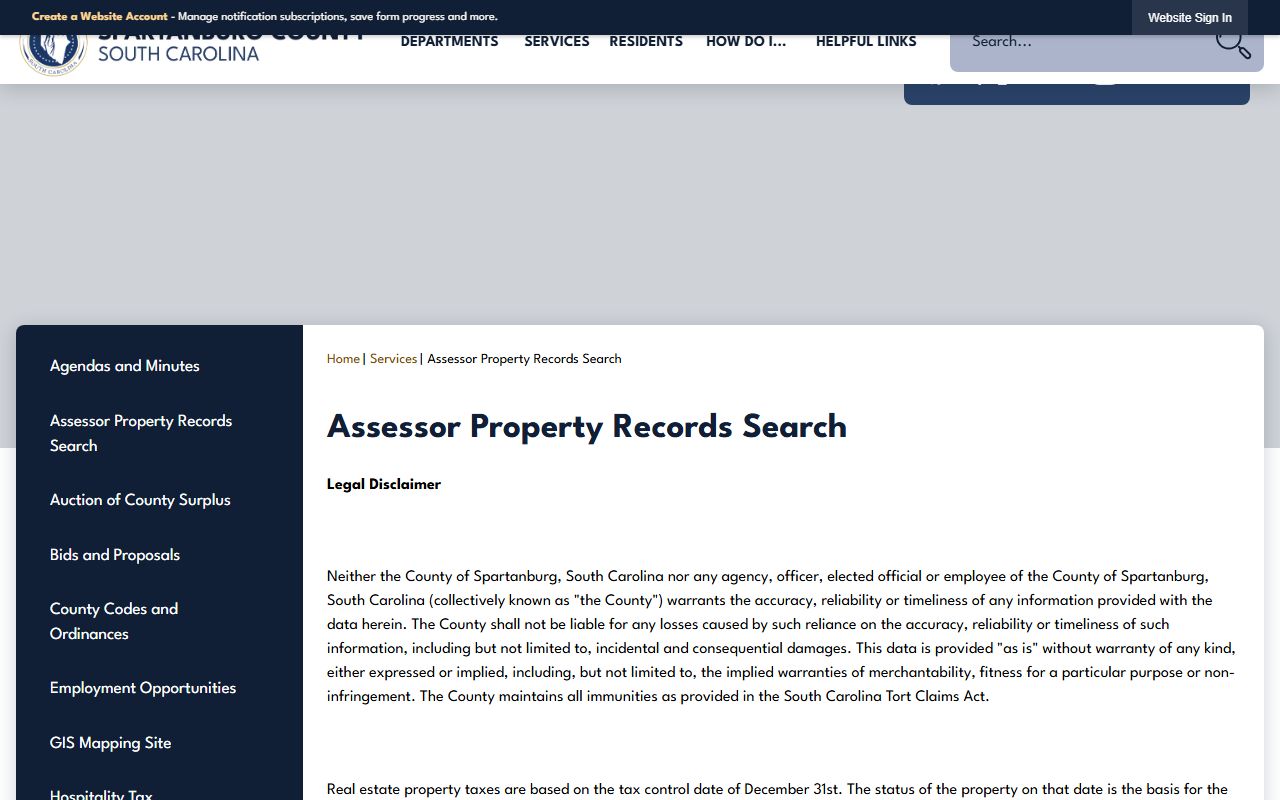
The Spartanburg County Assessor's search portal lets users look up property values, parcel details, and assessment history directly from the county's official records database.
Note: Ownership information in assessor records reflects data at the time of last update; for the most current deed ownership, contact the Spartanburg County Register of Deeds directly.
Assessment Ratios and Property Classification in Spartanburg County
South Carolina property taxes depend heavily on how a property is classified. Classification determines which assessment ratio applies, and that ratio directly affects the size of the tax bill. Title 12, Chapter 43 establishes the framework for assessment ratios and the statewide reassessment cycle that applies to every county, including Spartanburg.
Owner-occupied residential properties in Spartanburg County assessed at the 4% ratio benefit from the lowest rate available. To qualify, the property must be the owner's primary legal domicile, and the owner must apply through the Assessor's office. Properties that do not qualify as primary residences, including rental homes and vacation properties, are assessed at 6%. Commercial real property also carries the 6% ratio. Manufacturing real and personal property, along with commercial personal property, are assessed at 10.5%.
Spartanburg County adds a notable benefit for qualifying homeowners. Primary residential owner-occupied properties are exempt from school property taxes in Spartanburg County. This exemption reduces the effective tax burden for homeowners who claim the 4% owner-occupied classification. The median property tax in Spartanburg County is approximately $1,149 per year, based on a median home value of $195,800. The county's median effective tax rate of 0.63% is meaningfully lower than the national median of 1.02%, making Spartanburg County one of the more affordable counties in the state for property owners who qualify for primary residence status.
Spartanburg County Reassessment Records
Spartanburg County conducts a countywide reassessment of all real property every five years, as required by Chapter 43. The reassessment updates the fair market value of every parcel in the county based on current market conditions. The Assessor reviews sales data, construction cost information, and income data for income-producing properties to arrive at updated values. Each property owner receives a notice of the new value before the reassessment takes effect.
Property owners who disagree with their reassessed value have the right to appeal. The appeal process begins with an informal review by the Assessor's office. If the owner remains unsatisfied, the dispute moves to a formal hearing before the county Board of Assessment Appeals. Unresolved appeals may ultimately be taken to the Administrative Law Court under Title 12, Chapter 60. Spartanburg County property tax records include notation of pending and completed appeals, which can affect the assessed value shown in the public record at any given time.
Note: A pending appeal does not delay the tax due date. Taxes based on the current assessed value are still due by January 15 while an appeal is in progress.
Tax Billing and Payment in Spartanburg County
The Spartanburg County Treasurer at (864) 596-2547 handles billing and collection of property taxes once the Auditor calculates the annual tax bill. Bills are mailed in the fall and payment is due by January 15 each year under Title 12, Chapter 45. The postmark rule applies: a payment mailed on or before January 15 and bearing a United States Postal Service postmark is considered timely, even if it arrives after that date.
Penalties apply to late payments. A 3% penalty attaches if the bill is not paid by January 15. An additional 7% penalty accrues after that deadline passes, followed by a further 5% penalty under the Chapter 45 penalty schedule. Taxpayers who need help managing payments may qualify for an installment plan. Spartanburg County taxpayers can split their annual payment into installments, reducing the impact of a single large payment. Contact the Treasurer's office for details on enrollment and eligibility requirements for the installment program.
The image below shows additional Spartanburg County property resources available through the City of Spartanburg's website.
The City of Spartanburg maintains property-related resources that complement the county's assessor and treasurer records for properties located within city limits.
Delinquent Tax Records in Spartanburg County
Unpaid Spartanburg County property taxes become delinquent on April 1 under Title 12, Chapter 51. Once a parcel enters delinquency, the Treasurer pursues collection through a tax sale process. A delinquent tax sale is held annually, allowing the county to sell the tax lien on delinquent parcels to outside bidders or to take title if no bidder purchases the lien.
Property owners whose parcels are sold at a delinquent tax sale retain a 12-month redemption period. During this window, the owner may reclaim the property by paying all delinquent taxes, penalties, and interest. The interest rate under Chapter 51 increases by quarter: 3% for the first quarter, 6% for the second, 9% for the third, and 12% for the fourth. After the 12-month redemption period expires without redemption, the purchaser may apply for a deed to the property.
South Carolina Code Title 12, Chapter 49 establishes that property taxes constitute the first lien on real property in the state. The lien attaches on December 31 of the tax year. This lien priority means that property taxes take precedence over other encumbrances, including mortgages, in the event of a delinquency sale. Buyers and lenders researching Spartanburg County property tax records should verify lien status as part of any due diligence process.
Note: Delinquent tax records and redemption notices are public documents maintained through the Spartanburg County Treasurer's office and can be requested directly from that office.
Homestead Exemption Records for Spartanburg County
The Homestead Exemption reduces the taxable value of a qualifying Spartanburg County property by $50,000 of fair market value. Eligibility requires that the owner be 65 years of age or older, legally blind, or permanently and totally disabled. The owner must have held title to the property for at least one year and must use the property as their primary residence. Applications are submitted through the Spartanburg County Auditor's office, not the Assessor.
Once approved, the exemption is reflected in the county's property tax records going forward. The exemption applies to the first $50,000 of fair market value, meaning a home valued at $150,000 would have only $100,000 subject to assessment and taxation after the exemption is applied. The Homestead Exemption works alongside the 4% owner-occupied assessment ratio, which also requires primary residence status. Both benefits together produce a significantly lower tax bill for qualifying Spartanburg County homeowners. For more information on exemptions under state law, see Chapter 37, which outlines the statutory framework for exemptions and their administration by county officials.
South Carolina Department of Revenue and Spartanburg Records
The South Carolina Department of Revenue plays a central role in setting the rules that govern Spartanburg County property tax records. While the DOR does not maintain individual parcel records, it oversees compliance with the statewide assessment standards, classification rules, and reassessment timelines. The DOR also handles certain categories of property that are assessed centrally rather than by local county assessors, including railroad property, utility property, and other special categories that cross county lines.
For standard real property in Spartanburg County, the DOR's most direct influence comes through its guidance on assessment ratios and its oversight of the county reassessment process. The full text of Title 12 of the South Carolina Code covers all property tax law in the state, from definitions and classification to enforcement and appeals. Property owners researching their rights and obligations will find the statute a thorough reference. The South Carolina Association of Counties at sccounties.org also publishes resources on county tax administration that are useful for property owners navigating the system.
Nearby Counties
Spartanburg County borders several other South Carolina counties, each with their own property tax record systems.