
Kershaw County Tax Records and Assessments
Kershaw County property tax records are managed through county offices in Camden, the county seat, located at 515 Walnut Street. The Assessor, Auditor, and Treasurer each play a distinct role in administering property taxes across Kershaw County. Records maintained by these offices include parcel assessments, ownership data, deed history, and tax payment information. This page explains how Kershaw County property tax records are organized, where to find them, and what state law governs the process for all property owners in this county.
Kershaw County Property Tax Quick Facts
Kershaw County Assessor Property Records
The Kershaw County Assessor's office is the starting point for most property tax records in the county. Located at 515 Walnut Street in Camden, this office is responsible for identifying, listing, and valuing all real property within Kershaw County. Under South Carolina Code Title 12, Chapter 37, each county must maintain a full-time assessor. That chapter also outlines the Assessor's duty to keep deed records, building permits, and tax maps current.
Kershaw County property tax records maintained by the Assessor cover a wide range of data for each parcel. Every record includes a parcel identification number, the owner's name and mailing address, the legal description of the property, and the assessed value used to calculate the tax bill. The Assessor also records the property classification, which determines which assessment ratio applies. These classification distinctions matter significantly for property owners. Residential homes used as a primary residence carry a 4% assessment ratio. Commercial property and non-primary residential property are assessed at 6%. Manufacturing and industrial uses carry a 10.5% ratio under Chapter 43.
Tax maps form another important layer of Kershaw County property records. The Assessor maintains these maps, which show parcel boundaries throughout the county. When a subdivision is created or a parcel is divided, the tax map is updated. These maps are especially useful for anyone researching property near the county's rural areas, where boundaries can be large and irregular. Building permits issued in Kershaw County also feed into the assessment process. When significant construction or improvement occurs, the Assessor uses permit data to update the property's value before the next reassessment cycle.
Note: Kershaw County property owners should verify their property classification with the Assessor when purchasing or improving a property. An incorrect classification can result in overpayment of property taxes.
Assessment Ratios and Kershaw County Tax Records
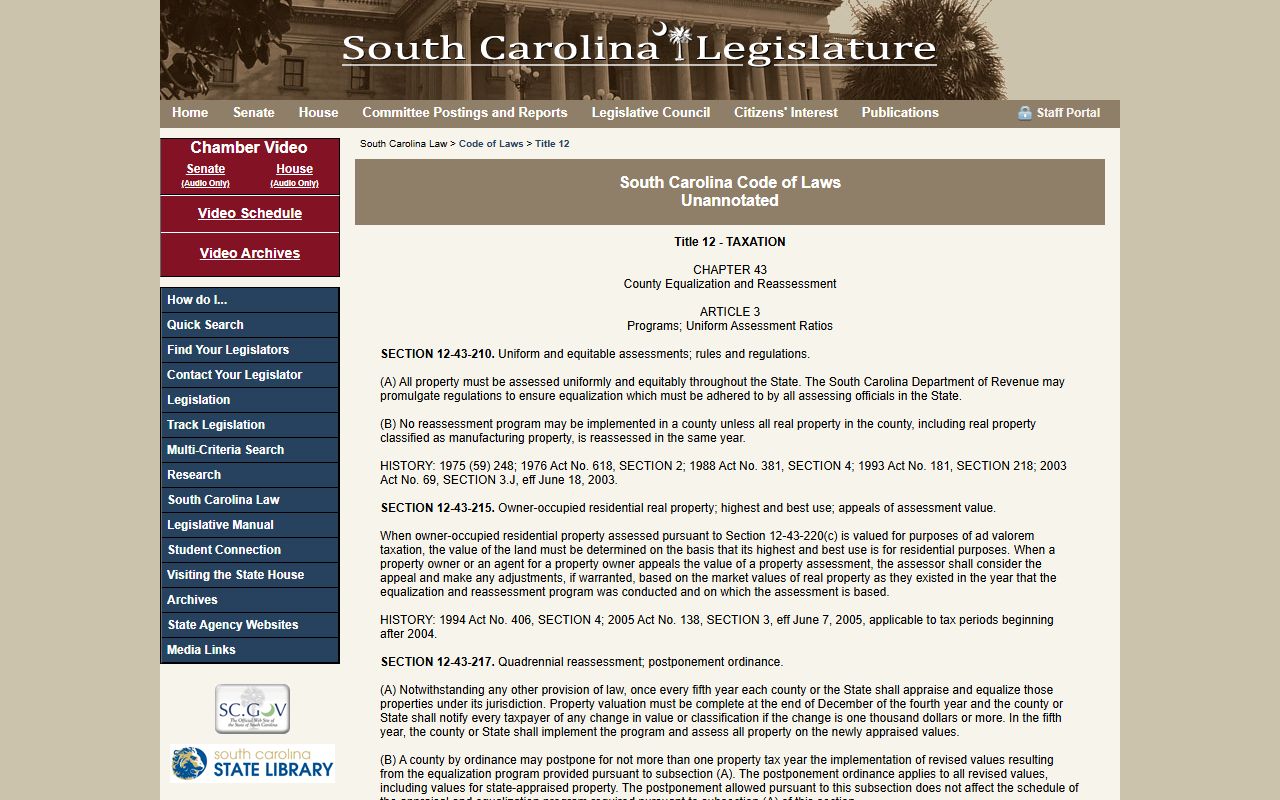
South Carolina law sets specific assessment ratios that all counties, including Kershaw, must follow. These ratios are established in Chapter 43 of Title 12. Section 12-43-220 defines the standard rates. Owner-occupied residential properties up to five acres are assessed at 4% of fair market value. Agricultural land held by private individuals is also assessed at 4%, while agricultural land held by corporations is assessed at 6%. Commercial and non-primary residential property carries a 6% ratio. Manufacturing and industrial property is taxed at 10.5%.
Understanding how the ratio works helps Kershaw County property owners read their tax records correctly. If a home has a fair market value of $250,000 and qualifies for the 4% owner-occupied ratio, the assessed value shown on the Kershaw County tax record would be $10,000. The millage rate set by county and municipal taxing districts is then applied to that $10,000 figure. The final tax bill depends on all taxing jurisdictions that cover the parcel.

The South Carolina Department of Revenue provides oversight for county assessors across the state. DOR resources help standardize how Kershaw County property tax records are prepared and how assessors apply valuation methods. Property owners in Kershaw County can consult DOR guidance to understand what the Assessor is required to do and what rights they have throughout the process.
Kershaw County Property Tax Payment and Treasurer Records
Property taxes in Kershaw County are due on January 15 each year. This deadline is established by South Carolina Code Chapter 45, which governs county treasurers and the collection of property taxes statewide. The Kershaw County Treasurer's office, also located in Camden, processes all payments and maintains payment records for every parcel in the county.
Missing the January 15 deadline triggers a penalty schedule. Under Chapter 45, a 3% penalty is added starting January 16. If taxes remain unpaid after February 2, an additional 7% applies. A further 5% penalty is added after March 16. These penalties accumulate, making it important for Kershaw County property owners to pay on time. One protection available to taxpayers is that a payment postmarked by the US Postal Service on or before the due date is considered timely, even if it arrives at the Treasurer's office after the deadline. Installment payment plans may also be available through the Kershaw County Treasurer for those who qualify.
Under South Carolina Code Chapter 49, property taxes are a first lien on real property. This lien attaches on December 31 of each year, covering the tax obligation for that tax year. Any buyer or lender reviewing Kershaw County property records should be aware of this lien priority, as it takes precedence over most other claims against the property.
Note: Kershaw County property owners who expect difficulty paying by January 15 should contact the Treasurer's office before the deadline to ask about available installment options. Acting early can prevent the full penalty schedule from applying.
Reassessment Cycle for Kershaw County Records
South Carolina law requires every county to conduct a countywide reassessment every five years. Kershaw County follows this schedule under Section 12-43-217. The reassessment process involves the Assessor reviewing market data and updating the fair market value assigned to all parcels in Kershaw County. Property owners receive a notice when their assessed value changes.
Between reassessment cycles, Kershaw County property tax records generally reflect the same value year after year unless a qualifying change occurs. A sale of the property, new construction, or a subdivision are all events that can trigger a mid-cycle value update. Keeping an eye on your Kershaw County tax record is a practical way to catch errors or unexpected changes before they affect your tax bill for multiple years.
The five-year cycle benefits property owners by limiting how often values can increase dramatically. In a rising real estate market, a parcel's assessed value may lag behind its current sale price until the next reassessment. This can work in a property owner's favor if fair market values are increasing faster than assessments. Conversely, in a declining market, reassessment may lower values and reduce the tax burden for Kershaw County property owners.
Kershaw County Delinquent Tax Records
When property taxes in Kershaw County remain unpaid through the penalty period, the account enters delinquent status. South Carolina Code Chapter 51 governs the delinquent tax process across all counties. In Kershaw County, delinquency notices must be sent by April 1. After notice, delinquent properties are advertised for sale over a three-week period.
Property owners in Kershaw County have a 12-month redemption period after a tax sale. During this window, the original owner can reclaim the property by paying all taxes owed, penalties, and costs. The redemption amount increases in quarterly increments: 3% for the first three months, 6% for months four through six, 9% for months seven through nine, and 12% for months ten through twelve. Once the redemption period expires, the tax sale purchaser moves forward with title proceedings.
Kershaw County delinquent tax records are public. Searching these records helps buyers and researchers identify properties with outstanding tax obligations. Any search of Kershaw County property tax records should include a check for delinquent status, particularly for properties that have been vacant or recently transferred.
Homestead Exemption and Kershaw County Tax Relief
South Carolina's Homestead Exemption offers a meaningful reduction for qualifying Kershaw County property owners. The exemption removes the first $50,000 of fair market value from the tax calculation. Qualifying property owners include those who are age 65 or older, legally blind, or permanently and totally disabled. To apply for the Homestead Exemption in Kershaw County, the owner must have held title to the property for at least one full year. Applications are submitted through the Kershaw County Auditor's office in Camden.
Once approved, the Homestead Exemption appears on the Kershaw County property tax record and reduces the taxable value going forward. The exemption applies only to the primary residence. It does not apply to investment properties, vacation homes, or commercial parcels. Property owners who recently purchased a home in Kershaw County and meet the age or disability qualifications should apply promptly. The exemption is not automatic and must be applied for through the Auditor.
Agricultural exemptions are another form of tax relief available for qualifying land in Kershaw County. Land used for bona fide agricultural purposes may qualify for the 4% agricultural assessment ratio rather than the higher commercial rate. The Assessor's office reviews agricultural use applications and determines whether a parcel qualifies. Maintaining records of agricultural activity helps support an application for this classification in Kershaw County.
Note: Religious organizations, schools, and other qualifying nonprofits may also be eligible for property tax exemptions under Chapter 37 provisions. These exemptions must be applied for separately through the appropriate county office.
Appealing Kershaw County Property Tax Assessments
Kershaw County property owners who believe their assessed value is incorrect have the right to appeal. South Carolina provides a structured appeal process under Chapter 60 of Title 12. The first step is contacting the Kershaw County Assessor's office to request a review. If the Assessor's determination is unsatisfactory, the next step is a formal appeal to the county Board of Assessment Appeals.
If the county-level appeal does not resolve the dispute, the property owner may escalate to the Administrative Law Court. This court hears tax assessment disputes from all 46 South Carolina counties, including Kershaw. The South Carolina Association of Counties provides resources to help property owners understand the appeal process and what to expect at each stage. Having supporting documentation, such as recent comparable sales or an independent appraisal, strengthens an appeal significantly.
Appeals must be filed within specific deadlines after the assessment notice is received. Missing the appeal window means accepting the assessed value for the current tax year. Kershaw County property owners should track when assessment notices arrive and act quickly if they believe an error has occurred.
Nearby Counties
Kershaw County borders several South Carolina counties where similar property tax record systems apply.