
Search Lee County Property Tax Records
Lee County property tax records are administered through county offices in Bishopville, the county seat, at 123 South Main Street. The Assessor maintains parcel data and assessed values, the Auditor prepares the tax rolls, and the Treasurer collects payments and keeps payment records. These offices together hold the complete record of how real property in Lee County is valued, classified, and taxed each year. This page covers the record types available, the applicable assessment ratios, payment deadlines, and the rights that Lee County property owners have under South Carolina law.
Lee County Property Tax Quick Facts
Lee County Assessor and Property Records
The Lee County Assessor's office in Bishopville is the primary keeper of property tax records for real property throughout the county. South Carolina law, under Chapter 37 of Title 12, requires every county to maintain a full-time assessor. Lee County's Assessor is responsible for discovering all real property, listing it accurately, and assigning fair market values. Chapter 37 also sets the Assessor's duty to maintain deed records, building permits, and tax maps as part of the property tax record system.
Lee County property tax records at the Assessor level include the parcel identification number, current owner name and mailing address, property classification, fair market value, and assessed value. Each of these data points directly affects what a property owner owes. Classification determines the ratio applied to fair market value to produce the assessed value. Owner-occupied residential property is assessed at 4%. Commercial and non-primary residential property is assessed at 6%. Manufacturing and industrial property carries a 10.5% ratio under Chapter 43. The millage rates set by Lee County's taxing districts are then applied to the assessed value to calculate the annual tax bill.
Tax maps and plat maps are also part of the Lee County property record system. The Assessor uses these maps to track parcel boundaries across the county. When a new subdivision is recorded or a parcel is divided, both the tax map and the assessment records are updated. These geographic records support the accuracy of the overall Lee County property tax record database.
Note: Lee County property owners who have subdivided land or completed major construction should confirm with the Assessor that the changes are reflected in the current property tax records. Updates may not occur automatically without a permit or deed transfer triggering the review.
Lee County Property Tax Assessments Explained
Lee County property tax assessments follow the framework established in Section 12-43-220. Each parcel receives a fair market value determination from the Assessor. That value is then multiplied by the applicable assessment ratio to produce the assessed value shown on the Lee County property tax record. For a $175,000 home with an owner-occupied classification, the assessed value is $7,000. The millage rate applied to that $7,000 figure determines the actual tax owed.
Reassessment in Lee County occurs every five years, as required by Section 12-43-217. The five-year cycle is designed to keep assessed values aligned with market conditions over time. Between cycles, most Lee County property tax records hold their assessed value steady unless a qualifying event occurs. A sale of the property, new construction, or a change in use can all trigger a mid-cycle reassessment. Property owners who believe their value has been updated incorrectly have the right to appeal.

The South Carolina Department of Revenue provides oversight and guidance to county assessors, including Lee County. DOR resources help ensure that the valuation methods and assessment ratios applied across Lee County property tax records are consistent with statewide standards. Property owners can consult DOR guidance to understand what the Assessor is required to do and how to verify their own records.
Paying Lee County Property Taxes
Lee County property taxes are due on January 15. The Lee County Treasurer's office in Bishopville processes all payments and maintains payment records for every parcel in the county. Under Chapter 45 of the South Carolina Code, the US postmark date determines whether a mailed payment is on time. Property owners who mail their payment on or before January 15 are considered current, even if the payment arrives at the Treasurer's office after the deadline.
Late payments trigger a structured penalty schedule. Beginning January 16, a 3% penalty applies. After February 2, an additional 7% penalty is added. If the balance remains unpaid after March 16, a further 5% penalty applies. These penalties stack. A Lee County property owner who pays in late March faces the original tax amount plus 15% in combined penalties. Installment plans may be available through the Lee County Treasurer's office for property owners who need to spread payments over time. Contacting the Treasurer early is the best way to explore these options.
Property taxes are a first lien on all real property in South Carolina. Under Chapter 49, this lien attaches on December 31 of each tax year. Anyone conducting due diligence on Lee County real estate, including buyers and lenders, should review the property tax records to confirm that no outstanding liens exist from prior tax years.
Lee County Delinquent Tax Records
Delinquent property taxes in Lee County follow a process established by Chapter 51 of the South Carolina Code. When taxes remain unpaid through the penalty period, the county sends a delinquency notice by April 1. After notice is sent, delinquent properties are advertised for three consecutive weeks. The advertisement period precedes the delinquent tax sale, at which unpaid tax obligations are addressed.
Lee County property owners who lose property at a tax sale retain a 12-month redemption right. This window allows the original owner to reclaim the property by paying all outstanding amounts plus a quarterly redemption cost. The redemption addition is 3% for the first three months, 6% for the second quarter, 9% for the third, and 12% for the final quarter of the 12-month period. After the redemption window closes, the tax sale purchaser proceeds toward title, and the original owner's right to recover the property ends.
Lee County delinquent tax records are available as public documents. Reviewing these records is a useful step for anyone researching property in Bishopville or elsewhere in Lee County, as outstanding tax obligations affect title and marketability.
Note: The Lee County Auditor maintains the tax rolls used for collection. Property owners who believe an error in the roll affects their tax obligation should contact the Auditor's office in Bishopville to request a correction before the annual bill is generated.
Homestead Exemption for Lee County Residents
South Carolina's Homestead Exemption provides direct tax relief for qualifying Lee County property owners. The exemption removes the first $50,000 of fair market value from the taxable calculation. For a home valued at $120,000, the exemption reduces the fair market value subject to assessment to $70,000. The tax bill is then calculated based on that reduced figure rather than the full value.
Lee County residents who are age 65 or older, legally blind, or permanently and totally disabled qualify for the Homestead Exemption. The property must be the owner's primary residence. The owner must also have held title for at least one full year before the exemption is granted. Applications are submitted through the Lee County Auditor's office at 123 South Main Street in Bishopville.
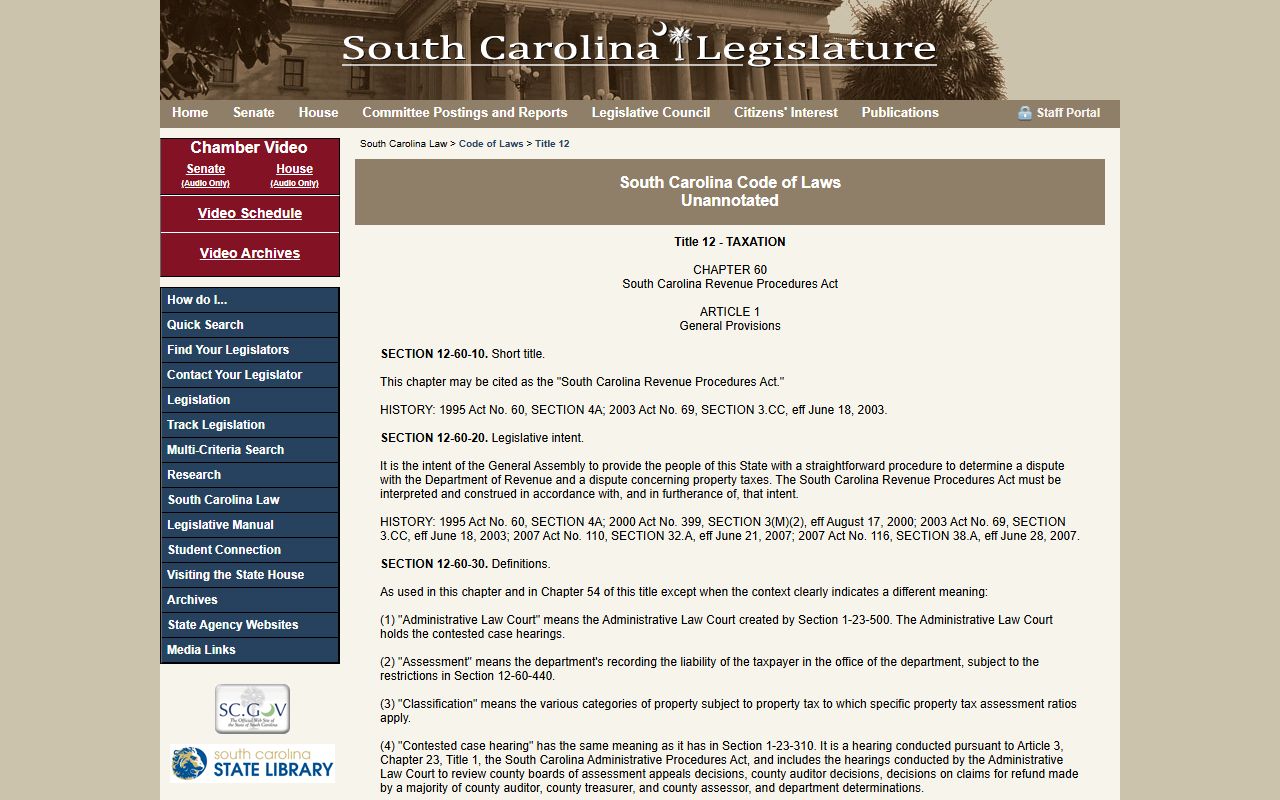
Chapter 60 of Title 12 governs the appeal procedures for property tax assessments across South Carolina. This chapter is relevant not only to assessment appeals but also to disputes over exemption denials. Lee County property owners whose Homestead Exemption application is denied have appeal rights under Chapter 60. The same appeal pathway is available for any disagreement with an assessed value or classification shown in a Lee County property tax record.
Lee County Property Tax Record Types
Several distinct record types make up the property tax system in Lee County. Each serves a specific function, and together they form the complete picture of how a parcel is taxed from year to year.
The Assessor's parcel records are the foundation. They contain the identification number, owner name, mailing address, legal description, classification, fair market value, and assessed value for every parcel in Lee County. These are updated when ownership changes, when new construction is completed, or after each five-year reassessment cycle. The tax rolls prepared by the Lee County Auditor are derived from Assessor records and represent the official list of taxable parcels for each tax year.
Deed records from the Lee County Register of Deeds show the ownership history of each parcel. When a property is sold and a new deed is recorded, the Assessor updates the ownership information in the property tax record. Tax map records maintained by the Assessor show parcel boundaries and are updated when properties are divided or combined. Plat maps, recorded through the Register of Deeds, show subdivision layouts and individual lot configurations. Building permit records connect improvements to specific parcels and trigger value updates in the Lee County property tax system.
Payment records maintained by the Lee County Treasurer show whether taxes have been paid for each parcel and in what amount. These records are particularly useful for title research. Confirming that all prior-year taxes are satisfied is a routine step in any Lee County real estate transaction. Together, these record types give a complete view of a property's tax history and current obligations within Lee County.
The South Carolina Association of Counties and the South Carolina Code Title 12 provide the legal and resource framework that governs all of these record systems in Lee County and across the state.
Nearby Counties
Lee County is adjacent to several other South Carolina counties where similar property tax systems and record-keeping practices are in place.