
Newberry County Property Tax Records
Newberry County property tax records are maintained at the county offices located at 1512 Martin Street, Newberry, SC. The Assessor's office keeps ownership records and valuations for all real property in the county. The Auditor generates tax bills from those values, and the Treasurer collects payments. Together, these three offices manage Newberry County property tax records from valuation through collection. This page explains how the system works, what records are available, and how to access the information you need for any property in Newberry County.
Newberry County Property Tax Quick Facts
Newberry County Assessor Ownership Records
One of the primary functions of the Newberry County Assessor is maintaining current and accurate ownership records for every parcel in the county. When a deed is recorded with the Register of Deeds, the Assessor updates its ownership database to reflect the new owner. This record-keeping is essential because the tax bill must go to the correct property owner each year.
The Assessor also maintains the valuation and assessment of all real property in Newberry County. This means determining the fair market value of each parcel and applying the correct assessment ratio. Under South Carolina Code Title 12, Chapter 37, this responsibility falls entirely on the county Assessor, who must use deed records, building permits, and tax maps to keep property data current.
Newberry County sits in the central part of South Carolina, bordered by Fairfield, Chester, Laurens, Greenwood, Saluda, and Lexington counties. The county seat is the city of Newberry. The Assessor's office serves the entire county, handling a mix of residential, commercial, agricultural, and industrial properties.
Note: If you have recently purchased a property in Newberry County, confirm with the Assessor's office that ownership records have been updated to reflect your name. Delays in deed recording can sometimes cause tax bills to go to a prior owner.
Assessment Ratios and Newberry County Property Values
South Carolina's property tax system relies on fractional assessment. The state assigns different assessment ratios based on property use. Owner-occupied residential property qualifies for a 4% assessment ratio, meaning the taxable assessed value is 4% of the fair market value. Commercial property is assessed at 6%. Manufacturing real property carries a 10.5% ratio.
These ratios are set by state law and apply uniformly across all 46 South Carolina counties, including Newberry. The difference between a 4% and 6% ratio can represent a substantial tax savings for homeowners who qualify for the legal residence designation. A property valued at $200,000 as owner-occupied carries an assessed value of $8,000, while the same property valued as commercial would carry an assessed value of $12,000.
Title 12, Chapter 43 requires Newberry County, like all South Carolina counties, to conduct a full reassessment of real property at least once every five years. Reassessment brings assessed values in line with current market conditions. Following a reassessment cycle, individual property values may increase or decrease based on local market trends.
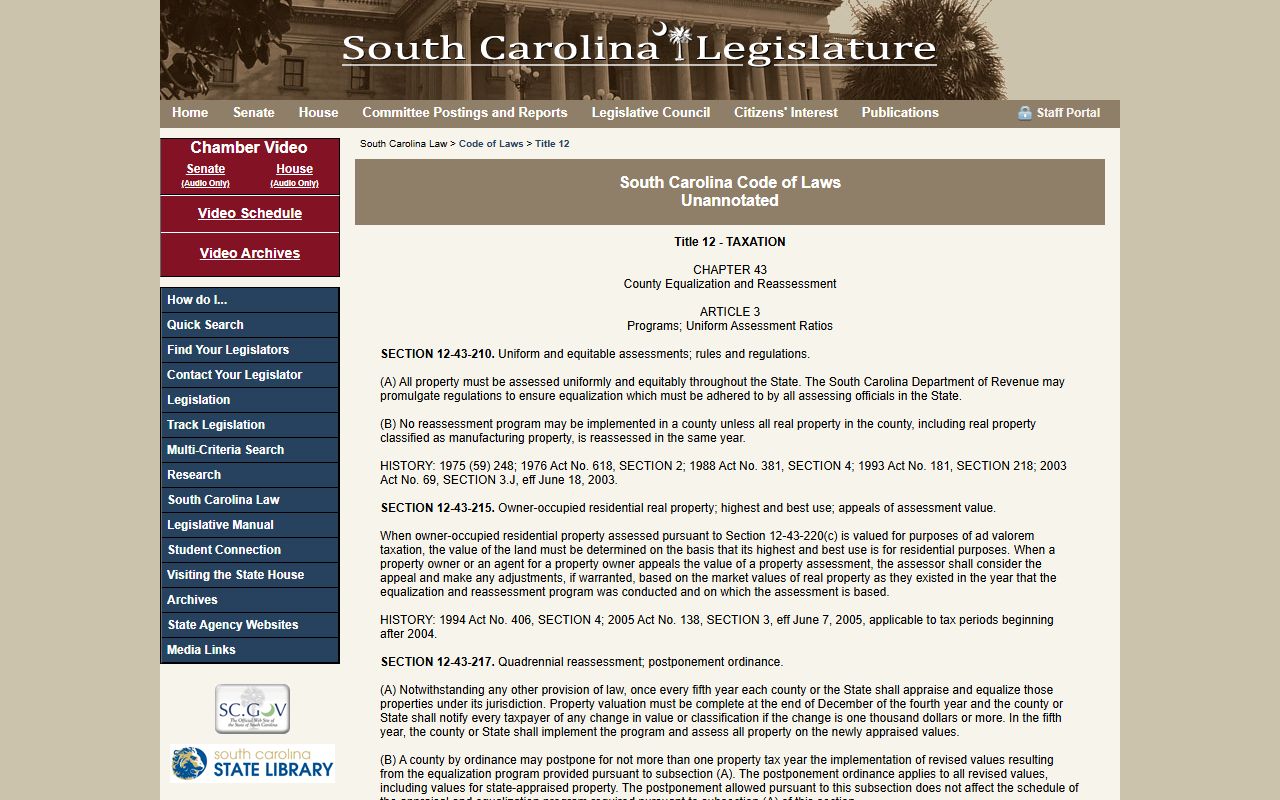
South Carolina Code Title 12, Chapter 43 establishes the five-year reassessment cycle and the assessment ratios that govern how Newberry County property values are determined for tax purposes. Understanding these provisions helps property owners anticipate changes to their assessed values.
Paying Newberry County Property Taxes
The Newberry County Treasurer's office collects property tax payments. Taxes are due by January 15 each year. The Treasurer accepts several forms of payment to make compliance as convenient as possible.
Newberry County offers electronic payment options, allowing property owners to pay online without visiting the Treasurer's office. A telephonic payment service is also available for those who prefer to pay by phone. These services make it easier for property owners who live outside the county or have difficulty visiting the office in person to meet the January 15 deadline.
Chapter 45 of Title 12 governs tax payment deadlines and penalties throughout South Carolina. The January 15 due date applies statewide. Payments mailed on or before January 15 are considered timely if they bear a US Postal Service postmark for that date. This rule provides flexibility for property owners who mail their payments close to the deadline.
Installment payment plans are another option under Chapter 45. Eligible property owners can divide their annual tax obligation into scheduled payments rather than paying everything at once. Contact the Newberry County Treasurer's office for details on how to enroll.
Penalties for Late Newberry County Tax Payments
Missing the January 15 deadline results in financial penalties that grow over time. The first penalty is 3% of the tax owed. If the bill remains unpaid, a second penalty of 7% is added. A further 5% penalty follows after that. These penalties apply on top of the original tax amount and can add up quickly.
The penalty structure under Title 12, Chapter 45 is designed to encourage timely payment. Once taxes reach delinquent status, the process becomes more complex and costly for the property owner. Reaching out to the Treasurer's office early, before penalties escalate, is always the better course of action.
Note: Penalties are applied by law and generally cannot be waived by county officials. Paying on time is the most reliable way to avoid extra costs.
Newberry County Delinquent Tax Records
When property taxes are not paid after penalties have accrued, the account enters delinquent status. The Newberry County Treasurer pursues delinquent taxes through the process outlined in Title 12, Chapter 51. A delinquency notice is issued on April 1. From that date, the property owner has 12 months to redeem the property by paying all owed taxes, penalties, and associated costs.
Delinquent tax records in Newberry County are public records. They are often published in local newspapers and maintained in county databases. Anyone researching a property for purchase should review delinquency records to identify any outstanding liens before the transaction closes.
Under Title 12, Chapter 49, property taxes are the first lien on real estate. This lien attaches to the property on December 31 of the tax year and has priority over virtually all other claims. Buyers and lenders take this lien seriously during real estate transactions.
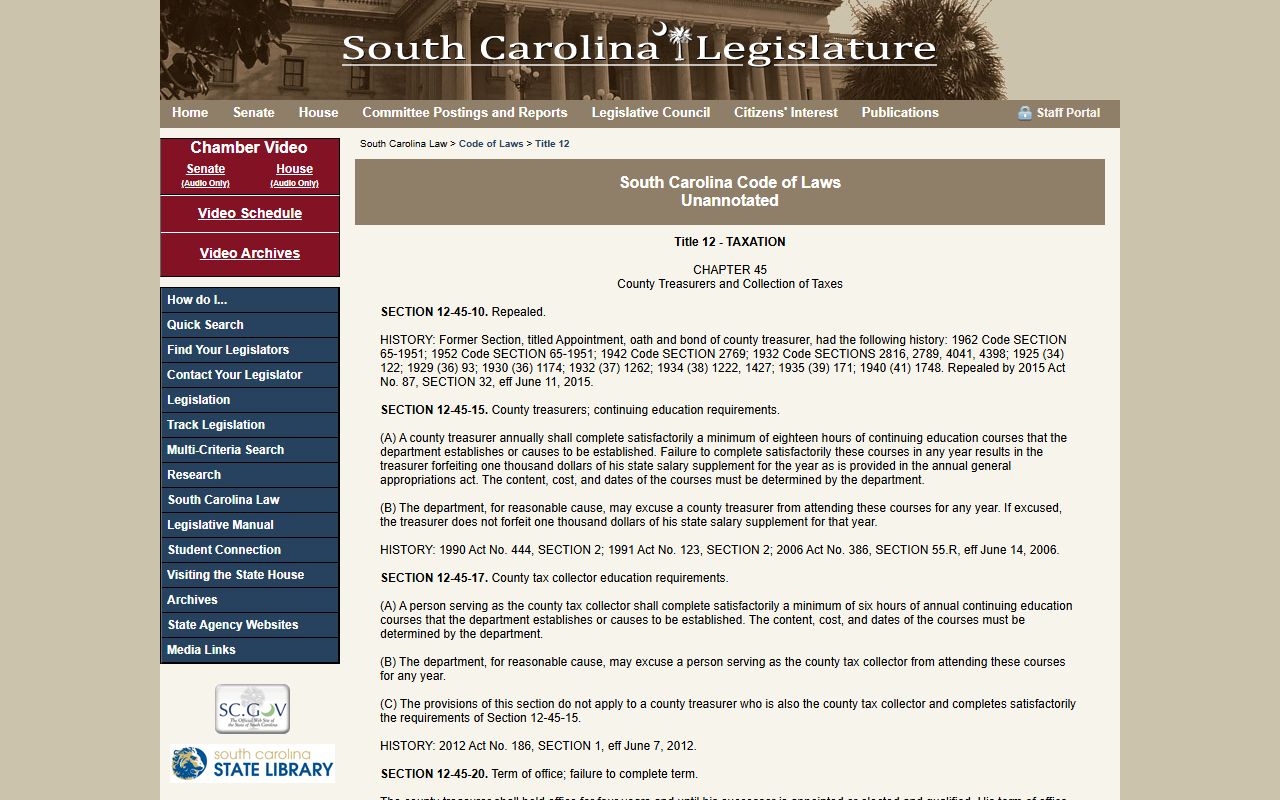
Title 12, Chapter 45 covers the property tax payment schedule, penalty provisions, installment plan options, and the US postmark rule that applies to mailed payments in Newberry County and across South Carolina.
Homestead Exemption in Newberry County
The South Carolina Homestead Exemption provides meaningful tax relief to qualifying residents. Newberry County property owners who are 65 years of age or older, permanently disabled, or legally blind may apply for an exemption that removes the first $50,000 of fair market value from the taxable calculation.
Applications are processed through the Newberry County Auditor's office. To qualify, the applicant must have owned and occupied the property as their primary residence for at least one full year. Once granted, the exemption does not need to be renewed annually, but the property owner must notify the Auditor if their circumstances change. The Homestead Exemption is separate from the legal residence designation and provides a different form of tax relief.
Appealing a Newberry County Property Assessment
Newberry County property owners who disagree with their assessed value have a formal appeal process available to them. The first step is contacting the Assessor's office and requesting a review. The Assessor will examine the basis for the assessment and respond to the appeal.
If the Assessor's response does not resolve the dispute, the owner may appeal to the Newberry County Board of Assessment Appeals. This board provides an independent review. Should the matter remain unresolved, Title 12, Chapter 60 allows further appeal to the South Carolina Administrative Law Court. This formal route ensures that property owners have multiple opportunities to present their case.
Strong appeals are supported by evidence. Recent sales of comparable properties, an independent appraisal, or documentation of property condition issues all help build a persuasive case. The South Carolina Department of Revenue also provides guidance on the appeal process at the state level.
Note: Filing an appeal does not suspend the tax payment obligation. Continue paying on time to avoid penalties while the appeal proceeds.
Nearby Counties
Newberry County shares borders with several other South Carolina counties, each maintaining their own property tax records under the same state framework.