
Fairfield County Property Tax Records and Assessments
Fairfield County property tax records are maintained through county offices in Winnsboro, the county seat. The Assessor's office at 101 South Congress Street is open Monday through Friday from 9:00 AM to 5:00 PM. Property owners, title researchers, and buyers can access Fairfield County property tax records to review parcel valuations, ownership history, tax status, and exemption information. This page explains how the Fairfield County property tax system works and what resources are available to property owners in the county.
Fairfield County Property Tax Quick Facts
Fairfield County Assessor and Property Records
The Fairfield County Assessor's office is the official source for all real property valuations in the county. Under Title 12, Chapter 37 of the South Carolina Code, every county must employ a full-time assessor responsible for maintaining deed records, building permits, and tax maps. The Fairfield County Assessor fulfills these duties from the office at 101 South Congress Street in Winnsboro.
The Assessor appraises real property, processes ownership transfers from recorded deeds, updates records for new construction, and administers exemption applications. The office does not set the tax rate and does not collect taxes. Those functions belong to other county offices. For questions about property valuation, classification, or the assessment of a specific parcel, the Assessor is the right contact.
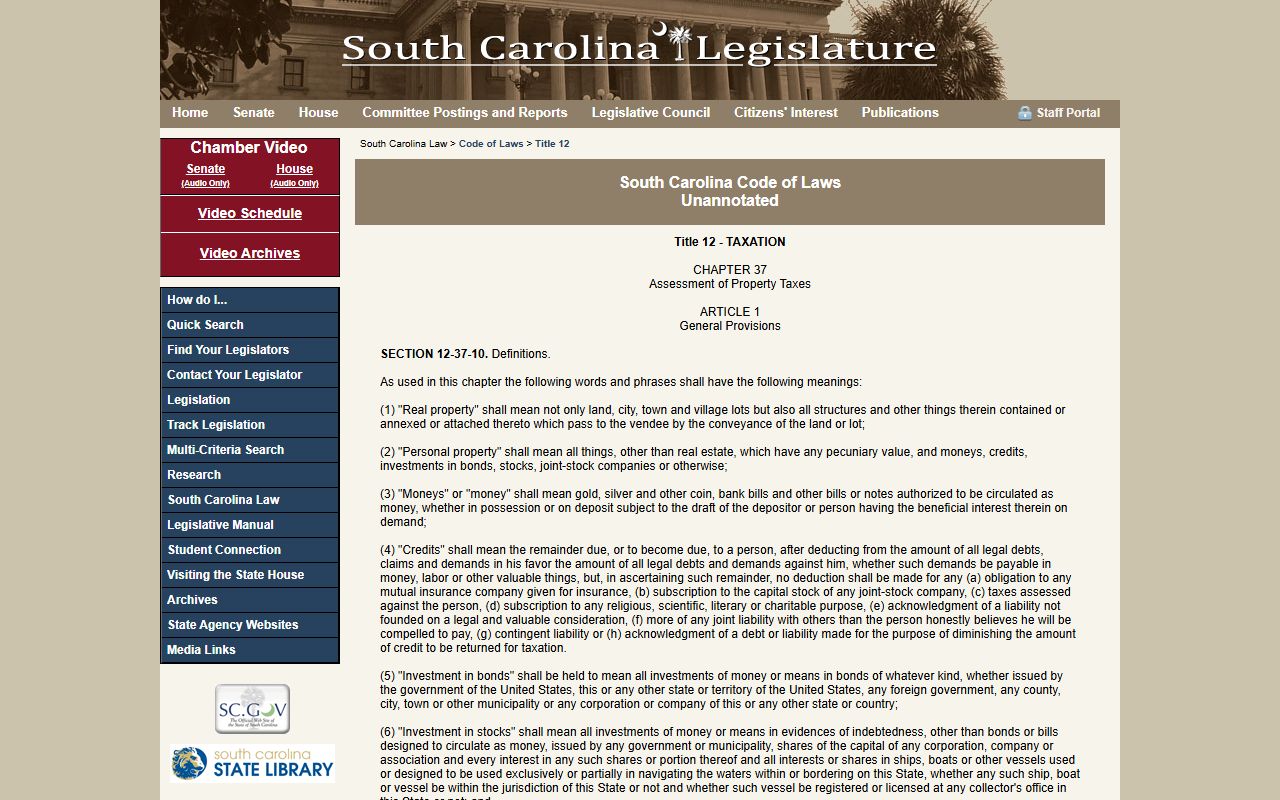
Chapter 37 of South Carolina's tax code, shown above, establishes the legal framework for county assessors across the state. The full text of Chapter 37 details the Assessor's duties, the types of records that must be maintained, and the exemptions that county assessors administer, including the Homestead Exemption for qualifying residents of Fairfield County.
Fairfield County Assessment Ratios and Valuation
Fairfield County follows the statewide assessment ratio framework set by Title 12, Chapter 43. Owner-occupied residential property is assessed at 4% of fair market value. Commercial property, investment property, and non-owner-occupied residential property carry a 6% ratio. Manufacturing and industrial property is assessed at 10.5%.
Qualifying for the 4% owner-occupied rate requires filing a legal residence application with the Assessor. The property must be your primary residence. The 4% classification cannot be applied to vacation homes, rental properties, or properties where the owner does not reside. Once approved, the classification remains active until ownership or occupancy changes.
The difference between a 4% and 6% assessment matters significantly at scale. Consider a property with a fair market value of $175,000. At 4%, the assessed value is $7,000. At 6%, it is $10,500. The $3,500 difference in assessed value, multiplied by a 300-mill rate, results in $1,050 more per year in taxes. Verifying your current classification in Fairfield County property tax records is a simple step that can prevent overpayment.
Fairfield County Reassessment Cycle
Countywide reassessment in Fairfield County occurs every five years as required by Section 12-43-217. All properties are reviewed during the reassessment year and values updated to reflect current market conditions. Between reassessments, property values generally remain fixed unless new construction, an addition, or an ownership change triggers an update.
South Carolina's assessment cap provision offers some protection against large increases between reassessments. Even when a property is reassessed upward, the cap limits how much the assessed value can increase in a single cycle for properties that have not been sold. Understanding how the cap applies requires reviewing your specific property's history with the Assessor.
Note: When a Fairfield County property is sold, the cap resets and the new assessed value is based on the sale price, which may result in a higher tax bill for the new owner in the first year after purchase.
Tax Due Dates and Penalties in Fairfield County
Fairfield County property taxes are due January 15 each year under Title 12, Chapter 45. A 3% penalty applies to payments made between January 16 and February 1. From February 2 through March 16, the penalty grows by an additional 7%. After March 16, a further 5% penalty applies, for a total of 15%.
Installment payment options are available under Chapter 45. Property owners who enroll in an installment plan can spread their annual tax obligation across multiple payments rather than a single year-end payment. Enrollment deadlines apply, so contacting the county early in the year is advisable if you want to participate in the installment program.
Missing the January 15 deadline is a common occurrence for property owners who have changed mailing addresses without notifying the Assessor. If your bill did not arrive because of an address issue, the penalty still applies regardless. Keeping your contact information current in Fairfield County property tax records helps ensure you receive your bill in time to pay before the deadline.
Delinquent Tax Collection in Fairfield County
Fairfield County's Tax Collector handles delinquent tax accounts. When taxes go unpaid through the penalty period, the account moves into delinquency under Title 12, Chapter 51. A delinquency notice is issued on or about April 1. The county then publishes the delinquent list in a local newspaper for three consecutive weeks to fulfill the required public notice before a tax sale can proceed.
After a tax sale, the original property owner retains a 12-month redemption period. The owner can reclaim the property by paying the outstanding taxes plus interest. Redemption interest rates are 3% for the first quarter, 6% for the second, 9% for the third, and 12% for the full 12-month period. Redeeming early limits the total interest cost.
Under Title 12, Chapter 49, property taxes are a first lien on real property, attaching on December 31 of the tax year. This lien has priority over mortgages and other encumbrances in most situations. Buyers of Fairfield County real estate always confirm no delinquent taxes are attached before closing. The Tax Collector can confirm whether a parcel has any outstanding delinquent obligations.
Homestead Exemption for Fairfield County Residents
Fairfield County residents who meet the eligibility requirements can apply for the South Carolina Homestead Exemption. The exemption reduces the taxable value of a qualifying primary residence by $50,000 of fair market value. Eligibility requires being 65 or older, totally and permanently disabled, or legally blind. The property must have been owned for at least one year before applying.
Applications for the Homestead Exemption are submitted through the county Auditor's office, not the Assessor. The Auditor reviews the application and, if approved, applies the exemption to the tax bill. Property owners should confirm the exemption appears on their bill each year and contact the Auditor promptly if it is missing. A missing exemption that is not caught early can take more than one cycle to fully correct.

The South Carolina Association of Counties, shown above, serves as a resource for county governments and property owners across the state. The SCAC website publishes comparative data on millage rates, assessment ratios, and tax collections across all 46 counties. Fairfield County residents can use SCAC resources to understand how their county's tax structure compares to neighboring counties like Newberry, Chester, and Richland.
Appealing a Fairfield County Property Assessment
The right to appeal an assessment is available to all Fairfield County property owners. Title 12, Chapter 60 sets out the appeal procedure. The first step is filing a written appeal with the Assessor within 90 days of receiving the assessment notice. Include supporting documentation such as comparable sales, a recent appraisal, or evidence of factual errors in the property description.
If the Assessor's written response does not resolve the dispute, the property owner may appeal to the county Board of Assessment Appeals. Beyond that, the South Carolina Administrative Law Court is the next level of review. The process is sequential: you must complete each level before moving to the next, and deadlines apply at every stage.
Common grounds for a successful appeal include errors in recorded property data such as wrong square footage or lot size, a value that exceeds comparable recent sales in the immediate area, or an incorrect property classification that applied the wrong assessment ratio. Gathering solid factual evidence before filing strengthens the appeal and increases the chance of resolution at the first level without further escalation.
South Carolina Title 12 and Fairfield County Tax Records
All property tax administration in Fairfield County operates under the authority of Title 12 of the South Carolina Code. The various chapters of Title 12 govern everything from how assessors value property to how delinquent taxes are collected. Familiarity with the relevant chapters helps property owners understand their rights, responsibilities, and options at each stage of the tax process.
The South Carolina Department of Revenue plays a supervisory and policy role at the state level. While routine property tax matters are handled by Fairfield County offices, the SCDOR sets the framework within which those offices operate. For manufacturing property assessments, state-level appeals, and regulatory guidance, the SCDOR is the appropriate resource alongside county offices.
Nearby Counties
Fairfield County borders Newberry, Chester, Lancaster, Richland, and Kershaw counties in the central part of South Carolina.