
Union County Property and Tax Records
Union County property tax records are maintained through the county's Assessor, Auditor, and Treasurer offices, with the county seat located in the City of Union, South Carolina. Property search and tax payment functions are available online for Union County residents and researchers. The Assessor handles property valuations and classifications. The Auditor computes bills. The Treasurer collects payments. Together these offices keep Union County property tax records accurate and accessible under the rules set by South Carolina state law, including the statutes found in Title 12 of the South Carolina Code.
Union County Property Tax Quick Facts
Union County Assessor and Property Records
The Union County Assessor is the central office for property tax records in the county. The Assessor identifies every taxable parcel, assigns a fair market value, and applies the correct assessment ratio based on how the property is used. Each parcel in Union County has a record that includes a unique identification number, the owner's name and mailing address, the legal description of the property, acreage or square footage, and the assessed value that determines the annual tax bill.
South Carolina law under Title 12, Chapter 37 requires Union County to maintain a full-time assessor. That same chapter mandates that the Assessor keep deed records, building permits, and tax maps current as property conditions change. When a deed is recorded at the Union County Register of Deeds, the Assessor updates ownership data in the property tax records. When a permit is issued for new construction or a significant improvement, the Assessor factors that work into the property's valuation. Tax maps are revised when new subdivisions are created or parcels are reconfigured.
Union County property tax records are publicly accessible online. Residents and researchers can search by parcel number, owner name, or property address to find current assessment data, property characteristics, and ownership history. This online access supports transparency in local property tax administration and allows property owners to verify that their records are accurate before the annual tax bill is issued.
The image below is drawn from the South Carolina Department of Revenue, the state agency that oversees property tax administration standards across all 46 counties, including Union County.
The South Carolina Department of Revenue sets the assessment standards and compliance requirements that shape how Union County administers its property tax records and valuation processes.
Assessment Ratios for Union County Property
Union County property taxes follow the same assessment ratio structure required by state law for every county in South Carolina. Title 12, Chapter 43 establishes the three primary ratios. Owner-occupied residential property used as a primary domicile is assessed at 4% of fair market value. Commercial real property is assessed at 6%. Manufacturing real and personal property is assessed at 10.5%. Commercial personal property also carries the 10.5% ratio.
These ratios matter because they directly determine the assessed value of each property. The assessed value is then multiplied by the millage rate to produce the tax bill. A residential home in Union County with a fair market value of $100,000 and a 4% ratio would have an assessed value of $4,000. That $4,000 figure is then multiplied by the applicable millage rate to calculate the tax owed. A similar property classified as commercial at 6% would carry an assessed value of $6,000 before millage is applied, resulting in a higher tax bill from the same underlying market value.
Owners who believe their property is classified incorrectly should contact the Union County Assessor. Misclassification can lead to overpayment of taxes for years. Getting the classification right, particularly for properties that qualify as owner-occupied primary residences, is one of the most impactful steps a Union County property owner can take. The application for the 4% special assessment must be submitted to the Assessor with documentation supporting the primary residence claim.
Note: The 4% owner-occupied ratio requires an active application and does not apply automatically when a property changes hands. New owners of Union County homes should apply promptly after taking title.
Union County Property Tax Reassessment Cycle
Union County reassesses all real property every five years. This countywide review, required by Chapter 43, updates the fair market value of every parcel to reflect current market conditions at the time of the reassessment. The Assessor analyzes sales data from comparable properties, reviews permit activity for improvements made since the last reassessment, and produces updated values for each record in the county's system.
Owners receive written notice of their new assessed value before the reassessment year takes effect. The notice explains the new value and the deadline for filing a challenge. Union County property owners who dispute their reassessed value should first request an informal meeting with the Assessor. Many disputes are resolved at this stage. Those that are not can proceed to a formal appeal before the Board of Assessment Appeals, and ultimately to the South Carolina Administrative Law Court under Chapter 60.
The following image is from Chapter 43, which sets out the statewide reassessment requirements that apply to Union County property tax records.
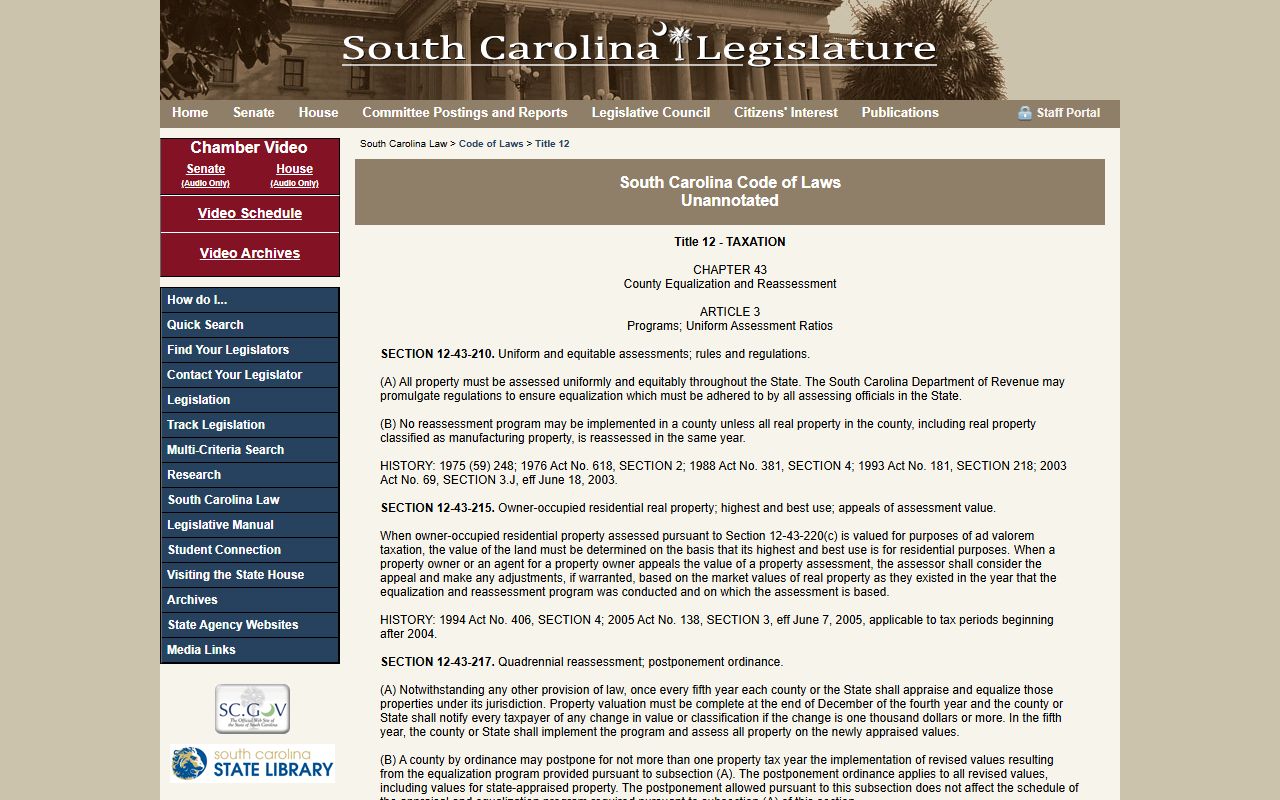
Chapter 43 of Title 12 governs the five-year reassessment cycle and the assessment ratio structure that applies to Union County real property, setting the legal foundation for how parcel values are determined.
Union County Tax Bills and Payment Records
Union County property tax bills are calculated by the Auditor using the assessed values produced by the Assessor and the millage rates set by local taxing authorities. Bills are mailed in the fall. Payment is due by January 15 of the following year under Title 12, Chapter 45. The United States Postal Service postmark rule applies: a payment postmarked on or before January 15 is accepted as timely regardless of when it physically arrives at the Treasurer's office.
Late payments carry a 3% penalty under Chapter 45. Additional penalties of 7% and then 5% apply as the delinquency progresses. Union County property owners who need flexibility in how they pay may ask about the installment plan option. South Carolina law authorizes installment payment arrangements that let taxpayers break the annual bill into smaller payments. Contact the Union County Treasurer's office directly for information on installment enrollment and payment schedules.
Delinquent Property Tax Records in Union County
Unpaid Union County property taxes become delinquent on April 1 each year. Title 12, Chapter 51 governs the delinquency process across South Carolina, setting out the rules for tax sales, redemption periods, and ultimate transfer of title. Once a parcel is delinquent, the Treasurer pursues collection and may place the property in an annual delinquent tax sale where bidders can purchase the right to the tax lien.
A Union County property owner whose parcel is sold at a delinquent tax sale retains the right to redeem the property during a 12-month window. Redemption requires payment of all delinquent taxes, interest, penalties, and costs. The interest rate increases by quarter: 3% in the first quarter, 6% in the second, 9% in the third, and 12% at the end of the fourth quarter. Failure to redeem within the 12-month period allows the purchaser to seek a deed to the property.
Under Chapter 49 of Title 12, South Carolina property taxes represent the first lien on real property. This lien attaches on December 31 of the tax year. The lien's first-priority status means Union County tax obligations must be satisfied before most other claims against a property can be resolved. Anyone researching a Union County property for purchase or financing should verify the tax lien status as part of their review of the property's records.
Note: Delinquent tax sale lists for Union County are public records and may be reviewed through the Treasurer's office prior to the annual sale.
Homestead Exemption in Union County
Union County residents who are 65 or older, legally blind, or permanently and totally disabled may qualify for South Carolina's Homestead Exemption. The exemption reduces the taxable fair market value of the qualifying property by $50,000. The owner must hold title to the property and have done so for at least one year. The property must be the owner's primary legal residence. Applications are submitted to the Union County Auditor's office.
Once approved, the exemption carries forward automatically each year and is reflected in Union County's property tax records. The reduction in taxable value, combined with the 4% assessment ratio for owner-occupied residential property, produces a significantly lower annual tax bill for eligible homeowners. The exemption is governed by Chapter 37 of South Carolina law, which outlines the full range of property tax exemptions available to qualifying owners and the procedures counties must follow to administer them.
State Resources for Union County Property Tax Records
The South Carolina Department of Revenue provides oversight and guidance for property tax administration throughout the state, including in Union County. The DOR does not maintain individual parcel records for standard real property but sets the rules that county offices follow. The DOR handles assessment of centrally valued property categories, including utilities and railroads, which may be relevant for certain Union County parcels near infrastructure corridors.
The South Carolina Association of Counties publishes resources on county tax administration practices that can help property owners understand the systems used in Union County and elsewhere. For property owners who want to read the underlying law directly, Title 12 of the South Carolina Code covers the complete property tax statutory framework from definitions through enforcement. Understanding the timeline, the ratios, and the appeal rights outlined in that statute helps Union County property owners engage effectively with the county's records and tax processes.
Nearby Counties
Union County neighbors several other South Carolina counties, each with independent property tax record systems.