
Chester County Property Tax Records
Chester County property tax records are managed by the county Assessor and available for public research through online tools and in-person requests. Records include parcel identification, ownership details, assessed values, property classifications, and tax status for all real property in Chester County, South Carolina. The Assessor's office is at P.O. Box 580, Chester, SC, and the official website is at chestercountysc.gov. Property taxes in Chester County fund essential local services including schools, police, fire protection, and public libraries. Understanding how property values are determined and how taxes are calculated helps owners manage their obligations and identify potential savings.
Chester County Property Tax Quick Facts
Chester County Assessor Office
The Chester County Assessor's office is at P.O. Box 580, Chester, SC. The official website is chestercountysc.gov. The Assessor's office handles all real property valuation in Chester County, including residential homes, commercial buildings, agricultural tracts, and manufactured homes. Staff appraise property, maintain ownership records, and process classification applications throughout the year.
Under SC Code Title 12, Chapter 37, the Chester County Assessor is required to maintain a full-time operation that tracks deed transfers, processes building permits, maintains tax maps, and discovers property not yet listed for taxation. When a deed is recorded at the Chester County courthouse, the Assessor's office uses that information to update ownership records and confirm that the property is correctly classified and assessed.
Building permits are another key source of data for the Assessor. When a homeowner completes an addition, builds a new structure, or makes significant improvements, a permit is typically required. The Assessor reviews permit activity to identify properties where improvements have increased value beyond what the current record reflects. This process keeps assessments aligned with actual property conditions between reassessment cycles.
Chester County also uses the Beacon and qPublic platforms for interactive property mapping and assessment data. These tools allow users to view parcel boundaries on a map, access ownership information, and review assessment details without visiting the Assessor's office in person.
The screenshot below shows the Chester County Assessor's official website, which provides forms, property search access, and contact information for owners researching Chester County property tax records.
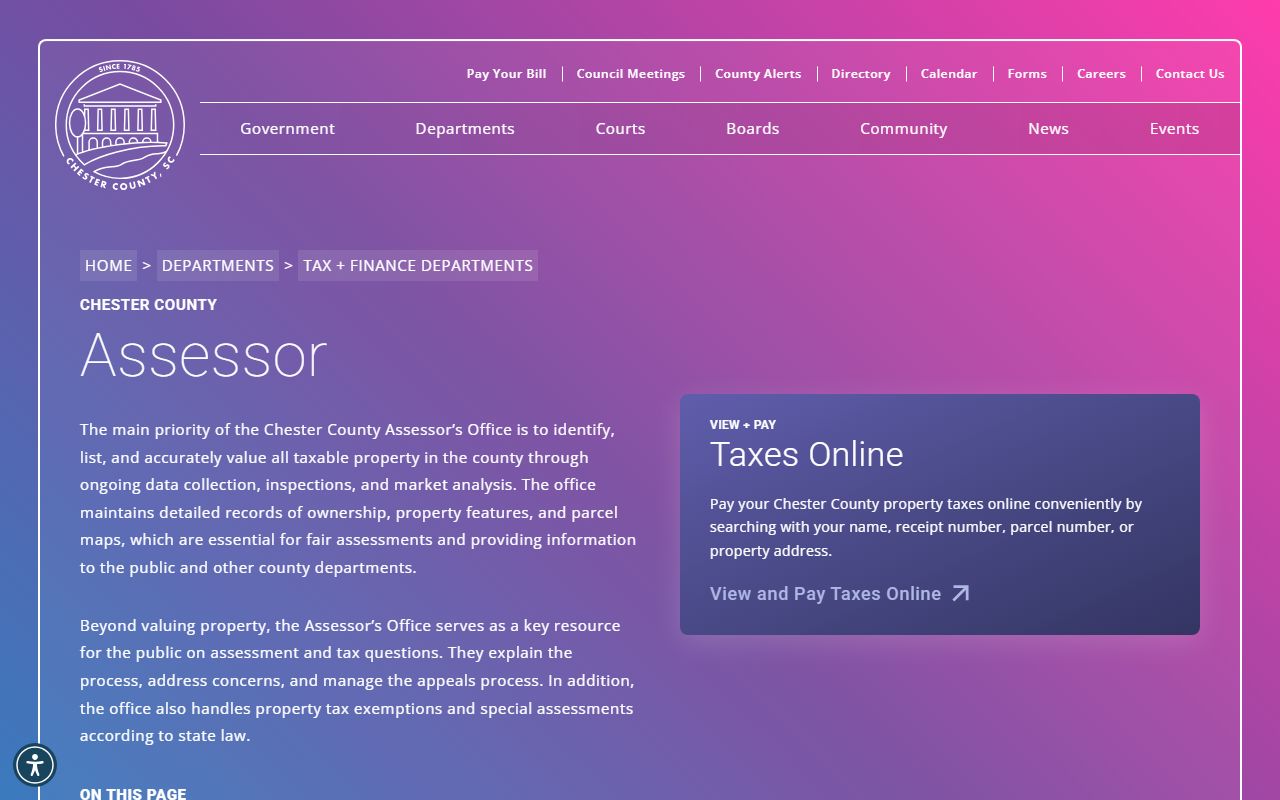
The Assessor's website is the central resource for Chester County property tax research. It links to the online property search tool, provides downloadable forms, and lists staff contacts for specific questions.
How Chester County Calculates Property Tax
Chester County property tax is calculated using a straightforward formula. The tax bill equals the property's fair market value multiplied by the applicable assessment ratio, then multiplied by the local millage rate. Fair market value is determined by the Assessor based on recent comparable sales, property size, square footage, location, and amenities. The assessment ratio is set by state law. The millage rate is set annually by local government bodies.
Property size and square footage play a key role in valuation. Larger homes on bigger lots generally carry higher fair market values than smaller properties nearby. Location matters too. Properties near schools, commercial areas, or desirable neighborhoods may be valued higher than those in more remote locations. Amenities such as finished basements, updated kitchens, or extra bathrooms also contribute to a higher market value.
These factors are reviewed during each reassessment cycle and when significant improvements are permitted. If you believe the Assessor's estimate of your property's fair market value does not reflect its actual condition or the prices of comparable properties that have recently sold, you may have grounds to appeal. The time to act is within 30 days of receiving an assessment notice, not when the tax bill arrives. Under SC Code Chapter 60, assessment disputes that are not resolved locally can be appealed to the Administrative Law Court.
Note: Appeals must be filed within 30 days of the assessment notice. The tax bill is not the trigger for an appeal. If you miss the assessment notice deadline, you lose the right to contest that year's value.
Chester County Assessment Ratios by Property Class
South Carolina sets assessment ratios by statute under SC Code Chapter 43. These ratios are uniform across all counties, including Chester County. The ratio for a home used as a primary legal residence is 4%. This applies to owner-occupied residential property on five acres or less. Second homes and investment properties are assessed at 6%. Commercial property also carries the 6% ratio. Manufacturing property is assessed at 10.5%.
Agricultural land in Chester County follows the statewide framework. Privately owned agricultural tracts qualify for the 4% rate. Corporately held agricultural land is assessed at 6%. Chester County has significant rural and agricultural land, so these distinctions matter for many landowners in the area.
The difference between a 4% legal residence and a 6% investment property classification has a direct effect on the annual tax bill. A Chester County homeowner who qualifies for the 4% rate but has not filed the required application is paying more than necessary. The legal residence application should be filed when moving into a property as a primary home. The recommended time to file is before January 15 of the year you want the benefit to apply. Applications are submitted through the Assessor's office.
Chester County Reassessment Cycle
State law at SC Code 12-43-217 requires each county to conduct a countywide reassessment every five years. Chester County follows this schedule. During reassessment, every parcel is reviewed and values are updated to reflect the current real estate market. Owners receive written notices showing proposed new values before the new roll is certified.
Between reassessments, property values in Chester County generally remain stable. The primary exceptions are ownership changes and significant new construction or improvements. When a property is sold, the assessed value is reset to reflect the sale price and current market conditions. When a building permit is issued for substantial work, the Assessor reviews the improvement and may adjust the value upward to reflect the added square footage or features.
Chester County property owners who receive a reassessment notice with a value they believe is too high have 30 days from the notice date to file an appeal. An appeal should include evidence supporting a different value, such as recent sales of comparable properties. The Assessor's office handles first-level reviews. If not resolved there, the dispute can move forward under SC Code Chapter 60.
Chester County Property Tax Payment and Late Penalties
Property taxes in Chester County are due by January 15 each year. SC Code Chapter 45 establishes both the due date and the penalty schedule. Missing the January 15 deadline triggers an immediate 3% penalty on January 16. An additional 7% is added after February 2. A further 5% penalty is imposed after March 16. Combined, late payment through mid-March adds 15% to the original tax amount.
Payments can be made in person at the county offices, by mail, or through available online payment channels. Property owners who anticipate difficulty paying by the deadline should contact the Treasurer's office early. Installment payment plans may be available under state law for accounts that qualify. Acting early gives you more options than waiting until penalties have already accrued.
Under SC Code 12-49, property taxes constitute a first lien on real estate in South Carolina. The lien attaches on December 31 of the tax year and takes priority over most other creditors. This means a buyer of Chester County property should always confirm that all outstanding taxes have been paid prior to closing. Unpaid taxes do not disappear when ownership transfers.
- January 15: Tax due date
- January 16: 3% penalty begins
- February 2: Additional 7% penalty added
- March 16: Further 5% penalty added
- April 1: Delinquency notice typically issued
Delinquent Chester County Property Tax and Tax Sales
When Chester County property taxes remain unpaid past the March 16 deadline, the account becomes delinquent. Under SC Code Chapter 51, the county issues delinquency notices around April 1. If payment is still not made, the property is scheduled for a public tax sale. Three weeks of published notice are required before the sale can take place.
The tax sale proceeds result in the property being sold to pay the delinquent taxes, penalties, and costs. The original owner retains a 12-month period during which they can redeem the property. Redemption requires payment of all amounts the purchaser paid at the sale, plus interest at a quarterly rate. Interest is 3% for the first quarter after the sale, 6% for the second, 9% for the third, and 12% for the fourth.
After the redemption period expires without redemption, the tax sale purchaser can seek a deed to the property. This process makes delinquent tax research important for anyone buying Chester County real estate. The Tax Collector's office can provide information on a parcel's delinquency and tax sale history.
The South Carolina Association of Counties and the SC Department of Revenue both provide additional guidance on property tax obligations and rights for South Carolina property owners.
Homestead Exemption in Chester County
South Carolina's Homestead Exemption removes the first $50,000 of fair market value from the taxable base of a qualifying home. Owners must be 65 or older, permanently disabled, or legally blind. They must also have held title for at least one year. Applications go to the county Auditor's office.
Chester County residents who qualify benefit from a lower taxable value each year. The savings are proportional to the local millage rate. For a homeowner on a fixed income, eliminating $50,000 from the taxable base each year is a meaningful reduction. New applicants should file as soon as they become eligible, since the exemption applies prospectively and does not cover prior tax years.
Additional exemptions under SC Code Chapter 37 cover schools, churches, household goods, and agricultural equipment used in farming. Chester County property owners who believe they may qualify for a special exemption should contact the Assessor's office to review eligibility and obtain the correct application form.
Nearby Counties
Chester County is bordered by several South Carolina counties. Use the links below to look up property tax records in neighboring areas.